In an era marked by persistent inflation, rising interest rates, and mounting climate threats, societies face unprecedented uncertainty. Today, the concept of adaptive economies involves societies and businesses evolving their behaviors to survive and thrive. By studying past innovations and deploying modern strategies, communities can build a durable foundation for long-term growth and stability in a changing world.
Historical Foundations of Adaptation
From the earliest human settlements to sprawling empires, history offers countless lessons in resilience. During the Neolithic era, communities shifted from foraging to planting crops, laying the groundwork for permanent settlements and surplus management. In medieval Europe, farmers perfected the three-field crop rotation, enhancing yields and reducing soil exhaustion. The Industrial Revolution then mechanized production, fueling urbanization and transforming labor markets.
- Transition from foraging to agriculture enabled food surpluses and population growth.
- Three-field system with seasonal planting promoted soil health and consistent harvests.
- Mechanization and factory assembly lines revolutionized output and efficiency.
- Silk Road trade networks facilitated cultural exchange and technological diffusion.
These milestones demonstrate that structural adaptations drive societal progress. Each innovation emerged in response to environmental, demographic, or technological pressures, underscoring the need for economic systems to remain flexible and responsive.
Mechanisms of Adaptive Economies
Adaptive economies rely on two interlocking frameworks: adaptive efficiency and adaptive expectations. While adaptive efficiency focuses on adjusting institutions and markets to foster innovation, adaptive expectations shape the way individuals and firms forecast future conditions based on past experiences.
Adaptive efficiency as institutional flexibility empowers economies to reconfigure resource allocation rapidly. This involves regulatory reform, investment in new sectors, and public-private partnerships that accelerate discovery and diffusion of ideas.
Adaptive expectations shape long-term decision-making by anchoring forecasts to historical trends. For instance, past episodes of high inflation inform wage negotiations and price-setting behaviors, aligning stakeholder actions with anticipated market shifts.
- Implement governance that supports creative competition and market discovery
- Allocate capital toward technological innovation and human capital
- Engage in proactive scenario planning to anticipate economic shocks before they arise
Through these mechanisms, economies can maintain a dynamic equilibrium, continually adjusting to emerging threats and opportunities without resorting to rigid or outdated policies.
2025 Challenges and Global Priorities
As we navigate 2025, the global outlook is clouded by recession risks, supply chain disruptions, and environmental stressors. Persistent inflation has eroded purchasing power, while climate events and public health crises threaten critical infrastructure and workforce stability.
International organizations emphasize repair and renewal. The IMF calls for macroeconomic rebalancing and AI-driven reforms to restore fiscal health, while the World Bank prioritizes private sector job creation and infrastructure investment to sustain long-term development.
These challenges demand that both businesses and governments embrace proactive preparedness and resilient planning. By adopting measures before crises strike, stakeholders can minimize recovery costs and accelerate continuity.
Strategies for Building Resilience
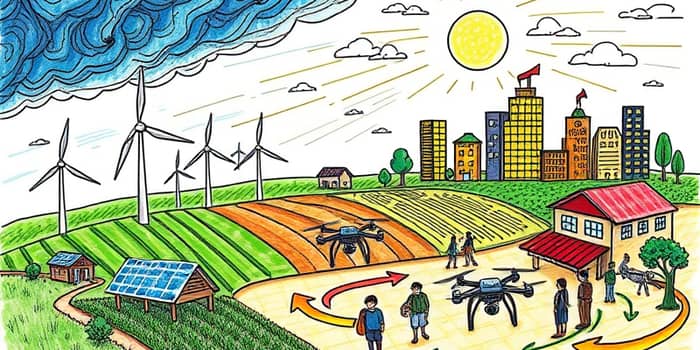
To thrive amid volatility, a holistic approach combining innovation, sustainability, and financial prudence is essential. Effective strategies span energy, production, finance, and infrastructure.
- Invest in sustainable energy solutions to decrease reliance on fossil fuels
- Develop closed-loop and circular economy models to minimize waste
- Integrate digital tools and AI systems for supply chain optimization
- Strengthen financial defenses with cash reserves and flexible budgets
Sustainable energy is a cornerstone of modern resilience. Denmark’s wind technology leadership and Germany’s Energiewende illustrate how policy incentives and private investment can create renewable energy leadership and innovation that safeguards against price shocks in global oil markets.
Circular economy models repurpose materials and close the loop on production. By designing products for reuse and recycling, industries cut costs, reduce environmental footprints, and foster closed-loop systems for resource efficiency.
Digital transformation enhances adaptability by providing real-time data and predictive analytics. Smart agriculture platforms and e-commerce networks leverage smart agriculture platforms and e-commerce networks to help businesses respond swiftly to consumer trends and supply disruptions.
Financial resilience hinges on meticulous planning: businesses should maintain at least 3–6 months of operating expenses in reserve, diversify revenue streams across markets, and continuously refine budgets to extend cash runways during downturns.
Case Studies and Institutional Roles
Successful adaptation often hinges on institutional support and collaboration. In Denmark, government research grants paired with private R&D propelled wind turbines to global prominence, demonstrating the power of public-private partnership for innovation.
China’s provincial growth patterns reveal that regions with agile regulatory frameworks and targeted investments exhibit higher adaptive efficiency in resource allocation. This model underscores the vital role of local governance in nurturing competitive clusters and emerging industries.
Urban centers like Charlotte in the United States have launched workforce development initiatives that link employers with vocational programs, building a talent pipeline for resilient economies. In Ireland, technology hubs and innovation grants support startups that diversify the national economic base.
Supply chain resilience is another critical domain. By establishing financing mechanisms for sustainable sourcing and enhancing logistical networks, companies ensure continuity of essential goods during crises, turning vulnerabilities into strategic advantages.
Future Outlook
Looking forward, demographic shifts and climate projections through 2050 signal transformative changes in labor markets. Agriculture, construction, and healthcare sectors will require extensive upskilling to meet evolving demands.
Artificial intelligence and machine learning will play a growing role in monitoring environmental risks, predicting market trends, and optimizing resource allocation. These technologies offer data-driven insights for proactive decision-making across domains.
Building resilience is not a one-time project but a continuous journey. It demands sustained investment, regulatory agility, and a culture of innovation that embraces uncertainty as an opportunity rather than a threat.
By fostering deep collaboration among governments, businesses, and communities, we can create an economic landscape that is dynamic, inclusive, and prepared for whatever challenges lie ahead.
Ultimately, our collective future depends on our willingness to adapt, innovate, and remain steadfast in the face of change. The journey toward resilient economies begins today, and its success will define generations to come.
References
- https://www.studysmarter.co.uk/explanations/anthropology/economic-anthropology/economic-adaptation/
- https://www.uschamberfoundation.org/disasters/the-resilience-reset-building-resilience-conference-2025
- https://www.tandfonline.com/doi/full/10.1080/14765284.2025.2489276
- https://www.abacum.ai/blog/navigating-measures-for-economic-resilience-and-sustainable-growth
- https://www.youtube.com/watch?v=L1ZtPUJUSUA
- https://www.imf.org/en/news/articles/2025/10/17/sp101725-resilience-in-a-world-of-uncertainty
- https://www.economicshelp.org/blog/glossary/adaptive-expectations/
- https://www.lga.cpa/insights/blog/2025-is-your-business-ready-to-thrive/
- https://en.wikipedia.org/wiki/Adaptive_strategies
- https://www.worldbank.org/en/news/immersive-story/2025/12/16/2025-resilient-economies-smart-development-more-jobs
- https://smallbusinesstogo.com/economic-adaptation-and-business-strategies/
- https://belkcollege.charlotte.edu/2025/10/03/communities-must-build-resilience-to-survive-economic-shocks-charlotte-and-irish-experts-say/
- https://fiveable.me/key-terms/honors-economics/adaptive-expectations
- https://www.clarmondial.com/reflections-wef-2025/
- https://www.paytronix.com/resources/e-books/economic-resilience-guide
- https://meetmarigold.com/resources/blog/economic-resilience-marketing-strategy