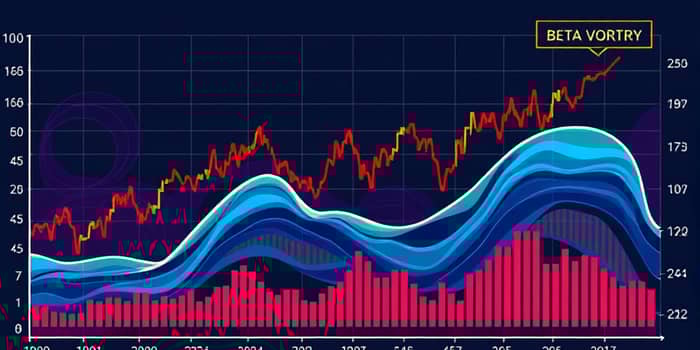
In the dynamic world of investing, grasping the concept of volatility is essential for navigating financial markets.
Volatility represents the degree of fluctuation in an asset's returns or prices over time.
One powerful tool for this is beta, which quantifies systematic risk and relative volatility effectively.
It compares a stock's movement to a benchmark like the S&P 500.
Understanding beta can transform how you approach risk management.
It empowers investors to make smarter choices in uncertain environments.
The Nature of Volatility
Volatility is often misunderstood as mere price swings.
It encompasses both total volatility and systematic volatility.
Total volatility includes all risks, while systematic is market-related.
Here are key points to remember about volatility:
- It measures dispersion from average returns.
- Higher volatility indicates greater price fluctuations.
- It can be calculated using standard deviation.
- Systematic risk is captured by metrics like beta.
This foundation is crucial for diving deeper into beta.
Beta Fundamentals Explained
Beta is a statistical measure that gauges an asset's sensitivity to market movements.
A beta of 1 means the asset moves in line with the market.
Values above 1 signal higher volatility, while below 1 indicate lower.
For instance, a beta of 1.5 suggests the asset is 50% more volatile.
This makes beta invaluable for assessing investment risk in portfolios.
Interpretations of beta values include:
- Beta 0.5: Less volatile than the market.
- Beta 1.0: Matches market volatility.
- Beta 1.5: More volatile than the market.
These interpretations help investors align with their risk tolerance.
How Beta is Calculated
Beta is derived through regression analysis of historical returns.
The formula is β = Cov(R_asset, R_market) / Var(R_market).
This involves comparing asset returns to market returns over time.
Key steps in the calculation process are:
- Gathering price data over 1-5 years for accuracy.
- Calculating daily, weekly, or monthly returns.
- Performing regression to find covariance and variance.
- Using R-squared to measure how well beta fits.
This mathematical foundation ensures beta's reliability as a metric.
Comparing Beta to Other Volatility Metrics
Beta stands out because it measures relative volatility.
Other metrics offer different perspectives on risk.
To provide clarity, here is a comparison table:
This table highlights that beta focuses on market correlation uniquely.
Understanding these differences enhances risk assessment.
Practical Applications of Beta
Beta is widely used in portfolio management and investment strategies.
Investors apply it to diversify and manage risk effectively.
Key applications include:
- Mixing high and low beta assets for balance.
- Evaluating mutual funds for risk levels.
- Adjusting strategies based on market conditions.
- Using in 401(k) plans to match risk tolerance.
- Assessing new investments for volatility profiles.
For example, conservative investors might prefer beta less than 1 assets.
This helps reduce exposure to market swings.
Limitations and Considerations
While useful, beta has limitations that require awareness.
It assumes a linear relationship with the market.
This can ignore idiosyncratic risks specific to an asset.
Other limitations include:
- Lack of historical data for new funds.
- Proprietary scales from firms obscuring details.
- Not accounting for direction of price movements.
- Dependence on the chosen benchmark index.
Understanding these helps in making informed decisions beyond beta.
It prevents overreliance on a single metric.
Advanced Insights: Beyond Beta
To gain a holistic view, investors explore related concepts.
The VIX index, for instance, averages around 20 long-term.
It spikes during periods of uncertainty, reflecting market fear.
Other advanced metrics include:
- Implied volatility from options for forward-looking insights.
- Historical volatility using standard deviation over various periods.
- Risk-adjusted measures like the Sharpe Ratio.
- Max drawdown for assessing peak-to-trough declines.
Integrating these can enhance risk management strategies significantly.
They provide a fuller picture of market dynamics.
For example, during the 2008 financial crisis, funds showed high standard deviation.
This underscored the consistency of volatility metrics across different measures.
By embracing these tools, investors can navigate volatile markets with confidence.
Beta remains a cornerstone, but combining it with other insights is key.
This approach leads to more resilient and informed investment practices.
Ultimately, mastering volatility through beta and beyond empowers financial success.
References
- https://ptmwealth.com/articles/how-wall-street-measures-stock-volatility
- https://octopusinvestments.com/resources/guides/explaining-risk-and-volatility/
- https://www.fidelity.com/learning-center/smart-money/what-is-volatility
- https://corporatefinanceinstitute.com/resources/career-map/sell-side/capital-markets/volatility-vol/
- https://www.td.com/ca/en/investing/direct-investing/articles/understanding-vix