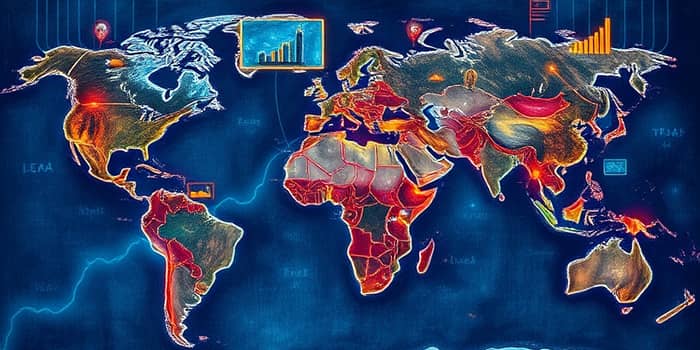
The global economy in 2026 stands at a crossroads, shaped by rapid technological advances, shifting trade patterns, and evolving policy frameworks. While forecasts vary—from the IMF’s robust global growth forecasts to more cautious views—one theme remains consistent: opportunity lies in adaptation. This article explores how businesses, governments, and individuals can harness emerging forces to navigate uncertainty and drive prosperity.
By analyzing how these projections emerge, policymakers and business leaders can create targeted initiatives that spur innovation, inclusivity, and resilience in diverse economic contexts.
Understanding Global Growth Projections
Major institutions offer differing growth estimates: the IMF suggests 3.3% expansion in 2026, while UNCTAD projects a closer 2.7%. These figures reflect a balance of optimism around technology and caution regarding trade tensions. Recognizing the drivers behind these numbers is the first step toward leveraging them for strategic advantage.
Critical themes include heightened AI investment, targeted infrastructure spending, and diverse regional trajectories. Stakeholders who align their strategies with these macro trends can capitalize on shifts in consumer demand and policy priorities.
These forecasts underscore the importance of proactive scenario planning and continuous market analysis. By focusing on targeted fiscal and monetary measures, stakeholders can anticipate shifts in market conditions and tailor responses that align with broader economic currents.
Harnessing AI and Technological Innovation
Artificial intelligence remains the most powerful engine of economic transformation. In early 2025, AI-driven expenditure contributed roughly 0.5 percentage points to U.S. GDP growth, and tech profits have surged over 20%. Organizations that invest intelligently today will capture outsized gains tomorrow.
Practical steps for businesses and policymakers include:
- Invest in AI research and development centers to build proprietary capabilities.
- Adopt data-driven decision-making platforms for supply chain and customer analytics.
- Forge partnerships with technology startups to accelerate innovation cycles.
- Upskill workforces through AI literacy and digital training programs.
These actions help cultivate AI-driven investment powering growth across sectors, ensuring that enterprises remain competitive in a fast-evolving landscape.
Navigating Trade Policies and Tariff Landscapes
Trade tensions, including tariffs and ongoing USMCA reviews, continue to influence export and manufacturing strategies. While U.S. tariffs have proven less burdensome than anticipated, businesses that rely on cross-border trade must develop resilient approaches to protect their operations.
Key recommendations for corporate and regional planners:
- Diversify sourcing by identifying alternative suppliers in emerging markets.
- Implement nearshoring initiatives to reduce logistical complexity and lead times.
- Engage with trade associations to monitor policy changes and advocate for favorable terms.
- Invest in supply chain mapping tools to visualize and mitigate potential bottlenecks.
By fostering fostering resilient supply chain networks, companies can weather policy fluctuations and maintain market access even amid shifting regulatory environments.
Aligning Fiscal and Monetary Strategies
Global divergence in fiscal and monetary policy presents both challenges and openings. While several central banks signal rate hikes, others are easing. Governments are deploying expansionary budgets, prioritizing defense, infrastructure, and technology. Understanding this mix is vital for financial planners and sovereign wealth managers.
Actionable guidance includes:
Monitor central bank communications to anticipate interest rate movements and adjust treasury strategies accordingly. Align corporate investment horizons with regional policy cycles to maximize returns. In regions where central banks are cutting rates, consider extending debt maturities at lower interest costs. Advocate for public-private partnerships that leverage government spending on infrastructure to drive economic multipliers.
These steps embody actionable strategies for economic adaptation, enabling stakeholders to position themselves advantageously within a patchwork of policy regimes.
Seizing Regional Opportunities
Economic prospects vary widely by geography. Savvy investors and entrepreneurs can identify markets with strong growth catalysts and tailor their efforts to local conditions. Below is a concise overview of regional forecasts and their drivers:
Targeting investments in regions with unlocking regional economic potential allows for differentiated portfolios that capitalize on local growth dynamics and policy initiatives.
Strengthening Resilience and Mitigating Risks
While the outlook is generally positive, stakeholders must prepare for potential headwinds: trade volatility, overcapacity in certain industries, and uneven technological diffusion. A proactive risk management framework is essential to preserve gains and navigate downturns.
- Develop scenario planning exercises to explore alternative economic trajectories.
- Diversify asset allocations across sectors and regions to reduce concentration risk.
- Maintain robust liquidity reserves to capitalize on distressed asset opportunities.
- Invest in workforce adaptability through continuous learning initiatives.
This approach emphasizes supply chains that withstand volatility and institutional structures capable of withstanding shocks in an interconnected global economy.
Conclusion
The year 2026 offers a tapestry woven from technological breakthroughs, strategic policy interventions, and shifting trade patterns. By embracing innovation, aligning with policy cycles, and cultivating resilience, businesses and individuals can transform challenges into stepping stones toward prosperity.
Across every sector, from small enterprises to global multinationals, the time to act is now. Embrace digital transformation, champion sustainability, and build partnerships that transcend borders. Your strategic choices today will define your competitive position tomorrow. Let the catalysts of change fuel your journey toward sustainable growth and shared prosperity.
References
- https://www.deloitte.com/us/en/insights/topics/economy/global-economic-outlook-2026.html
- https://privatebank.jpmorgan.com/eur/en/insights/markets-and-investing/tmt/5-catalysts-for-2026
- https://www.imf.org/en/publications/weo/issues/2026/01/19/world-economic-outlook-update-january-2026
- https://www.capitaleconomics.com/blog/five-macro-themes-will-shape-world-2026
- https://www.morganstanley.com/Themes/outlooks
- https://sites.wf.com/outlook/
- https://www.youtube.com/watch?v=3rWOmdqJB9Q
- https://unctad.org/publication/world-economic-situation-and-prospects-2026