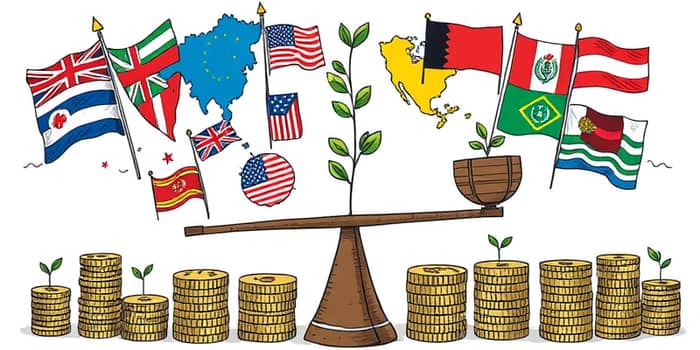
Across continents and economies, the weight of debt has become a defining obstacle to progress. From high-income nations to emerging markets, borrowing has surged in the wake of crises, creating a landscape where servicing obligations threatens essential development goals.
Global Debt: A Looming Crisis
In 2024, total global debt topped over 235% of world GDP, reaching a staggering $251 trillion. Public debt alone accounted for nearly $99.2 trillion, roughly 93% of global GDP, while private sector borrowing soared to $151.8 trillion, or 143% of output. Despite slight declines in some advanced economies, the overall burden remains historically high.
After pandemic stimulus and social protections stretched government budgets, many states now grapple with unsustainable fiscal paths. Rising interest costs—driven by monetary tightening and inflation—compound these pressures, making the cost of rolling over existing obligations ever more onerous.
Divergent Paths: Economies at a Crossroads
While the global aggregate paints a dire picture, individual countries reveal contrasting trends. Advanced economies slightly reduced their total debt ratios from 270% to 267% of GDP, largely due to private deleveraging. Yet public liabilities edged up toward 110% of GDP outside the United States.
- Japan: Public debt ratios soared between 230% and 256%, the highest among wealthy nations.
- United States: Government obligations hovered around 118.7% to 121% of GDP, a historic peak in sheer magnitude.
- Emerging Markets: Total borrowing climbed by approximately five percentage points, driven by both public and private sectors.
Low-income states face even starker realities. Constrained financial markets and limited reserves leave them vulnerable to shocks, often forcing new loans just to service maturing obligations.
Unpacking the Mechanics of Debt Traps
A debt trap emerges when a country must borrow increasingly just to pay interest and principal on existing loans. This cycle undermines investment in critical areas—health, education, and infrastructure—essential for sustainable development.
High interest rates intensify the burden, particularly for economies dependent on external funding in foreign currencies. When debt servicing outflows exceed inflows, nations face currency pressure and dwindling reserves, heightening default risks and eroding investor confidence.
Impact on Human Development
As governments allocate more of their budgets to debt repayment, spending on social services shrinks. Austerity measures often follow, cutting public sector wages, slashing subsidies, and delaying infrastructure projects.
The human fallout can be severe. Unemployment rises as public investment falls, while inflation spikes erode household purchasing power. In extreme cases, political unrest and social instability become imminent threats.
Strategies for Breaking Free
Experts advocate for credible, medium-term fiscal plans that balance debt reduction with growth-oriented spending. Transparent budgeting and improved tax collection can expand revenue without stifling private sector activity.
- Debt Restructuring: Renegotiating terms to extend maturities and lower interest rates.
- Expenditure Controls: Identifying and reallocating non-essential spending.
- Tax Reform: Broadening bases and improving enforcement to boost revenues.
These measures must be tailored to each country’s context. For some, phased fiscal consolidation combined with social protection safeguards can preserve vulnerable populations during adjustment phases.
Looking Ahead: Innovations and Partnerships
Beyond traditional approaches, novel solutions are gaining traction. Debt-for-nature swaps channel debt relief into environmental conservation, while green and climate-linked bonds tie borrowing costs to sustainability targets.
Multilateral institutions and creditor coalitions are exploring more systematic sovereign debt workout frameworks. These aim to reduce negotiation delays and cut litigation risks, ensuring that countries in distress can access relief swiftly.
Finally, strengthening domestic debt markets and enhancing institutional capacity for debt management will help prevent future crises. Transparent reporting, stress testing portfolios, and building reserve buffers are integral to resilience.
In an interconnected world, no nation is immune to the fallout of debt distress. Collective action—through supportive policies, innovative financing, and equitable global governance—can chart a path toward a more stable, prosperous future for all.
References
- https://www.imf.org/en/blogs/articles/2025/09/17/global-debt-remains-above-235-of-world-gdp
- https://www.voronoiapp.com/economy/Government-Debt-to-GDP-Around-the-World-in-2025--6978
- https://worldpopulationreview.com/country-rankings/debt-to-gdp-ratio-by-country
- https://www.weforum.org/stories/2025/01/public-debt-problem-davos-global/
- https://worldpopulationreview.com/country-rankings/countries-by-national-debt
- https://unctad.org/publication/world-of-debt
- https://www.visualcapitalist.com/ranked-countries-with-the-most-government-debt-in-2025/
- https://www.iif.com/Products/Global-Debt-Monitor
- https://www.worldbank.org/en/programs/debt-statistics/idr/products
- https://www.oecd.org/en/publications/2025/03/global-debt-report-2025_bab6b51e.html
- https://cepr.org/voxeu/columns/quantifying-global-debt-risks-amid-high-and-rising-public-debt
- https://www.visualcapitalist.com/sp/ter01-the-150t-global-debt-market/