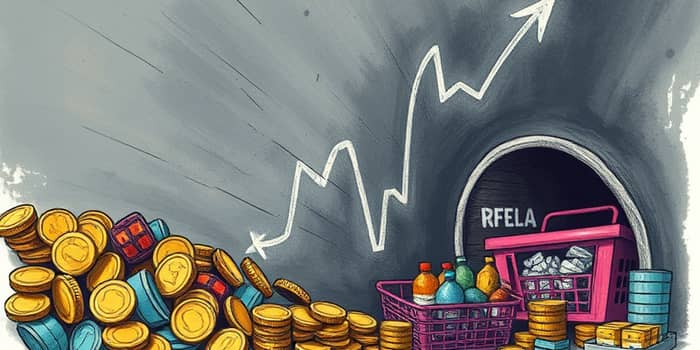
In an era of economic uncertainty, few concepts are as deceptive as deflation.
While it might seem like a bargain hunter's dream, with prices falling across the board, this sustained decrease in general prices masks a deep-seated danger.
Understanding deflation is not just an academic exercise; it is a vital step towards protecting your finances and navigating turbulent times.
This article will guide you through the intricate web of deflation, offering practical insights and inspiring action to safeguard against its perils.
What Is Deflation?
Deflation is defined as a persistent decline in the overall price level of goods and services.
It is often measured by drops in the Consumer Price Index (CPI), which tracks average price changes.
This phenomenon increases the real value of money, meaning your cash buys more in the short term.
However, this initial benefit is overshadowed by broader economic risks that can unravel stability.
It signals underlying weaknesses in the economy, often linked to recessions or depressions.
Causes of Deflation
Deflation stems from two primary factors that disrupt economic balance.
These causes can interact, creating a cascade of negative effects.
- A fall in aggregate demand, driven by tighter monetary policies such as central banks raising interest rates.
- Economic pessimism during recessions, which reduces consumer and business spending.
- An increase in aggregate supply, often due to technological advances that lower production costs.
- Rapid productivity gains, like improvements in total factor productivity.
These elements frequently coincide, exacerbating price declines and economic contraction.
Key Effects and Dangers
The impacts of deflation are interconnected and far-reaching, threatening both individuals and businesses.
Understanding these dangers is crucial for proactive financial planning.
- Delayed consumer spending, as people hoard cash expecting further price falls.
- Rising unemployment and falling wages, as companies cut costs through layoffs.
- An increased real debt burden, making fixed loans harder to repay as incomes drop.
- Business stagnation, with lower profits discouraging investment and innovation.
- Financial market disruptions, including equity declines and credit contractions.
These effects can spiral into a deeper economic crisis if left unchecked.
This table highlights how initial benefits quickly turn into long-term hardships.
The Deflationary Spiral
The core danger of deflation is the deflationary spiral, a self-reinforcing cycle.
It starts with falling prices, which lead consumers to delay purchases.
This reduces demand, causing businesses to cut production and wages.
As incomes fall, demand drops further, pushing prices down even more.
This vicious circle of economic decline can prolong recessions and lead to depressions.
Breaking this spiral requires decisive policy action, such as stimulus spending.
- Falling prices trigger delayed spending.
- Lower production results in layoffs.
- Reduced demand leads to further price drops.
- Consumer expectations amplify the cycle through pessimism.
Understanding this spiral empowers you to recognize early warning signs.
Historical Examples
Learning from past deflationary episodes can provide valuable lessons for today.
These examples illustrate the profound impact of deflation on societies.
- The Great Depression in the US from 1929 to 1933 saw industrial production fall by 47%.
- Real GDP dropped 30%, and the CPI declined 33%, with unemployment reaching 25%.
- Japan's Lost Decades represent an ongoing case of deflation, with depressed spending and stagnant growth.
These events underscore the need for vigilance in modern, debt-heavy economies.
Deflation vs. Inflation
Comparing deflation with inflation clarifies why deflation is often more harmful.
While moderate inflation can support growth, deflation typically signals trouble.
Key differences include spending behaviors and debt impacts.
- In deflation, purchasing power increases short-term but leads to demand drops.
- Inflation erodes savings but can encourage spending if managed properly.
- Deflation raises the real burden of debt, making it harder to repay loans.
- Inflation reduces the real value of debt, providing some relief to borrowers.
This comparison helps in making informed financial decisions during economic shifts.
Policy Responses and Mitigation
Governments and central banks have tools to combat deflation, offering hope for recovery.
Understanding these responses can inspire confidence in navigating economic challenges.
- Central banks may cut interest rates or expand the money supply through quantitative easing.
- Governments can deploy fiscal stimulus, such as infrastructure spending, to boost demand.
- Avoiding high-debt environments is crucial, as leverage amplifies deflationary risks.
These strategies highlight the importance of coordinated action to prevent spirals.
Additional Insights for Practical Help
Beyond the basics, there are nuanced aspects of deflation that can aid personal preparedness.
Embracing these insights fosters resilience and proactive financial management.
Technological deflation, for instance, arises from productivity gains and can be benign.
Unlike demand-driven spirals, it lowers prices without triggering economic collapse.
For investors, deflationary periods may favor bonds and fixed-income assets.
Cash gains value, but the broader economy suffers, requiring balanced portfolio strategies.
Measuring deflation through the CPI ensures accurate tracking of sustained declines.
Dispelling myths, such as the belief that initial price falls are always good, is essential.
The long-term spiral risk outweighs short-term benefits, making awareness key.
In a global context, modern economies with high debt are more vulnerable to deflation.
Historical low-debt periods faced less severe impacts, underscoring today's challenges.
By staying informed, you can adapt spending and saving habits to mitigate risks.
This knowledge empowers you to advocate for sound policies and protect your financial future.
References
- https://corporatefinanceinstitute.com/resources/economics/deflation/
- https://www.moomoo.com/us/learn/detail-inflation-and-deflation-117764-241217096
- https://www.wallstreetprep.com/knowledge/deflation/
- https://www.britannica.com/money/inflation-vs-deflation
- https://www.frbsf.org/research-and-insights/publications/doctor-econ/2003/05/deflation-risks/
- https://smartasset.com/financial-advisor/inflation-vs-deflation
- https://www.bankofengland.co.uk/explainers/what-is-deflation
- https://guardiantaxlaw.com/inflation-vs-deflation/
- https://en.wikipedia.org/wiki/Deflation
- https://www.schwab.com/learn/story/inflation-deflation-and-stagflation-explained
- https://www.empower.com/the-currency/money/deflation
- https://www.stlouisfed.org/open-vault/2023/august/explaining-inflation-disinflation-deflation