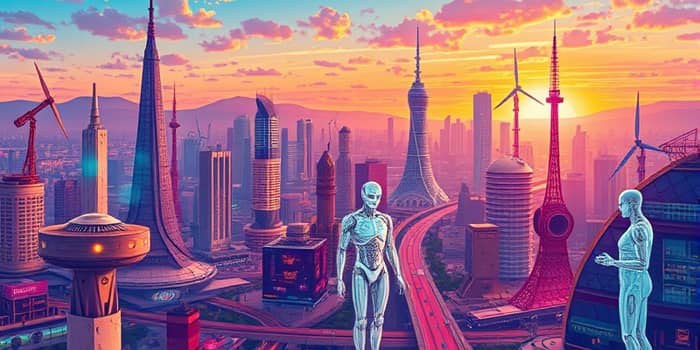
We stand at the threshold of a new industrial revolution, fueled by breakthroughs that redefine possibility. Across industries and continents, a profound transformation of the global economy is underway, driven by Artificial Intelligence, IoT, cloud computing, blockchain, and more. This article delves deep into the data, trends, and human stories behind the numbers, offering insights to inspire action and guide leaders, workers, and innovators toward a brighter, more inclusive tomorrow.
Strategic Overview of Disruptive Technologies
Disruptive technologies no longer belong to distant laboratories or sci-fi novels. They materialize in everyday tools, powering smart factories, precision medicine, and autonomous transport. At the heart of this shift is the convergence of cutting-edge technologies—where AI amplifies robotics, blockchain secures transactions, and 5G accelerates connectivity.
Key innovations poised to redefine the next decade include:
- Artificial Intelligence and Generative AI
- Internet of Things (IoT) and Edge Computing
- Cloud Platforms and Quantum Computing
- Blockchain, DeFi, and Tokenization
- 5G/6G Networks and Advanced Materials
Together, these technologies create an interlinked ecosystem where data flows seamlessly and decisions are optimized in real time.
Economic Impact and Growth Statistics
By 2030, AI alone is projected to contribute a staggering $15.7 trillion globally—$6.6 trillion from productivity gains and $9.1 trillion from consumer effects. IoT’s network of connected devices is expected to swell from 16.6 billion in 2023 to over 41 billion by 2030, generating $4–$11 trillion in economic value annually.
To illustrate the scale of these shifts, consider this table of leading technologies and their projected impacts:
These figures underscore an unprecedented wave of market growth that will reshape portfolios and national strategies. Venture capitalists are already committing over $1.5 trillion to AI by 2030, while global IT spending is forecast to rise by 9.3% in 2025.
Sectoral Transformation
Disruption is not uniform. Some sectors will see core operations revolutionized; others will experience incremental improvements.
Healthcare stands at the vanguard, with AI-driven diagnostics and digital therapeutics yielding annual savings of $150 billion in the U.S. alone. Finance is similarly transformed: algorithmic trading and intelligent risk management deliver efficiencies worth $447 billion per year.
In manufacturing, smart factories leverage robotics and predictive maintenance to add $1.5–$2.2 trillion in value annually. Renewable energy installations, bolstered by AI and IoT, added 582 GW in 2024, pushing total global capacity to 4,443 GW.
Workforce and Societal Implications
As machines handle repetitive tasks, the human role evolves toward creativity, problem-solving, and leadership. Yet this shift demands a reskilling imperative for global workforce. By 2030, half the world’s workers will require retraining to thrive in collaborative environments with intelligent systems.
Automation could affect up to 40% of jobs, particularly in advanced economies. However, history shows technology often creates new roles even as it renders some obsolete. The challenge lies in ensuring equitable access to education and digital resources, lest we risk economic inequality due to unequal access.
Challenges and Risks
The path forward is strewn with hurdles. AI-driven cyberattacks could cost the world $10 trillion annually by 2030. Complex, fragmented regulations hinder innovation while geopolitical competition intensifies around chips, data sovereignty, and critical supply chains.
- AI-driven cybersecurity threats
- Fragmented global tech regulations
- Tech-driven geopolitical rivalries
Addressing these risks requires coordinated policy frameworks, robust ethical standards, and public-private partnerships that prioritize resilience and human welfare.
Future Trends and Emerging Technologies
The next wave of breakthroughs will emerge at the intersection of existing advances. Generative AI can accelerate biotech research. Quantum computing promises to unlock new materials. And immersive reality platforms will redefine remote collaboration.
- AI & ML, Generative AI
- Quantum Computing
- Next-Gen Energy Storage
- Advanced Robotics
- AR/VR and Metaverse Platforms
- Decentralized Finance (DeFi)
- Edge Computing and 6G Networks
- Sustainable Energy Innovations
- Biotech and Gene Editing
- Advanced Materials & Nanotechnology
Maintaining a competitive edge will hinge on agility—governments, companies, and individuals must foster a culture of continual learning and experimentation.
In closing, the story of the coming decade is not predetermined by algorithms or patents alone. It unfolds through the choices we make: investing in human capital, forging inclusive policies, and aligning innovation with our shared values. By embracing this moment with ambition and empathy, we can ensure that disruptive technologies lift all societies, sparking a future defined not by inequality or fear, but by collaboration, prosperity, and hope.
References
- https://www.statista.com/statistics/826712/worldwide-disruptive-technologies-economic-impact-forecast/
- https://www.joineta.org/blog/economic-impact-and-projections-report-the-integration-of-ai-and-emerging-technologies-2025-2030
- https://www.startus-insights.com/innovators-guide/disruptive-innovation-practical-guide/
- https://www.ey.com/en_gl/insights/ai/tech-disruptions-can-inform-the-economic-impact-of-ai
- https://www.deloitte.com/us/en/insights/industry/technology/technology-media-telecom-outlooks/technology-industry-outlook.html
- https://www.mckinsey.com/capabilities/tech-and-ai/our-insights/the-top-trends-in-tech
- https://hai.stanford.edu/ai-index/2025-ai-index-report
- https://www.weforum.org/publications/top-10-emerging-technologies-of-2025/
- https://www.census.gov/library/stories/2025/09/technology-impact.html
- https://www.imf.org/en/publications/weo/issues/2025/10/14/world-economic-outlook-october-2025
- https://unctad.org/publication/technology-and-innovation-report-2025
- https://www.deloitte.com/us/en/insights/topics/technology-management/tech-trends.html
- https://www.pwc.com/gx/en/issues/artificial-intelligence/ai-jobs-barometer.html