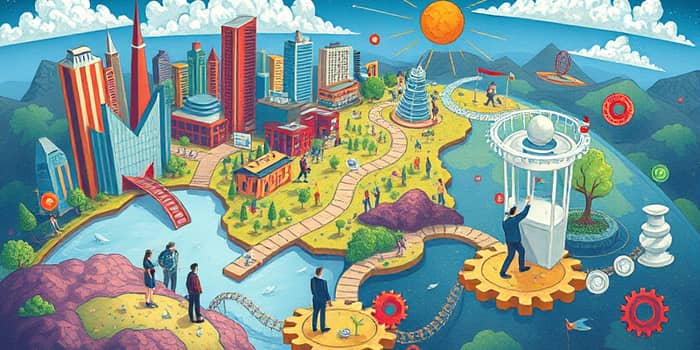
In today’s intertwined economies, market competition in a globalized economy mirrors the natural world’s relentless struggle for survival. Entities—whether individuals, firms, or nations—face continuous pressures to adapt, innovate, and outcompete rivals. This process, often described as Economic Darwinism, shapes outcomes in ways both inspiring and daunting.
Understanding these dynamics is vital for any stakeholder seeking not only to survive but to thrive in a world where change is the only constant.
Historical Evolution and Key Milestones
The post-World War II era marked a turning point in global economic integration. Governments established frameworks like GATT in 1947, setting the stage for tariff reductions that would evolve into today’s WTO by 1994. This institution unified 128 members, including former Soviet states transitioning to market economies.
In 1986, London’s “Big Bang” deregulation unleashed new financial flows. By dismantling restrictive trading rules, it accelerated cross-border capital mobility and set a precedent for neoliberal reforms worldwide. Less than a decade later, the 1995 General Agreement on Trade in Services (GATS) further extended globalization to services, allowing firms to export expertise with unprecedented ease.
By the late 1990s, global trade tensions surfaced vividly during the 1999 Seattle WTO protests, illustrating that rapid integration comes at social and environmental costs.
Mechanisms Driving Adaptation and Survival
Economic Darwinism is propelled by several interlocking forces:
- Capital and labor mobility imbalance: Capital roams freely, hunting low wages and lax regulations, while labor faces restrictive borders and social constraints.
- Neoliberal policy frameworks: Deregulation, privatization, and subsidy realignments favor large corporations over small enterprises and workers.
- Transnational corporate dominance: The top 300 firms now wield 25% of global productive assets, setting agendas that often eclipse national policies.
These dynamics foster intense pressures for efficiency and innovation. Firms unable to streamline operations or invest in technology find themselves edged out, while agile players capitalize on scale and scope advantages.
Economic Impacts: Growth, Inequality, and Power Shifts
Globalization’s record is mixed. On one hand, the IMF highlights widespread growth: 18 of 24 so-called “globalizers” achieved substantial GDP gains between 1980 and 2010, beyond the headline stories of China and India. Yet these gains often mask widening internal disparities.
Inequality and exclusion have intensified within many countries as owners of capital capture outsized profits, while low-skill workers face wage stagnation. Protecting vulnerable populations through education funding and social safety nets becomes essential to mitigate these trends.
Power dynamics have shifted decisively in favor of capital. TNCs negotiate from positions of unparalleled strength, demanding favorable tax deals and influencing regulatory frameworks. As a result, national governments sometimes prioritize corporate interests over voter wellbeing, creating a democratic deficit.
Criticisms and Social Darwinism Warnings
Critics argue that framing economic activity as endless competition paves the way for predatory practices. Mikhail Gorbachev famously warned of “something quite like social Darwinism,” where unchecked globalization risks societal fragmentation and environmental degradation.
- Inequity and social exclusion leave communities alienated, fueling populist backlashes and protectionist sentiments.
- Environmental externalities—deforestation, carbon emissions, and resource depletion—are often sidelined in pursuit of profit maximization.
- Democratic erosion occurs when policy decisions cater to global capital rather than local constituencies.
The 1999 Seattle protests and subsequent movements highlighted a growing appetite for an economic model that balances efficiency with equity, and competition with cooperation.
Learning from Evolution: Balancing Competition and Cooperation
Biological analogies offer both warnings and guidance. Just as ecosystems thrive on diversity and symbiotic relationships, economies flourish when competition coexists with collaboration.
Renowned investor George Soros emphasizes that untempered self-interest can undermine social cohesion. By contrast, firms that embed social responsibility into their core strategies not only enhance their public image but often achieve more stable, long-term performance.
Individuals and organizations can adopt practical strategies to navigate Economic Darwinism:
- Invest in continuous learning: upskill and reskill to adapt to shifting labor demands.
- Forge strategic partnerships: Collaborate with peers, NGOs, or research institutions to innovate responsibly.
- Implement resilient practices: Diversify supply chains, embrace digital tools, and monitor geopolitical risks.
- Advocate for inclusive policies: Support regulations that level the playing field, from fair trade agreements to environmental safeguards.
Future Outlook: Toward a Sustainable Global Economy
As we look ahead, the challenge lies in reshaping globalization to reflect shared values of sustainability, equity, and resilience. Proposals range from imposing global carbon taxes to expanding social protections across borders.
Emerging technologies—such as decentralized finance, blockchain-based supply chain tracking, and green energy innovations—offer pathways to more transparent and inclusive markets. However, technology alone cannot resolve structural imbalances. Collective action, informed policymaking, and ethical leadership are crucial to ensure that the “fittest” in tomorrow’s economy are those who balance profitability with purpose.
Economic Darwinism need not be a race to the bottom. By embracing cooperative strategies, investing in human capital, and advocating for responsible governance, businesses and individuals can chart a course toward a future where every participant has the opportunity to adapt, evolve, and flourish.
The survival of the fittest in a globalized world ultimately depends on our capacity to redefine fitness—not merely as raw competitiveness, but as an ability to innovate responsibly, care for community, and steward the planet.
References
- https://en.wikipedia.org/wiki/Economic_globalization
- https://ciaotest.cc.columbia.edu/olj/sa/sa_jul03/sa_jul03bha01.html
- https://www.britannica.com/event/antiglobalization
- https://www3.gmu.edu/programs/icar/ijps/vol3_1/learch.htm
- https://davidkorten.org/globalization-as-a-natural-evolutionary-process/
- https://www.cliffsnotes.com/study-notes/18913863
- https://www.piie.com/microsites/globalization/what-is-globalization