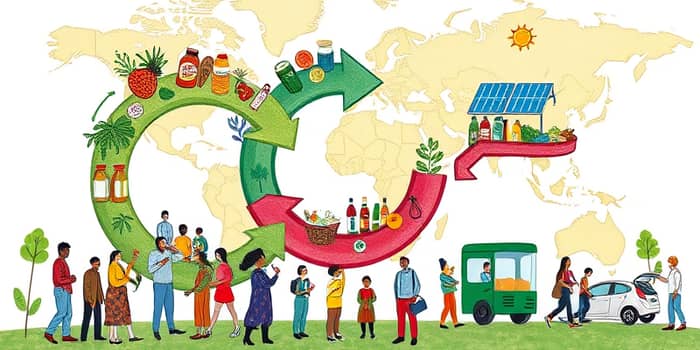
As global consumers brace for yet another year of economic uncertainty, the imperative to rethink our consumption habits has never been clearer. Shifting from a traditional linear model—take, make, waste—to a regenerative circular paradigm offers a path toward resilient economies and healthier ecosystems.
Global Spending Shifts
Entering 2026, consumers worldwide display heightened caution and renewed financial discipline. Despite an overall net intent to reduce spending by 18 percentage points—over 60% more contraction than 2025—three in four people still plan to spend the same or more in select areas. This tension between restraint and desire reveals opportunities for businesses and policymakers to innovate within evolving budgets.
Spending intentions vary markedly by region:
- Europe and U.S.: Most likely to cut back, with net reductions of 22 and 20 percentage points respectively.
- China: Swinging from a projected +10 percentage points in 2025 to an anticipated -8 in 2026.
- Middle East: The only region planning to increase spending, at +5 percentage points net.
Category-Specific Patterns
Different sectors face divergent trajectories. Groceries stand out as the only category likely to rise in 2026, with a net increase of eight percentage points. More than 80% of consumers expect to maintain or boost grocery purchases, though they will chase value over volume by planning meals and curbing impulse buys.
Conversely, non-food retail anticipates a steep 24-point net reduction globally. Older demographics (55-64 and over 65) signal the sharpest pullbacks, while only 13% expect to spend more. Travel spending, once poised for growth, dips from +2 to -9 points, even as younger cohorts remain relatively optimistic.
These shifts reflect a broader bifurcation between essential and discretionary outlays, with essentials like groceries more insulated against downturns.
- Eating out: 27% plan to cut back, driven by rising costs and health concerns.
- Fitness and wellness: A priority for younger consumers and those in China and UAE if incomes rise.
- Spending on travel and holidays: Remains a top wish list for many, especially in Italy and China.
The Psychology Behind Consumption Changes
Understanding why spending contracts is as important as tracking what declines. Five core drivers are reshaping behaviors:
- Persistent financial constraints: 65% cite diminishing disposable income amid stubborn inflation.
- The rise of frugality: 30% feel they already own what they need, driving disciplined purchasing.
- Value-seeking behavior: Buy-now-pay-later use for groceries jumped to 25% globally.
- Shifting consumption philosophy: Two-thirds seek ways to simplify in a world of overload.
- Healthier lifestyles and drug effects: Weight-loss treatments and home wellness spur category shifts.
These motivations underscore a growing maturity among consumers: seeking durability, multifunctionality and environmental responsibility rather than sheer novelty.
Strategic Spending and Wallet Priorities
Even in markets where overall spend may rise, consumers engage in dynamic category switching—a dynamic wallet hierarchy where consumers prioritize essentials and experiences over non-essentials. In the Middle East, for instance, willingness to increase spend coexists with aggressive reallocation across categories.
If extra income were available, priorities differ by country:
- U.S.: Saving first, groceries second.
- Italy and China: Favor spending on travel and holidays over savings.
- High-income consumers: 32% would put additional funds toward travel, up 4 points from 2025.
Embracing the Circular Economy
Transitioning to a circular model demands innovation at every stage of product design, use and end-of-life. Environmental pragmatism is on the rise: consumers buy air conditioners to adapt to climate shifts, yet also seek refillable, repairable and upgradable goods.
Key statistics summarize this transformation:
Digital and Emerging Market Dynamics
The digital revolution accelerates circularity. Social commerce—expected to account for 17% of online sales by 2026—and livestream shopping, projected at $70 billion in the U.S., empower brands to engage consumers with transparent sourcing and repair services. Meanwhile, Chinese exporters leverage mobile-first marketing and algorithmic personalization to reshape global price expectations, notably in electric vehicles.
Healthcare and Wellness Expansion
Spending on health products and medical services edges toward $6.9 trillion in 2026, driven by home-based fitness, telehealth and personalized supplement subscriptions. Half of consumers crave products that reflect their unique identities, underscoring an appetite for customization aligned with circular principles.
Conclusion
Our collective future hinges on reimagining consumption from a linear race to a regenerative loop. Businesses that embed circularity—repair, reuse, recycle—into their core strategies will unlock resilient growth, while consumers will find lasting value in products designed for longevity.
As 2026 unfolds, the call is clear: embrace a circular mindset to preserve resources, strengthen communities and redefine prosperity for generations to come.
References
- https://www.byyd.me/en/blog/2026/01/the-new-logic-of-consumption-in-2026-what-the-market-will-look-like/
- https://www.rbccm.com/en/insights/2025/12/five-themes-reshaping-consumer-markets-in-2026
- https://www.statista.com/outlook/co/consumption-indicators/worldwide
- https://escalent.co/blog/top-consumer-trends-2026-market-research-insights-brands-need-to-build-winning-strategies/
- https://www.mintel.com/insights/consumer-research/global-consumer-trends/
- https://www.gwi.com/connecting-the-dots
- https://www.bny.com/corporate/global/en/institute/q1-global-investment-council-report.html