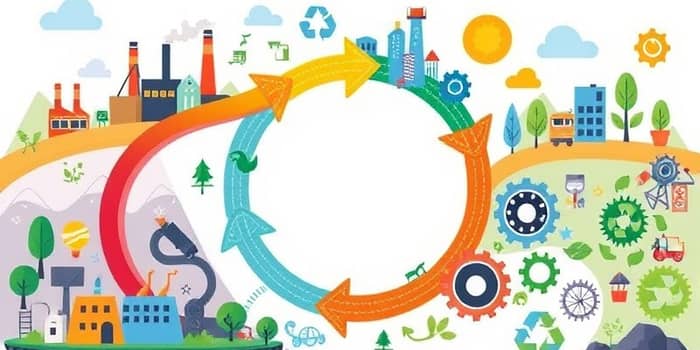
Our world stands at a critical crossroads, where the traditional ways of managing resources are pushing our planet to its limits.
The linear model of extract, use, and discard has fueled unprecedented growth, but at a devastating cost to our environment and economies.
This approach has led to resource depletion, escalating climate change, and a loss of biodiversity that threatens our very future.
It’s time for a profound shift—one that reimagines how we produce, consume, and sustain.
Enter the circular economy, a transformative framework that offers hope and practical solutions.
The Failures of the Linear Economy
For decades, the global economy has operated on a simple, yet destructive, principle: take, make, and waste.
This linear model extracts raw materials, manufactures products, uses them briefly, and then disposes of them as waste.
It’s a one-way street that has left our natural resources dwindling and our ecosystems in crisis.
The consequences are stark: accelerated climate change, pollution, and a staggering loss of wildlife.
Economically, it leads to inefficiencies and lost opportunities, as valuable materials end up in landfills instead of being reused.
We can no longer afford to ignore the urgent need for systemic change that addresses these deep-rooted issues.
Embracing the Circular Economy
The circular economy represents a radical departure from this outdated approach.
In this model, products and materials are kept in circulation through maintenance, reuse, refurbishment, remanufacture, and recycling.
Here, waste becomes the new raw material, creating a closed-loop system that mimics natural cycles.
This shift not only conserves resources but also drives innovation, reduces CO₂ emissions, and sparks new business opportunities.
It’s about designing out waste and pollution, keeping products and materials in use, and regenerating natural systems.
By adopting this mindset, we can build a more resilient and sustainable world for generations to come.
Key Structural Elements of the Circular Model
At the heart of the circular economy lies the Butterfly Diagram framework, which divides resource utilization into two main cycles.
The biological cycle focuses on materials like textiles, fruits, and foods that can regenerate and return to the environment safely.
The technical cycles are restorative, emphasizing technical materials such as metals and plastics that can be looped back into production.
To make this work, several integration components are essential:
- Reverse logistics to recover products after use
- Performance economy models that prioritize service over ownership
- Sharing economy platforms that maximize asset utilization
These elements enable reusing, recycling, remanufacturing, and refurbishing, turning waste into wealth.
By embracing these cycles, businesses can reduce their environmental footprint while unlocking new revenue streams.
Practical Business Models and Inspiring Examples
Across the globe, innovative companies are proving that circularity is not just a theory—it’s a viable, profitable reality.
One powerful approach is industrial symbiosis, where companies exchange surplus materials to create green business models.
For instance, 25 Danish companies collaborating in this way have lowered environmental impacts and cut production expenses.
The benefits are tangible and far-reaching:
- Reduced waste management costs
- Lower materials procurement expenses
- Extra income through product innovation
- Creation of new markets and customer groups
Here is a table showcasing some pioneering companies leading the charge in circular practices:
Another compelling example is brick reuse, where old bricks are collected, cleaned, and reused, saving over 95% of the energy needed for new bricks.
These stories demonstrate that circular strategies can drive both environmental and economic gains.
Systemic Barriers and Challenges to Overcome
Despite the promise, transitioning to a circular economy faces significant hurdles, particularly in resource management.
In professional services, for example, billable utilization has fallen to 68.9% in 2024, below the optimal range of 70-80%.
This inefficiency costs firms millions annually, highlighting a broader crisis in how organizations manage their resources.
Talent shortages exacerbate the problem, with over 300,000 accountants leaving the profession in three years and 83% of leaders reporting critical gaps.
Technology and data gaps further impede progress:
- 42% of average firms are held back by legacy systems
- 47% of project managers lack real-time data access
- Only 10% of firms wholly trust their resource data
Project delivery performance is also suffering, with only 34% of projects delivered on time and on budget.
Market performance has declined, with revenue growth slowing to 4.6% in 2024, down from higher averages in previous years.
Addressing these barriers requires a concerted effort to improve resource utilization and productivity across sectors.
Organizational Priorities and Emerging Trends
Forward-thinking organizations are prioritizing resource management to navigate these challenges and seize circular opportunities.
In 2025, top priorities include improving utilization, with 20% of organizations citing it as their foremost goal.
High-performing companies are setting the standard by investing in real-time resource management visibility systems that show current and projected capacity at a glance.
They also standardize processes for consistent data input and integrate resource planning with project management and financial systems.
Key trends shaping the future include:
- Increased adoption of AI and automation
- Focus on workforce analytics and cloud-based solutions
- Collaborative partnerships to share costs and risks
By maintaining utilization rates of 75-80%, these leaders demonstrate that efficiency and sustainability can go hand in hand.
The Role of Technology and AI in Driving Circularity
Technology is a game-changer in the circular economy, with AI adoption seeing a dramatic jump to 72% of organizations using it in business functions.
However, there’s a paradox: the most advanced users show 739% higher revenue growth than others, largely due to systematic investment in resource management.
AI-powered tools can optimize material flows, predict demand, and enhance recycling processes, making circular models more feasible.
For instance, integrated systems help track materials throughout their lifecycle, enabling better decision-making and reducing waste.
As technology evolves, it will be crucial to bridge the gap between early adopters and laggards to ensure widespread benefits.
Implementation Strategies for a Smooth Transition
Moving from linear to circular requires strategic, phased approaches that address both technical and cultural shifts.
Organizations can start by adopting collaborative partnerships to share the costs and risks associated with circular initiatives.
Engaging customers is vital; clearly communicating the value proposition of circular offerings can drive adoption and loyalty.
Flexibility is key, as seen with companies like Interface, which pivoted from unsuccessful models to sustainable practices.
Policy support is also essential to scale circular efforts:
- Financial incentives to reward sustainable practices
- Regulatory frameworks to balance costs and benefits
- Shared spaces like bio-industrial parks for innovation testing
NGOs and institutions play a pivotal role in raising awareness and building capacity among stakeholders.
By combining these strategies, we can create an ecosystem where circularity thrives.
The Broader Impact and Path Forward
The shift to a circular economy holds immense promise for our planet and societies, encouraging mindfulness about environmental issues.
In agriculture, for example, adopting circular principles can boost yields, reduce runoff, and improve soil health.
Market projections reflect this potential, with the human resource management market expected to grow from USD 27.51 billion in 2024 to USD 60.52 billion by 2030.
Similarly, the marketing resource management market is poised to expand, driven by AI and analytics.
To succeed, we must foster a culture of innovation and collaboration, where businesses, governments, and communities work together.
Embracing circular economy principles means rethinking everything from product design to end-of-life management.
It’s a journey that requires persistence, but the rewards—a healthier planet, resilient economies, and a brighter future—are worth every step.
Let’s commit to this transformation, turning challenges into opportunities and paving the way for sustainable prosperity.
References
- https://www.retaininternational.com/blog/resource-management-statistics-2026
- https://stateofgreen.com/en/news/10-examples-of-circular-economy-solutions/
- https://www.runn.io/blog/resource-management-statistics
- https://primed-project.eu/linear-to-circular-economy/
- https://www.saviom.com/blog/infographic-top-resource-management-trends-2026/
- https://www.okonrecycling.com/consumer-recycling-initiatives/learn-about-recycling/circular-economy-business-models/
- https://www.grandviewresearch.com/industry-analysis/human-resource-management-hrm-market
- https://www.government.nl/topics/circular-economy/from-a-linear-to-a-circular-economy
- https://www.researchandmarkets.com/reports/5533267/marketing-resource-management-market-global
- https://www.ellenmacarthurfoundation.org/topics/circular-economy-introduction/overview
- https://blog.workday.com/en-us/top-5-human-resource-management-challenges-2026.html
- https://blog.bluebeam.com/circular-economy-in-construction/
- https://resourcemanagementinstitute.com/rmgs-2026-ignite/
- https://www.avvale.com/newsroom/from-linear-to-circular-economy