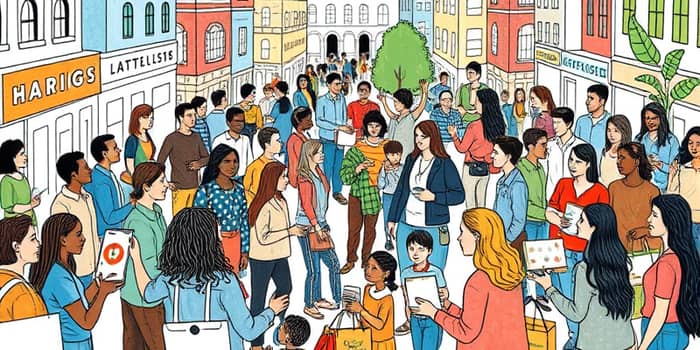
As the world grapples with resource constraints and evolving consumer expectations, a profound shift is underway. Collaborative consumption is no longer a niche phenomenon—it has become a powerful catalyst shaping economies, communities, and individual lives.
Understanding the Rise of Collaborative Consumption
The concept of sharing resources has existed for centuries, but the digital revolution has accelerated its scale and impact. Today, platforms connect millions of users who exchange tangible assets like cars and homes, as well as intangible services such as co-working and tool rentals. This transformation is underpinned by global sharing and collaborative consumption, creating a vibrant ecosystem that redefines ownership.
Market projections underscore this momentum. Valued at $66.17 billion in 2025, the tangible asset sharing market is projected to reach $372.53 billion by 2032, growing at a 28.0% CAGR. Broader estimates forecast the sharing economy expanding to $1.4 trillion by 2030, fueled by rapid urbanization and digital adoption.
Key Segments Driving Expansion
Several segments stand out as engines of growth, each addressing unique needs and preferences:
This table highlights how diverse asset types and end-user segments contribute to a robust market landscape. From ride-sharing services to flexible office spaces, organizations and individuals alike are seizing new avenues to maximize utilization and minimize costs.
Major Drivers Fueling Growth
Several powerful forces are converging to propel collaborative consumption forward:
- Urbanization and digital connectivity: Rapid city growth intensifies resource pressure, while mobile apps and IoT platforms facilitate peer-to-peer exchanges.
- Consumer preference for access: Younger generations value experiences and services over traditional ownership, embracing flexibility and variety.
- Technological innovation: AI and blockchain improve personalization, trust, and transaction security, making platforms more efficient and scalable.
- Sustainability imperatives: Aligning with circular economy principles, collaborative models reduce waste, lower emissions, and support carbon neutrality goals.
The post-pandemic era has further accelerated adoption. Consumers and businesses seek resilient, hygienic, and adaptable solutions, while remote work and virtual collaboration underscore the appeal of on-demand, shared services.
Regional Highlights and Opportunities
Although collaborative consumption is a global trend, regional dynamics reveal distinct patterns and opportunities:
North America leads with a mature ecosystem. Pioneers like Uber, Airbnb, and Lyft have normalized shared mobility and accommodation, capturing $98 billion in 2024. High internet penetration, supportive regulations, and strong sustainability initiatives underpin continued innovation.
Asia-Pacific is the fastest-growing region, driven by urbanization, youth demographics, and digital payments. China alone is set to hit $374.7 billion by 2030 at a 33.7% CAGR. In India and Southeast Asia, government data openness and expanding smartphone access are unlocking new sharing solutions in transport, housing, and logistics.
Emerging markets in Latin America, Europe, and the Middle East & Africa are also gaining traction. Affordability, sustainability goals, and urban mobility challenges create fertile ground for shared models to flourish.
Navigating Challenges and Strategic Considerations
Despite its promise, collaborative consumption faces hurdles that stakeholders must address strategically:
- Intense competition and price pressures, leading to consolidation and the need for clear differentiation.
- Regulatory uncertainty as governments adapt legal frameworks to protect consumers and encourage innovation.
- Profitability challenges, particularly for startups balancing rapid growth with sustainable margins.
New entrants should invest in user experience, robust technology stacks, and partnerships with local authorities to navigate complex market dynamics. Embracing data-driven decision-making and scalable platforms will be essential for long-term success.
Practical Steps for Businesses and Innovators
Companies looking to leverage collaborative consumption can take actionable steps today:
- Identify high-demand assets or services where underutilization exists, then build flexible access models tailored to target segments.
- Integrate advanced analytics and AI to personalize offerings, forecast demand spikes, and optimize asset allocation.
- Form partnerships with governments and other stakeholders to access shared datasets, streamline regulations, and co-create sustainable urban solutions.
By focusing on customer-centric platform design and continuous innovation, businesses can cultivate loyal communities and unlock new revenue streams.
The Road Ahead: Embracing a Shared Future
The shift from scarcity to sharing represents more than a market trend—it embodies a cultural transformation. As collaborative consumption matures, its impact will extend beyond economic metrics to reshape social norms and environmental stewardship.
Individuals empowered by choice and flexibility will redefine the meaning of ownership. Enterprises harnessing shared infrastructure and services will achieve agility and resilience. Communities collaborating on resource sharing will foster deeper connections and shared responsibility.
Ultimately, the global sharing economy is not just about transactions—it's about cultivating a sense of collective empowerment. By embracing collaboration, technology, and sustainability, we can build a future where resources are optimized, opportunities are democratized, and the planet thrives.
References
- https://www.strategymrc.com/report/sharing-and-collaborative-consumption-market
- https://www.grandviewresearch.com/industry-analysis/enterprise-collaboration-market-report
- https://www.globenewswire.com/news-release/2025/04/24/3067614/0/en/Sharing-Economy-Industry-to-Grow-by-US-1-Trillion-Reaching-US-1-4-Trillion-by-2030-Expansion-of-Collaborative-Consumption-Models-Drives-Adoption-in-Various-Sectors.html
- https://www.thebusinessresearchcompany.com/market-insights/sharing-economy-market-insights-2025
- https://www.startus-insights.com/innovators-guide/sharing-economy-market-report/
- https://www.mckinsey.com/industries/consumer-packaged-goods/our-insights/state-of-consumer
- https://www.technavio.com/report/sharing-economy-market-industry-analysis
- https://www.cognitivemarketresearch.com/collaboration-market-report
- https://www.proficientmarketinsights.com/market-reports/sharing-economy-market-1199