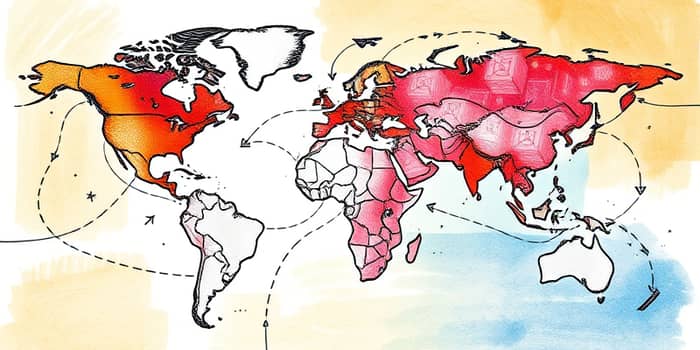
In an era marked by rapid technological change and geopolitical shifts, the global economy stands at a crossroads. Uncertainty and slowing global growth driven by rising tariffs and protectionist policies have unsettled markets, but emerging resilience factors offer a beacon of hope. This in-depth exploration examines how trade conflicts, supply chain restructuring, and policy adjustments will shape economic prospects through 2026 and 2027.
Escalating Tariffs and Trade Dynamics
The year 2025 witnessed a surge in cross-border commerce, with global trade reaching a record $35 trillion, up 7% from the previous year. Much of this spike reflected front-loading as businesses rushed to move goods ahead of impending duties. Yet manufacturing bore the brunt of new measures, particularly those targeting China, Europe, and Mexico.
- US tariffs on Chinese electronics and machinery.
- European duties on automotive parts and steel imports.
- Potential USMCA adjustments impacting Mexico and Canada.
Looking to 2026, tariff threats are set to intensify as protectionism becomes a lever for industrial and geopolitical goals. Elevated duties raise costs, weaken demand, and deter investment, fragmented supply chains and regional divides complicate sourcing strategies, and smaller economies feel the shock most acutely.
Global Growth Projections for 2026-2027
Multiple institutions anticipate moderate growth below the pre-pandemic average of 3.2%. Technology investment and policy measures provide partial offsets, yet trade headwinds remain a drag.
Despite divergent estimates, consensus points to below pre-pandemic growth levels with only gradual improvement into 2027. Fiscal expansion, lower energy prices, and easing inflation around 2.6% globally will underpin modest gains.
Regional Disparities and Impact
Trade frictions exacerbate existing divides. Advanced economies, buoyed by strong service sectors and digital transformation, near or exceed pre-2020 per capita incomes. Meanwhile, one in four developing nations lags behind its 2019 benchmark.
East Asia and the Pacific leads among regions, projecting over 4.4% growth, while Europe and Central Asia hover near 2.4%. Latin America and the Caribbean face moderate expansion around 2.3%, and South Asia tops the charts at over 6%. Commodity exporters and small open economies struggle with revenue volatility and tighter financing conditions.
Key Risks and Geopolitical Factors
Multiple threats could derail recovery. Trade policy volatility may trigger a mild global recession if tariffs spiral. Geopolitical flashpoints—from Kashmir tensions to instability in the Middle East—add unpredictability. Higher debt levels, commodity price swings, and fragile investment sentiment further heighten the stakes.
- Escalating US-China tariff disputes undermining cross-border supply chains.
- Regional conflicts risking energy and commodity market shocks.
- Fiscal strains and debt vulnerabilities in emerging markets.
- Sluggish capital flows despite monetary easing in key economies.
However, opportunities remain. Resilience factors emerging across sectors—especially in technology and services—offer avenues for growth even amid headwinds.
Paths to Resilience and Opportunity
Against this backdrop, businesses and policymakers can adopt strategies to thrive. Nearshoring and diversification reduce exposure to single-country dependencies. Investments in digital infrastructure enhance flexibility, and green initiatives unlock new markets.
- Accelerate structural shifts in global value chains by embracing nearshoring.
- Boost AI-driven manufacturing and logistics to cut costs.
- Strengthen regional trade agreements to bypass tariff barriers.
- Promote sustainable energy and resource efficiency for competitive edge.
International cooperation on standards and dispute resolution can mitigate policy swings. Public-private partnerships focusing on workforce retraining will equip labor markets for the digital and green transitions ahead.
Conclusion: Building a Stable Future
Trade tensions are reshaping the global economic order, imposing costs but also spurring innovation. By understanding projections and risks, and by pursuing diversified supply chains, digital transformation, and cooperative policies, stakeholders can safeguard global economic stability and forge a path to shared prosperity.
The decade ahead may prove the weakest since the 1960s if protectionism persists. Yet with deliberate action—embracing technology, enhancing regional ties, and maintaining open dialogue—nations can overcome friction and secure prosperity for future generations worldwide.
References
- https://www.worldbank.org/en/news/press-release/2026/01/13/global-economic-prospects-january-2026-press-release
- https://unctad.org/publication/world-economic-situation-and-prospects-2026
- https://www.deloitte.com/us/en/insights/topics/economy/global-economic-outlook-2026.html
- https://news.bryant.edu/will-2026-bring-stability-or-shock-bryant-economists-weigh
- https://unctad.org/news/10-trends-shaping-global-trade-2026
- https://www.imf.org/en/publications/weo/issues/2026/01/19/world-economic-outlook-update-january-2026
- https://www.un.org/en/desa-en/wesp-2026
- https://www.morganstanley.com/insights/articles/global-economic-outlook-2026
- https://unctad.org/publication/global-trade-update-january-2026-top-trends-redefining-global-trade-2026
- https://www.goldmansachs.com/insights/outlooks/2026-outlooks
- https://www.stimson.org/2026/top-ten-global-risks-for-2026/
- https://rsmus.com/insights/economics/economic-outlook-for-2026.html
- https://www.weforum.org/stories/2026/01/trade-is-changing-and-davos-2026-made-it-clear-here-are-10-insights/
- https://www.spglobal.com/market-intelligence/en/news-insights/research/2026/01/global-economic-outlook-january-2026
- https://www.spglobal.com/en/research-insights/special-reports/trade-tensions