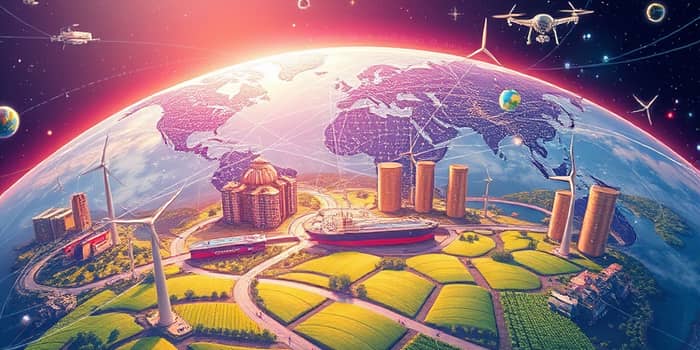
As we enter 2026, the world stands at a crossroads defined by powerful forces driving change. From energy revolutions to demographic shifts, these megatrends will reshape economies, societies, and individual lives. Understanding them is essential for leaders, investors, and citizens alike.
Economic Security and Supply Chain Resilience
In today’s fragmented geopolitical climate, nations and corporations prioritize reliable supply routes over mere cost savings. Tariffs, industrial policies, and rising tensions have prompted a shift from cost-efficiency to risk mitigation across industries. Companies are diversifying suppliers and relocating production closer to key markets, building resilient supply chains that adapt swiftly to disruptions.
U.S. LNG exports soar as Europe and Asia seek energy independence. Meanwhile, data centers now consume 3% of U.S. power, projected to reach 8% by 2030. This surge underscores the need for strategic resource planning, creating opportunities in defense, infrastructure, and critical materials. Active managers are targeting firms with robust capital deployment strategies, capitalizing on the wave of reindustrialization in the U.S. and Europe.
- Supplier diversification and nearshoring
- Strategic stockpiling of critical resources
- Investment in infrastructure and cybersecurity
Energy Transition and Climate Disruption
The global push toward renewables is no longer a distant aspiration but a present-day imperative. With AI’s energy appetite growing daily, speed to power now favors wind, solar, and storage solutions. Investors are channeling massive funds into clean technologies, aiming to meet a projected $640 billion annual market by 2030.
Despite political tensions, 113 countries have pledged to cut emissions by 12% by 2035. The EU’s carbon border adjustment mechanism takes effect in 2026, reshaping trade flows and accelerating decarbonization. However, the transition demands skilled labor—renewables are 2.5 times more labor-intensive than fossil fuels—highlighting training as a competitive edge for large firms.
Replacing a 250-year fossil infrastructure requires comprehensive electrification of grids, widespread battery deployment, and smart networks. These efforts are not only vital for climate goals but also represent massive capital for sustainable infrastructure and long-term economic opportunity.
Geopolitical Tensions and Trade Reconfiguration
Geopolitics remains a dominant driver of trade strategy in 2026. China’s leadership in shipbuilding, batteries, solar panels, and EVs is reshaping value chains. In response, the U.S., Europe, and emerging economies are imposing tariffs, offering subsidies, and even nationalizing key assets to secure critical industries.
Global trade grew 7% in 2025 to over $35 trillion, yet future growth faces headwinds from fractured partnerships. Tariff volatility has become its own megatrend, compelling firms to build flexibility into networks and anticipate abrupt policy shifts.
- Strategic alliances to counterbalance dominant players
- Regional trade blocs and bilateral agreements
- Increased government intervention in critical sectors
Digitalization, AI, and Technological Disruption
Digital trade now accounts for 27% of global commerce, driven by services that are 56% digitally deliverable. AI, robotics, and quantum computing are transforming industries, demanding both massive capital and abundant energy. As machines handle routine tasks, human roles are shifting toward creativity and ingenuity in a true human-machine collaboration fueling creative breakthroughs.
Ethical AI, cognitive infrastructure, and autonomous ecosystems are emerging megatrends. Companies that embrace adaptive learning systems and invest in neurotechnology stand to lead the next wave of productivity gains, addressing labor shortages with intelligent automation while safeguarding human values.
Demographic Shifts and the Circular Economy
Aging populations and declining birth rates threaten traditional growth models. Labor scarcity is intensifying, driving migration policies aimed at building “economic infrastructure” through diverse talent flows. Meanwhile, resource depletion and waste challenges are fueling a vigorous circular economy movement.
Recycling, waste-to-energy, and sustainable agriculture innovations—such as biomethane production and regenerative farming—are gaining traction. The idea of circular economy unlocking new value streams is no longer theoretical: companies and governments are investing in closed-loop systems that minimize waste and bolster resilience.
- Advanced recycling and material recovery systems
- Sensor networks for water and ecosystem monitoring
- Biotech solutions for sustainable agriculture
Investment Opportunities and Future Outlook
For investors seeking to navigate this complex landscape, four core themes stand out: climate transition, depopulation, post-truth trust economics, and geopolitics. Sectors poised for growth include AI and robotics, biotech, smart cities, and clean energy infrastructure.
Regional projections for 2026 highlight divergent paths:
South-South trade is deepening, with Africa exporting over 50% of goods to developing markets. Regional value chains in Asia and intercontinental service linkages are enhancing resilience and diversifying risk.
Conclusion: Steering Through Megatrends
As we navigate 2026, no single trend acts in isolation. Economic security, energy transition, digitalization, and demographic change intersect to redefine the global order. By understanding these dynamics and embracing AI-driven energy demands transform industries alongside human ingenuity, stakeholders can craft strategies that are both resilient and visionary.
In an era where trust as a measurable economic asset gains prominence, transparent governance and sustainable practices will determine winners and losers. The choices made today will echo through decades, shaping the prosperity and stability of future generations. Empowered by insight and guided by purpose, we can harness these megatrends to build a more secure, equitable, and vibrant world.
References
- https://am.gs.com/en-hk/advisors/insights/article/investment-outlook/megatrends-thematic-investing-2026
- https://www.youtube.com/watch?v=aZB7vcVXCVc
- https://unctad.org/news/10-trends-shaping-global-trade-2026
- https://www.homaio.com/post/where-to-invest-2026-megatrends
- https://www.ey.com/en_gl/megatrends
- https://it.scalable.capital/en/finances-stock-market/sectors-and-themes-to-monitor-for-2026
- https://www.frost.com/growth-opportunity-news/techvision/megatrends-2026-the-forces-reshaping-global-strategy-and-competitive-advantage-tnv10_megatrends2026theforcesreshapingglobalstrategyandcompetitiveadvantage_dec25_cim-sn/
- https://www.sitra.fi/en/publication/megatrends-2026/
- https://www.pwc.com/gx/en/issues/megatrends.html