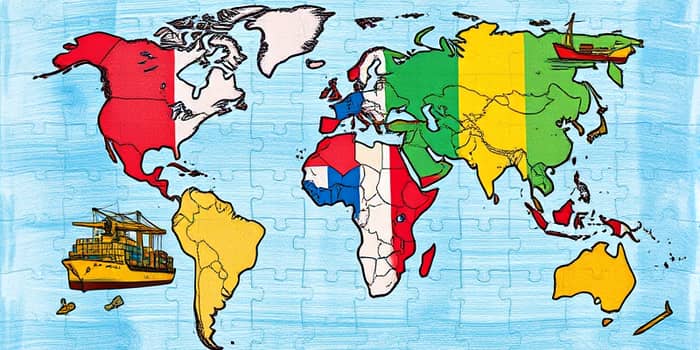
In recent years, the promise of an ever-expanding global economy has encountered significant headwinds. From trade wars to pandemic-induced supply disruptions, a palpable shift is underway. This article examines the multi-dimensional phenomenon of deglobalization—the reversal or slowdown of cross-border integration—and explores its causes, impacts, and potential pathways forward.
Drawing on data from the IMF, World Economic Forum, S&P Global, and leading think tanks, we provide an authoritative, data-rich narrative that illuminates how nations, businesses, and citizens can navigate this emerging landscape.
Understanding the Roots of Deglobalization
Deglobalization manifests as a slowdown in cross-border flows of goods, capital, and people, often driven by heightened protectionism and resource nationalism. At its core lie several intertwined forces:
- Rising protectionism: Global trade restrictions climbed from around 1,000 measures in 2019 to over 3,000 by 2023, with proposed US tariffs reaching 60% on China imports and 10–20% on goods from allies.
- Resource nationalism: Governments assert tighter control over energy, minerals, and food supplies through export controls or nationalization, amplified by crises like COVID-19 and the Ukraine war.
- Geopolitical rivalries: The US-China tension and Europe’s strategic recalibration have prompted countries to reduce dependencies on perceived adversaries.
- Supply chain resilience: The pandemic exposed fragile supply chains, spurring reshoring and “friend-shoring” to allied nations.
- Populism and inequality: Domestic backlashes—Brexit, anti-immigration policies, and populist electoral gains—reflect growing unease with globalization’s uneven gains.
Measuring the Backlash Through Data
Quantitative evidence underscores the scale of fragmentation. Consider these key indicators:
Global merchandise trade growth is projected at just 2.3% per year through 2031, below world GDP growth of 2.5% (Boston Consulting Group). Services trade remains more resilient—forecast at 4% annually in 2025–2026—but cannot fully offset goods trade’s slowdown.
Emerging economies—dependent on foreign direct investment and commodity exports—face the steepest declines in growth, productivity, and innovation as investment flows slow and market access shrinks.
Regional and Sectoral Impacts
Deglobalization does not affect all regions and industries equally:
- US and Canada: Aggressive tariff increases and tighter immigration could shrink labor supply and raise production costs.
- European Union: Efforts to reclaim supply chain sovereignty in energy and pharmaceuticals seek to reduce external vulnerabilities.
- Asia: China pursues self-sufficiency while Southeast Asian nations recalibrate trade ties to balance US-China tensions.
Sectorally, energy and critical minerals see heightened government intervention. The high-tech and semiconductor industries, particularly in US-China trade, face stringent export controls and investment curbs.
Economic and Financial Ramifications
As fragmentation deepens, numerous macroeconomic consequences emerge:
• Growth and Inflation: Studies by the IMF and BIS show that open economies generally enjoy lower inflation and higher productivity. Deglobalization’s “stagflationary” risk emerges as costs rise without commensurate gains from specialization.
• Employment and Investment: Slower trade and FDI flows dampen job creation in export-oriented sectors. Policy uncertainty disrupts long-term business planning, reducing capital expenditure.
• Currency and Financial Flows: While the dollar retains dominance, growing financial fragmentation heightens volatility. Investors rebalance portfolios away from high-risk or US-centric assets, fragmenting global capital markets.
Countertrends and Forging Resilience
Despite the headwinds, dynamic forces offer partial offsets:
- Digitalization and technology: Cross-border services, digital trade, and AI adoption can sustain economic integration. Generative AI could boost productivity by 1.5% annually, adding $2.6–$4.4 trillion in benefits.
- Persistent global ties: US-China trade volumes remain substantial, and many businesses still exploit global efficiencies in finance, services, and technology.
To build resilience, policymakers and companies must invest in digital infrastructure, diversify sourcing strategies, and cultivate strategic alliances that transcend narrow geopolitical blocs.
Fragmentation Risks and Future Scenarios
The long-term outlook hinges on whether fragmentation deepens or adapts to a new multipolar equilibrium:
- Multipolarity: Power is shifting toward regional blocs—North America, EU, Asia—making coordination on climate, health, and security more complex but not impossible.
- “Smart globalization”: Proposals for ethical, rules-based frameworks aim to balance national interests with global cooperation, preserving critical links while shoring up vulnerabilities.
- Is deglobalization overstated? Services trade, technology diffusion, and global financial markets retain significant integration, suggesting that a full decoupling remains unlikely outside strategic sectors.
Yet the risk of a permanently splintered global economy looms large, threatening innovation, multilateral cooperation, and the capacity to address cross-border challenges.
Conclusion: Navigating a Fragmented World
We stand at a crossroads. The forces of deglobalization are reshaping trade, investment, and political alliances. However, by embracing digital transformation, fostering regional cooperation, and championing rules-based frameworks, policymakers and businesses can mitigate downsides and harness opportunities.
Global challenges—from climate change to pandemics—cannot be solved within national silos. The task ahead is to craft resilient, adaptable systems that blend national security with global solidarity, ensuring that the promise of globalization lives on in a smarter, more inclusive form.
References
- https://moderndiplomacy.eu/2024/09/20/the-current-trend-of-de-globalization-protectionism-and-resource-nationalism/
- https://www.rcgt.com/en/insights/expert-advice/global-economy-2025/
- https://www.imf.org/en/publications/fandd/issues/2023/06/growing-threats-to-global-trade-goldberg-reed
- https://journalrecord.com/2024/11/15/how-could-tariffs-deglobalization-impact-economic-growth-in-2025/
- https://www.weforum.org/stories/2025/01/5-transformational-trends-shaping-global-finance/
- https://www.pinebridge.com/en/insights/capital-market-line-deglobalization-marches-on
- https://www.lazard.com/research-insights/top-geopolitical-trends-in-2025/
- https://www.krungsri.com/en/research/research-intelligence/deglobalization-services-2025
- https://www.spglobal.com/en/research-insights/market-insights/geopolitical-risk
- https://www.spglobal.com/en/research-insights/market-insights/geopolitical-risk/evolution-of-deglobalization
- https://www.weforum.org/stories/2025/08/inflection-points-7-global-shifts-defining-2025-so-far-in-charts/
- https://www.imf.org/en/Blogs/Articles/2025/04/22/the-global-economy-enters-a-new-era
- https://thediplomat.com/2025/05/deglobalization-and-international-investment-trends/
- https://www.iese.edu/insight/articles/deglobalization-geopolitics-economy-china-united-states/
- https://www.mckinsey.com/mgi/our-research/geopolitics-and-the-geometry-of-global-trade-2025-update
- https://www.ssga.com/ca/en/institutional/insights/will-us-policies-drive-a-great-reglobalization