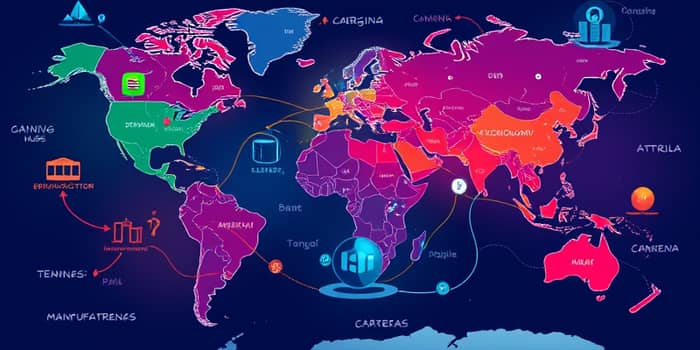
The global capital landscape is in flux, reshaping economies and influencing policies worldwide. As businesses navigate shifting opportunities, understanding where foreign direct investment (FDI) is heading becomes essential for governments, corporations, and investors.
Current State of Global Investment Flows
In 2024, total global FDI rose by a modest 1% to USD 1,485 billion in total FDI flows, but this headline figure masks a deeper story. When we exclude excluding large one-off transactions, overall flows actually declined by 9% compared to the year before.
During Q1 2024, cross-border investment reached $297 billion, reflecting continued demand for strategic assets despite economic headwinds. According to the IMF, by the end of 2023 Global inward FDI stock reached $41 trillion, a 4.4% increase year-over-year, setting a new record.
Looking ahead, analysts project that global FDI will projected to grow by 4.9% in 2025, as recovery from pandemic disruptions and cautious optimism over geopolitical stability begin to take hold.
Top Destinations and Sources for FDI
The distribution of capital reveals enduring power centers alongside fast-emerging players. The United States remains the anchor, but Asia-Pacific and select emerging markets are rapidly gaining ground.
- United States: Continues as the world’s largest FDI destination for 12 consecutive years, absorbing $76 billion in Q1 2024 and boasting a cumulative stock of $5.7 trillion.
- Europe: Although Europe’s share of global FDI has fallen from 33% (2004) to 23% (2024), Germany alone recorded a $164 billion increase in stock last year.
- Asia-Pacific: Projected to command over 35% of global FDI in 2024, led by China’s rise to third place and India’s manufacturing boom.
- Singapore: Posted the largest single-country gain in 2023, up $307 billion, driven by its finance and logistics sectors.
- Emerging Markets: India, Mexico, and Brazil each saw inward FDI rise by about $130 billion in 2023—their biggest annual increases since 2009.
- Least Developed Countries: Received $37 billion in 2023, up 9%, yet still representing just 2% of total global flows.
Sectors Attracting Investment
Capital is gravitating toward industries that promise future growth. Technology and advanced manufacturing lead the charge, while some traditional sectors experience slowdowns.
Semiconductors have witnessed a threefold surge in announced FDI projects in early 2025, with 90% of those investments targeting the U.S. Data centers and AI infrastructure are on track to draw $370 billion by year-end, accounting for 85% of new greenfield commitments in communications and software.
Advanced manufacturing projects—especially in machinery and electronics—comprise one quarter of global FDI announcements since 2022, with roughly $115 billion annually earmarked for new semiconductor fabs. In contrast, electric vehicle investments have slumped by more than 75% in the same period.
Top Destinations for FDI: Comparative Table
Regional Performance & Challenges
Asia-Pacific continues to lead, propelled by electronics, software, and green infrastructure investments. China’s relaxation of capital rules in major cities has fueled its ascent.
Latin America and Africa have seen declines, reflecting broader economic instability and policy uncertainty. By contrast, Southeast Asian nations have maintained steady capital inflows, benefiting from diversified supply chains and regional trade agreements.
Advanced economies are increasingly investing in each other, signaling a move toward friendshoring among allied nations. Notably, FDI flows to China dropped by nearly 70% in early 2025, while China itself has become a major outbound investor in Europe, Latin America, and North Africa.
Trends, Drivers, and Headwinds
Several forces are shaping the direction and volume of global investment:
- Geopolitical Fragmentation: Friendshoring accelerates the realignment of capital toward trusted partners.
- Volatile Policy Environment: Record-high FDI announcements in March 2025 contrasted sharply with the decade-low in May.
- Green & Digital Focus: Sustainable investing and digital infrastructure dominate new project pipelines.
- Developing Economies Rising: Developing countries now attract 31% of global FDI, up more than 10% since 2004.
Despite these drivers, future flows face headwinds from tightening financial conditions, regulatory shifts, and fluctuating exchange rates. The U.S. net international investment position improved by $1.92 trillion in Q1 2025, but remains deeply negative at –$24.61 trillion due to longstanding asset-liability imbalances.
As the world economy adapts to geopolitical realignments and technological revolutions, the paths of capital flows will continue to mirror broader strategic priorities. Understanding these patterns offers a roadmap for policymakers aiming to attract quality investment and for businesses seeking growth in a complex global marketplace.
By staying attuned to emerging sectors, regional shifts, and fundamental drivers, stakeholders can position themselves to capitalize on the next wave of international investments—and shape a more connected, resilient economic future.
References
- https://wisemoneytools.com/article/investment-statistics/
- https://www.imf.org/en/blogs/articles/2025/02/20/foreign-direct-investment-increased-to-a-record-41-trillion
- https://globalbusiness.org/foreign-direct-investment-in-the-united-states-2025/
- https://www.mckinsey.com/mgi/our-research/the-fdi-shake-up-how-foreign-direct-investment-today-may-shape-industry-and-trade-tomorrow
- https://www.bea.gov/news/2025/us-international-investment-position-1st-quarter-2025-and-annual-update
- https://unctad.org/publication/world-investment-report-2025
- https://www.worldbank.org/en/publication/global-economic-prospects