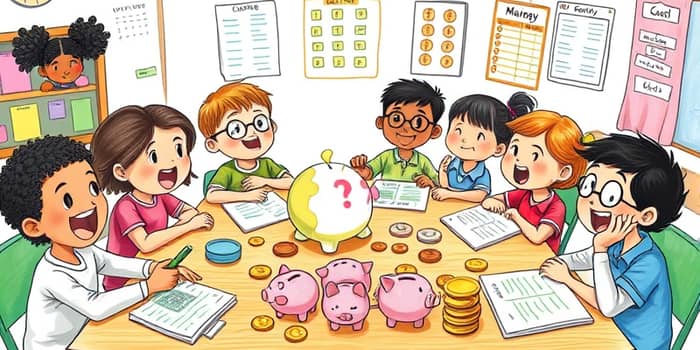
Financial literacy is no longer an optional topic—it’s a critical lifelong financial skill that equips today’s youth with the tools to navigate tomorrow’s economic challenges. As schools and families recognize this urgency, understanding the current landscape, proven outcomes, and practical solutions becomes essential to empower the next generation.
Current State of Financial Literacy Education
Across the United States, participation in financial literacy courses is on the rise. Today, 45% of high schoolers take a personal finance or financial literacy class, up from 31% in 2024. Yet, only 22.7% of U.S. high school students have guaranteed access to such courses, leaving a significant portion without consistent instruction.
Student attitudes reveal both hope and anxiety. While 64% of teens find existing curricula extremely or very helpful, 42% admit they feel terrified about future money shortages. Public opinion further underscores a gap: just 14% rate current school-based financial education as excellent, and only 26% as very good.
These figures highlight a dual challenge: increasing access to courses while ensuring content truly prepares students. Without comprehensive mandates, many states fall behind, and meaningful engagement remains uneven.
Impact and Outcomes of Early Financial Education
Evidence shows that when students receive well-structured instruction, the benefits extend far beyond the classroom. A recent study found that after a 12-week financial training program, over half of participating students could successfully budget, compared to just one student before the program began.
Mandated financial education in states like Georgia, Idaho, and Texas has produced measurable gains in credit health by the third year of implementation: +10.89 points in Georgia, +16.19 in Idaho, and +31.71 in Texas. Remarkably, parents of these students saw their credit scores rise by an average of 5%—a ripple effect extending to families.
- Better budgeting skills into adulthood
- Stronger credit health and financial stability
- Enhanced confidence around money management
Longitudinal research confirms that teens exposed to financial literacy lessons manage money more effectively as adults, reinforcing the need for early and consistent education.
Funding Landscape Shaping Financial Education
Understanding the funding environment is key to scaling successful programs. Nationally, K-12 public schools spend $612.7 billion annually, averaging $12,612 per pupil. Funding sources break down to 7.7% federal, 46.7% state, and 45.6% local contributions. Despite high spending, per-pupil allocations vary drastically by state, affecting the quality and availability of programs.
These per-pupil spending variations nationwide reflect differing local priorities and economic capacities. Federal proposals for FY2026—including $194 million for Comprehensive Literacy Development Grants and $30 million for Innovative Approaches to Literacy—offer targeted support but face potential cuts amid budget pressures.
Meanwhile, private school choice programs saw a 29% increase, allocating $10.6 billion last year. As enrollment projections anticipate a 2% rise to 56.8 million students by 2026, policymakers must balance allocation to public and private initiatives while ensuring no child is left behind.
Proven Programs and Practical Solutions
Successful financial literacy initiatives often blend classroom instruction with real-world experience. Organizations like Junior Achievement (JA) reach 4.6 million U.S. students annually, offering rigorous, standards-aligned curricula from pre-K through age 25. Likewise, the FDIC’s Money Smart for Young People program provides free, age-appropriate lessons that demystify banking, budgeting, and credit.
- Integrate hands-on activities and simulations
- Partner with nonprofit experts for authentic insights
- Encourage open conversations between parents and children
- Leverage digital tools for interactive learning
- Advocate state mandates to guarantee access
Third-party program evaluations confirm that these approaches yield proven financial readiness impacts. Schools and families working in concert can transform abstract concepts into tangible skills.
Building a Sustainable Future
Financial literacy is a shared responsibility. Educators, policymakers, and parents must collaborate to weave money management into daily life. With robust evidence at hand—credit score improvements, budgeting success rates, and survey data showing strong public support—now is the moment for action.
State rankings reveal that only seven states currently earn an “A” grade for financial education, while five receive an “F.” Yet projections indicate 23 states could reach “A” by 2028 if momentum continues. Enrollment trends underscore the growing need: public school populations are set to climb to 51.7 million, with high school enrollment rising to 16.5 million by 2026.
Ultimately, empowering young people with evidence-based strategies in financial literacy fosters resilience, confidence, and long-term prosperity. By investing resources wisely, championing effective curricula, and nurturing open dialogue at home and school, we can equip every child with the knowledge to thrive in a complex economic world.
Together, we can ensure that the next generation not only understands money but masters it—building a foundation for financial well-being that lasts a lifetime.
References
- https://worldpopulationreview.com/state-rankings/per-pupil-spending-by-state
- https://jausa.ja.org/news/press-releases/more-teens-are-participating-in-financial-literacy-courses-but-gaps-in-learning-evident-according-to-new-survey
- https://www.financialeducatorscouncil.org/youth-financial-literacy-statistics/
- https://www.edutopia.org/article/financial-literacy-education-yields-big-returns/
- https://www.edchoice.org/2026-edchoice-spending-share-rankings/
- https://www.aba.com/about-us/press-room/press-releases/new-survey-americans-support-financial-education-in-schools
- https://www.ffyf.org/2026/02/11/readynation-report/
- https://www.weforum.org/stories/2025/07/financial-education-students-to-parents/
- https://www.k12dive.com/news/6-k-12-trends-to-watch-in-2026/809065/
- https://www.intuit.com/blog/global-stories/financial-literacy-ranking-by-state/
- https://www.unicefusa.org/press/global-funding-cuts-could-force-6-million-more-children-out-school-coming-year-unicef
- https://www.ngpf.org/state-of-fin-ed-report-2021-2022/
- https://www.fdic.gov/consumer-resource-center/2026-02/youth-financial-education-and-its-impact-adult-financial-decisions