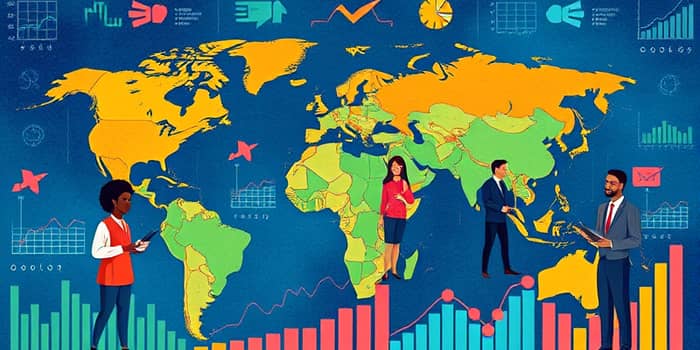
In an interconnected world, ensuring that every person can participate fully in economic life is both an ethical imperative and a driver of sustainable growth. This article explores how opportunity can be measured, benchmarked, and expanded through robust global metrics.
Understanding Economic Inclusion
Economic inclusion goes beyond simply reducing poverty. It means that all people have their basic needs met and can participate productively in society. This includes access to education, healthcare, housing, and meaningful employment.
At its heart, inclusion is about empowerment. When individuals can make choices, voice opinions, and access essential services, they contribute to community resilience and long-term development.
Key Global Metrics and Data
To track progress, international organizations rely on clear numerical benchmarks. Two of the most cited thresholds are:
The extreme poverty line set at $2.15/day defines the most severe deprivation. Yet, a threshold of $12/day indicates whether individuals have sufficient resources for basic welfare, skill development, and the capacity to save.
Globally, about 60% of humanity falls below that second benchmark, revealing a vast opportunity gap even in high-income nations where structural barriers persist.
Principal Indices and Frameworks
Multiple indices illuminate different facets of inclusion, from overall human development to corporate diversity:
Human Development Index (HDI): Life expectancy, education, and income where higher values signal broader well-being.
Bloomberg Gender-Equality Index (GEI): Corporate policies and performance toward gender equity.
Disability Equality Index (DEI) and Corporate Equality Index (CEI): Measures of workplace inclusion for people with disabilities and LGBTQ+ employees.
Workplace inclusion metrics such as pay equity, recruitment rates, retention, advancement opportunities, and Employee Net Promoter Scores help firms benchmark internal progress. For example, combining fair treatment, safety, and opportunity scores can yield an overall inclusion index above 75 out of 100.
Quantitative and Qualitative Approaches
Effective measurement balances objective data with human experience. Key distinctions include:
- Quantitative vs. Qualitative: Income figures vs. narrative surveys.
- Subjective vs. Objective: Feeling of belonging vs. access to services.
- Absolute vs. Relative: Poverty thresholds vs. deprivation compared to peers.
- Stock vs. Flow: Current wealth vs. upward mobility trends.
- Static vs. Dynamic: Single point snapshots vs. longitudinal analysis.
- Territorial and Group Indicators: Regional, gender, or age-based breakdowns.
Combining these perspectives reveals not just who is excluded, but why, and how interventions can be targeted.
Policy Context and Global Trends
Since the Millennium Development Goals, the United Nations has emphasized poverty eradication and decent work for all. The Sustainable Development Goals (SDGs) built on this, embedding inclusion across multiple targets.
Meanwhile, the rise of ESG reporting has driven corporations to integrate social metrics alongside environmental performance. In the European Union, harmonized social indicators facilitate cross-border comparisons and policy alignment.
International bodies increasingly call for universal global inclusion standards akin to financial reporting norms, promising more transparency and comparability.
Challenges and Future Directions
Despite progress, measurement faces obstacles:
1. Variability in national poverty lines and data collection methods makes direct comparisons difficult.
2. Voluntary corporate DEI reporting can lead to uneven disclosure and potential greenwashing.
3. Capturing lived experiences—cultural barriers, discrimination, or informal economies—demands nuanced, qualitative tools.
Looking ahead, technology-driven surveys, open-data platforms, and stakeholder participatory approaches can enhance reliability. Calls for ISO or GRI-style frameworks may finally yield harmonized global metrics.
Practical Steps for Measuring Inclusion Locally
Organizations and governments can begin measuring economic inclusion today by following these actions:
- Define your scope: Choose target populations and geographic areas of focus.
- Select relevant indices: Combine global benchmarks (e.g., HDI) with sectoral measures (e.g., GEI, DEI).
- Gather both quantitative and qualitative data to capture full experiences.
- Engage stakeholders—community members, civil society, employees—in participatory assessments.
- Set clear targets, publish dashboards, and review progress regularly.
- Adjust strategies based on evidence, scaling successful interventions.
By embedding robust metrics into policy and practice, leaders can transform data into action, closing opportunity gaps and fostering resilient economies.
Perception of belonging and safety is a powerful motivator. When individuals see their progress recognized in data, they gain confidence to pursue new opportunities.
Global trends show rising awareness of structural barriers—but also a growing commitment to dismantle them. Through comprehensive measurement, we can chart pathways from exclusion to empowerment, ensuring that no one is left behind.
Conclusion
Measuring economic inclusion is more than a technical exercise—it is an act of global solidarity. With transparent metrics, collaborative frameworks, and a shared vision, we can assess where opportunity thrives and where it falters.
Armed with precise data and inclusive narratives, policymakers, businesses, and communities can co-create resilient systems that uplift every individual. The challenge is immense, but the promise of a more equitable world is within our reach.
References
- https://lifestyle.sustainability-directory.com/area/economic-inclusion-metrics/
- https://www.grantthornton.global/en/insights/articles/measuring-diversity-and-inclusion-part-of-the-g-in-esg/
- https://www.mckinsey.com/featured-insights/mckinsey-explainers/what-is-economic-inclusion
- https://www.aihr.com/blog/dei-metrics/
- https://ecoactivetech.com/diversity-equity-and-inclusion_-measuring-impact-beyond-numbers/
- https://oxford-review.com/the-oxford-review-dei-diversity-equity-and-inclusion-dictionary/inclusion-metrics-definition-and-explanation/
- https://mitratech.com/resource-hub/blog/how-to-define-meaningful-diversity-inclusion-metrics/
- https://www.tandfonline.com/doi/full/10.1080/00220388.2015.1126256