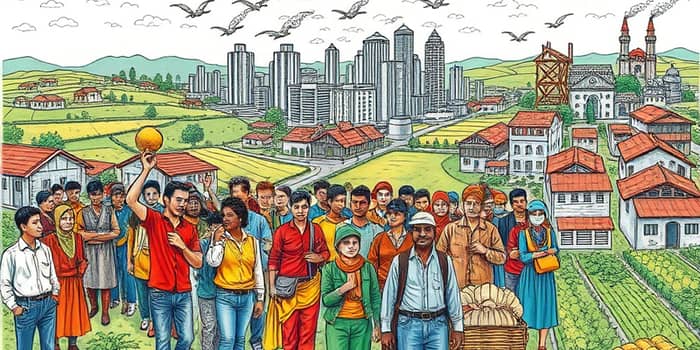
Migration has long been more than a demographic phenomenon; it is a powerful economic force that reshapes societies. It drives innovation, fills labor gaps, and bridges cultural divides. In recent years, unprecedented flows of people have redefined labor markets, fiscal health, and global growth trajectories. By examining the latest data and emerging trends, this article illuminates the broad impacts of migration on economies worldwide. Through a global lens, we will trace the threads that connect citizens and newcomers, and outline pathways toward sustainable, inclusive progress.
Global Trends in Migration
Between 2020 and 2024, the global migrant population swelled by 10.4% above previous estimates, far outpacing overall population growth. This surge demonstrates the resilience of mobility despite travel restrictions and pandemic disruptions.
OECD nations remain premier destinations for migrants. In 2024, permanent migration to these countries reached 6.2 million, marking a 4% decline from post-pandemic peaks. This slight downturn reflects both policy shifts and evolving labor demands.
Meanwhile, the United States has seen its immigrant share quintuple since 1965, reaching 53.3 million residents or roughly 15.8% of the population in January 2025. Even as inflows moderate, the cumulative effect of decades of migration continues to shape American demographics.
Shifting Dynamics in the United States
After peaking at 2.2 million net arrivals in 2024, U.S. net migration is projected to plunge to about 0.5 million in 2025—a staggering 75% drop. This shift results from a series of border restrictions, deportations, and the expiration of temporary work permits.
The Congressional Budget Office forecasts net migration falling by another one million in 2026 if current policies persist. Survey data also hints at a decline of 1.4 million foreign-born residents within the first half of 2025, though methodological caveats apply.
These changes ripple through the labor market. Immigration fueled most of the U.S. labor force growth in recent years. Without it, prime-age labor supply could stagnate or even shrink by 2042, undermining both economic expansion and fiscal stability.
Wage growth has been impacted by these shifts. Median real wage increases slowed by nearly half in 2025, partly because of lower competition and partly because overall demand weakened. Yet the long-term effect on wage inequality remains uncertain, hinging on policy choices and labor market flexibility.
Economic Impacts on Labor and GDP
Migrants contribute both workers and consumers, accelerating supply and demand forces simultaneously. In 2024, immigration drove job creation by 140,000–180,000 positions per month. By late 2025, that figure could dwindle to 10,000–40,000 jobs per month.
Employment growth in 2025 may register just 35,000 additional workers per month, compared to the 103,000 per month projected with higher immigration. The resulting gap underscores the critical role of newcomers in sustaining robust labor markets.
On the fiscal front, immigrants have historically bolstered the tax base and supported entitlement programs. Expanding high-skill migration could raise U.S. GDP by 4.6% and shave nearly $20 trillion off federal debt over three decades, according to some analyses.
However, restrictive policies could invert these gains. Reduced net migration threatens to lower GDP growth by up to 1.01 percentage points in 2025 and potentially by 0.49–1.49 points in 2027. Most of this shortfall stems from fewer border inflows rather than deportations themselves.
Interestingly, most models predict only modest inflationary changes, around 0.15 percentage points in 2025. This suggests that immigrant-driven growth can be absorbed without overheating the economy, particularly when paired with targeted monetary policies and investment in capacity expansion.
Sectoral and Fiscal Dimensions
Immigrants fill essential roles across sectors. In technology, medicine, and academia, they drive innovation and research breakthroughs. In agriculture, construction, and services, they ensure continuous production and customer support.
Sectors heavily reliant on migrant labor face acute labor shortages and rising costs when flows slow. Food processing plants, healthcare facilities, and logistics networks are among the hardest hit, leading to higher consumer prices and supply chain bottlenecks.
From a fiscal perspective, immigrants often contribute more in taxes than they receive in benefits, especially when integrated into the formal labor market. Their participation reduces dependency ratios and strengthens Social Security and Medicare funding.
Moreover, migrants often participate in frontline services and essential public functions, from teaching to caregiving. Their contributions alleviate pressure on aging workforces and support the provision of quality public services. Without them, many communities struggle to maintain schools, hospitals, and elder care facilities.
Policy Considerations and Future Outlook
Policymakers face a choice between restrictionist measures and strategic expansion of immigrant pathways. While tighter controls may offer short-term political gains, the long-term economic costs can be severe.
- Promote targeted high-skill visas to fill critical technology and healthcare gaps.
- Streamline work permit renewals for essential agricultural and service workers.
- Invest in integration programs that enhance skills and language proficiency.
- Monitor labor market trends to adjust quotas in real time.
Looking ahead, aging populations in most advanced economies mean that positive net migration will be indispensable for sustaining growth. By 2045, demographic models project that without immigrants, several G20 nations will face shrinking workforces and mounting pension burdens.
At a time when geopolitical tensions and economic uncertainties are rising, migration policies must be resilient and adaptable. Countries that succeed will be those that view newcomers as partners in progress, rather than as threats. By fostering collaboration between governments, businesses, and civil society, we can craft frameworks that maximize the benefits of migration while mitigating its challenges. This collaborative approach will require data-driven decision-making, transparent governance, and a commitment to human rights.
Ultimately, migration is not merely a policy issue but a reflection of our shared humanity. When managed wisely, labor mobility unlocks innovation, fuels productivity, and fosters cultural exchange. In a rapidly changing world, embracing migration as an economic asset may prove one of the most effective strategies for building resilient, inclusive societies.
References
- https://www.dallasfed.org/research/economics/2025/0708
- https://econofact.org/how-tighter-curbs-on-immigration-impact-the-u-s-economy
- https://www.minneapolisfed.org/article/2025/immigration-cant-explain-declining-employment-growth
- https://www.frbsf.org/research-and-insights/publications/economic-letter/2025/11/immigration-and-changes-in-labor-force-demographics/
- https://manhattan.institute/article/the-fiscal-impact-of-immigration-2025-update
- https://www.oecd.org/en/publications/2025/11/international-migration-outlook-2025_355ae9fd.html
- https://www.migrationpolicy.org/article/top-statistics-global-migration-migrants
- https://www.cbo.gov/publication/61735
- https://www.americanimmigrationcouncil.org/press-release/immigrants-keep-economy-strong-as-congress-debates-mass-deportation/