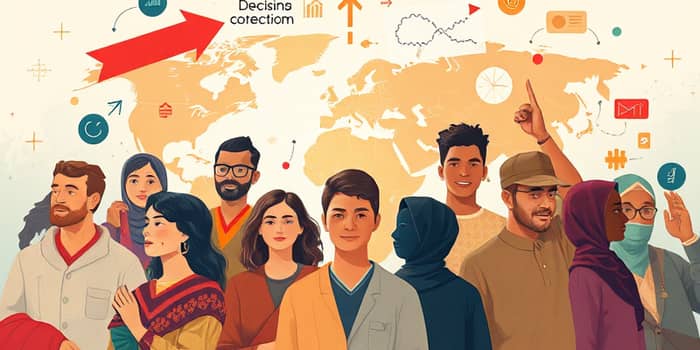
Every day, millions of decisions—from saving a few dollars to choosing a meal—are shaped not by cold calculation but by the subtle choreography of our minds. Behavioral economics peels back the curtain on these hidden forces, revealing how we actually decide, err, and adapt.
By weaving together stories from bustling markets in Nairobi to boardrooms in Berlin, this article illuminates the universal principles and local variations that underlie economic choices worldwide.
Core Principles: Rethinking Rationality
Traditional economic models portray humans as flawless calculators. Behavioral economics flips that script by studying how psychological, social, cognitive, and emotional factors steer decisions.
It challenges three cornerstone assumptions:
- Unbounded rationality
- Stable, context-independent preferences
- Pure self-interest maximization
Instead, individuals exhibit bounded rationality and bounded willpower, juggling limited attention, shifting desires, and social concerns.
From Foundations to Flourishing: Intellectual History
The field’s journey began with pioneers like Herbert Simon, who introduced bounded rationality, and Maurice Allais, who highlighted violations of expected utility.
Daniel Kahneman and Amos Tversky’s work on heuristics and Prospect Theory revolutionized our understanding of risk and reward. Richard Thaler popularized these insights through concepts such as mental accounting and the endowment effect.
Today, behavioral economics is taught at top universities and deployed in government “nudge units” around the world.
Mind Games Unveiled: Key Mechanisms
Let us explore the major cognitive patterns that drive economic behavior.
Prospect Theory and Loss Aversion
According to Prospect Theory, we evaluate gains and losses relative to a reference point and feel losses more intensely than gains.
This explains why we hold onto losing investments, buy insurance against rare events, and gamble on improbable jackpots.
Heuristics and Biases
Instead of exhaustive calculation, we rely on mental shortcuts. Our choices shaped by hidden biases often lead us astray.
- Availability heuristic
- Representativeness
- Anchoring
- Overconfidence
These tendencies influence everything from stock trading to job interviews and consumer purchases.
Time Inconsistency and Self-Control
We overweight immediate costs and benefits—known as present bias—leading to procrastination, undersaving, and avoidable health risks.
Hyperbolic discounting drives habits like missing credit-card payments or delaying a workout, even when long-term goals loom.
Social Preferences and Norms
Humans are inherently social. Concepts like fairness, reciprocity, and identity shape choices beyond dollars and cents.
Herd behavior and social comparison influence tax compliance, energy use, and charitable giving.
Choice Architecture and Nudges
By designing environments that guide decisions in predictable ways, policymakers and organizations deploy low-cost, choice-preserving policy interventions known as nudges.
From default organ donation to simplified enrollment forms, subtle tweaks can yield profound shifts in behavior.
Global Institutionalization: Nudge Units and Behavioral Hubs
Governments from Australia to Japan have established dedicated behavioral insights teams to incorporate evidence-based strategies into policy. Nonprofits like J-PAL, IPA, and Busara extend this work to underrepresented populations, ensuring interventions respect local languages and customs.
Behavioral Development Economics in the Global South
In low-income settings, the interplay of poverty, informality, and weak institutions magnifies behavioral patterns. Research shows that scarcity of money and mental bandwidth intensifies short-term decisions that can trap families in cycles of debt and missed opportunities.
Policy Innovations: Poverty, Health, and Education
Behavioral tools have been tailored to uplift communities around the world:
- Education: reminder texts and commitment devices to boost attendance
- Health: default vaccine appointments and SMS adherence prompts
- Agriculture: harvest-time discounts and peer-led information sessions
These interventions leverage timing, social proof, and simplified choices to drive lasting impact.
Regional and Cultural Perspectives
Chinese researchers are integrating behavioral insights with rapid urbanization and digital finance platforms, uncovering unique patterns in e-commerce and family-based saving behaviors.
Beyond WEIRD samples, global experiments validate core biases while adapting approaches to diverse cultural contexts.
Sectoral Applications: Markets, Finance, and Public Policy
In marketing, firms employ scarcity messaging, free trials, and loyalty frameworks to capture attention. Behavioral finance explores how overconfidence and herding fuel market bubbles and crashes.
Public policy harnesses social norms and feedback loops to improve tax payments, reduce energy consumption, and increase charitable donations.
Looking Forward: Ethical Considerations and Future Directions
As behavioral economics scales globally, ethical stewardship is crucial. Transparency, consent, and respect for autonomy must guide nudge design, ensuring that interventions empower rather than manipulate.
By blending rigorous science with empathetic understanding, practitioners can craft policies and products that align human nature with collective well-being.
Ultimately, behavioral economics offers not just explanations for our quirks, but a toolkit for designing a more inclusive and enlightened world. The real mind game lies in harnessing these insights to foster prosperity, resilience, and shared progress across every community on Earth.
References
- https://en.wikipedia.org/wiki/Behavioral_economics
- https://www.nationalacademies.org/read/26874/chapter/5
- https://www.en.mugtama.com/public/index.php/articles/6_examples_to_understand_behavioral_economics
- https://www.youtube.com/watch?v=6J37VPBaGtg
- https://www.ebsco.com/research-starters/economics/behavioral-economics-business
- https://thedecisionlab.com/insights/business/3-applications-of-behavioral-economics-in-the-real-world
- https://news.uchicago.edu/explainer/what-is-behavioral-economics
- https://pmc.ncbi.nlm.nih.gov/articles/PMC4871624/
- https://www.exploring-economics.org/en/orientation/behavioral-economics/
- https://pmc.ncbi.nlm.nih.gov/articles/PMC3680155/
- https://www.behavioraleconomics.com/resources/introduction-behavioral-economics/