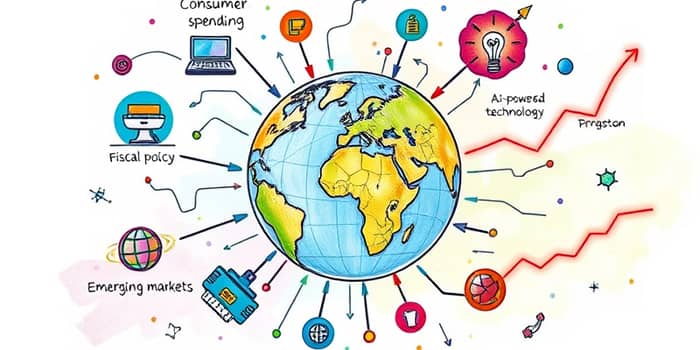
The global economy in 2026 stands at a crossroads of innovation, policy support, and consumer resilience. Despite trade tensions and lingering uncertainties, governments and business leaders are harnessing potent forces to sustain growth. This article delves into the projections, key drivers, regional nuances, risks, and practical strategies to navigate a dynamic economic landscape.
By understanding these momentum makers, readers will gain insights into how a culture of continuous innovation and learning can be fostered across sectors, how policies can be calibrated for impact, and how stakeholders can prepare for potential headwinds.
Global Growth Projections and Resilience
Multiple leading institutions forecast global GDP growth of approximately 2.7–3.3% in 2026, reflecting a steady yet cautious recovery from pre-pandemic norms. While slight variations exist—PwC at 2.7%, IMF at 3.3%, UN DESA at 2.7%, and UNCTAD at 2.7%—a consensus emerges around a broadly resilient expansion driven by private consumption, technology investment, and fiscal support.
Emerging markets continue to outpace advanced economies, led by India’s robust 6.6–7.8% trajectory. Advanced economies such as the United States and eurozone are projected to stabilize between 1–2.2%, buoyed by domestic spending and accommodative monetary policies.
Key Momentum Makers Shaping the Future
Across forecasts, five primary drivers—private consumption, fiscal policy, AI and technology investment, monetary easing, and structural reforms—emerge as the engines of growth. Each interacts with global trends and domestic circumstances to determine national outcomes.
- Private Consumption: Fueled by real wage gains, lower inflation, and robust labor markets, household spending remains the backbone of economic resilience.
- Government and Fiscal Policy: Expansionary budgets, infrastructure packages, and targeted tax cuts underwrite public investment and consumer confidence.
- AI and Technology Investment: Pioneering firms accelerate software, equipment, and high-tech exports, reinforcing productivity gains and global competitiveness.
- Monetary Easing: Rate cuts and accommodative financial conditions support credit flows, corporate profitability, and household borrowing capacity.
- Structural Reforms: Privatization, labor market modernization, and nearshoring initiatives drive long-term productivity and attract foreign investment.
Understanding the relative weight of each driver in different regions is crucial for stakeholders aiming to capitalize on growth pockets and mitigate vulnerabilities.
Regional Perspectives
Economic momentum varies significantly by region, shaped by local policies, structural characteristics, and external headwinds.
- United States: Growth of 2.0–2.2% led by consumer spending and fiscal easing. A potential Fed rate cut could lower borrowing costs and sustain demand.
- China: Moderation to 4.5%, constrained by property sector weakness but supported by fiscal stimulus and a firmer currency.
- India: A powerhouse at 6.6–7.8%, driven by consumption surges, manufacturing expansion, and stable inflation near 3%.
- Eurozone: Modest 0.2–1.4%, underpinned by labor market resilience and infrastructure spending but dampened exports.
- Latin America and Africa: Mixed recoveries, with Argentina rebounding to 3.5% and Africa averaging 4% on commodity demand and policy reforms.
Emerging markets overall outshine advanced economies, reflecting diversified portfolios to manage global uncertainty and proactive policy frameworks in many jurisdictions.
Headwinds and Risks Ahead
Despite robust drivers, several downside risks could slow momentum and increase volatility:
- Trade Policy Uncertainty: US tariffs and evolving trade agreements may dampen export growth and investment.
- Fiscal Constraints: Overextended budgets risk requiring consolidation that could undercut public investment.
- Inflation and Geopolitical Tensions: Persistent price pressures and regional conflicts could disrupt supply chains and investor confidence.
- Subdued Capital Expenditure: Property market corrections and limited corporate spending may restrain medium-term output gains.
Policymakers and investors should monitor these variables closely, as shifts can rapidly alter growth trajectories and market sentiment.
Building a Sustainable Economic Path
To reinforce resilience and foster inclusive prosperity, economies must embrace multi-pronged strategies:
First, prioritize long-term infrastructure and technology commitments that enhance productivity and unlock new growth corridors. Public-private partnerships can accelerate project delivery and innovation diffusion.
Second, adopt measured monetary adjustment to sustain growth while anchoring inflation expectations. Central banks should communicate clear forward guidance to avoid rate-shock episodes.
Third, encourage corporate and individual actors to diversify exposures across sectors and regions, promoting robust risk management. Financial institutions can lead by offering tailored instruments that hedge against currency, commodity, and interest rate fluctuations.
Finally, strengthen social safety nets and workforce development programs to ensure that technological advances and policy reforms yield broad-based benefits. Investments in upskilling and digital literacy will empower populations to thrive amidst rapid change.
By weaving together policy agility, technological adoption, and inclusive frameworks, stakeholders can navigate uncertainties and harness the full potential of the momentum makers driving global economic change in 2026 and beyond.
References
- https://www.deloitte.com/us/en/insights/topics/economy/global-economic-outlook-2026.html
- https://www.pwc.com/us/en/about-us/newsroom/press-releases/annual-outlook-2026.html
- https://www.imf.org/en/publications/weo/issues/2026/01/19/world-economic-outlook-update-january-2026
- https://desapublications.un.org/publications/world-economic-situation-and-prospects-2026
- https://rsmus.com/insights/economics/economic-outlook-for-2026.html
- https://unctad.org/publication/world-economic-situation-and-prospects-2026
- https://www.worldbank.org/en/publication/global-economic-prospects
- https://www.youtube.com/watch?v=TKR4OzTtcc4