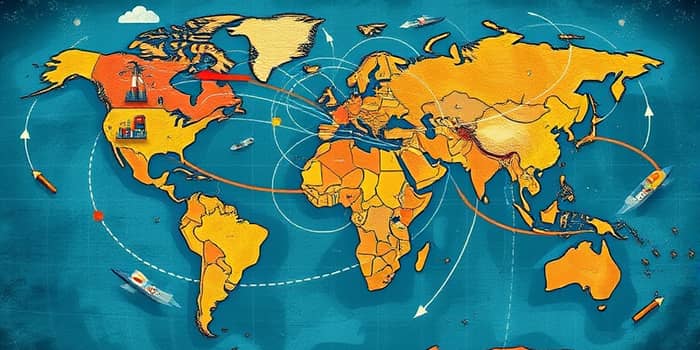
In an era of mounting tensions and shifting alliances, businesses and policymakers face unprecedented challenges. This article delves into the far-reaching economic impacts of today’s geopolitical upheavals and offers practical strategies to build resilience.
Overarching Trends and Global Shifts
Geopolitical instability is no longer confined to headlines; it is reshaping markets and industries worldwide. From the ongoing conflict in Ukraine to tensions in the South China Sea, wars and rivalries drive unpredictability.
Rising trade barriers have pushed global growth projections down to 2.3% in 2025, while the average US effective tariff rate has climbed to a historic 18.2% by July 2025. Companies are forced to rethink sourcing, production, and investment, accelerating deglobalization trends and emphasizing economic sovereignty.
Major Geopolitical Faultlines
Understanding the faultlines is essential for anticipating risks and seizing opportunities.
US-China Rivalry: Intensifying competition in trade, technology, and influence has led to proposed tariffs up to 60% on Chinese goods and protective measures on critical minerals. The decoupling drive creates supply chain fragmentation and complex business strategies.
Russia-Ukraine War: This conflict continues to unsettle European energy security, strain fiscal budgets, and spur market volatility. Western alliances are reevaluating energy sourcing to reduce reliance on Russian gas and oil.
Middle East Tensions: Renewed hostilities between Iran, Gulf states, and US involvement have elevated global energy prices. CEOs rank high energy costs as one of the top risks, driving shifts toward renewable investments.
Asia-Pacific Dynamics: The South China Sea and Taiwan Strait see increased military maneuvers, while regional governments scramble to secure critical minerals and diversify partners through friendshoring strategies.
Economic Impacts and Key Data
Geopolitical faultlines manifest in quantifiable economic disruptions.
Trade fragmentation has cost the global financial system up to $5.7 trillion, as supply chains regionalize to avoid punitive tariffs. Meanwhile, consumer inflation remains above pre-pandemic norms, fueled by high energy and food prices.
The technology sector, especially semiconductors, faces disruption from Taiwan Strait tensions and export controls. Central banks maintain elevated policy rates, limiting prospects for rapid rate cuts.
Corporate Responses and Strategies
Businesses are adapting through proactive measures to safeguard operations and maintain competitiveness.
- Reshoring and Localization: Shifting production closer to home markets reduces transport risk but raises costs and regulatory hurdles.
- Diversified Sourcing: Companies establish multiple suppliers across regions to enhance supply chain resilience and minimize single-source dependency.
- Strategic Partnerships: Engaging in bilateral agreements and friendshoring networks to secure critical inputs like rare earths and lithium.
These tactics, while costly, can shield firms from abrupt policy shifts and tariffs, fostering long-term stability.
National and Regulatory Responses
Governments are not passive observers; many pursue economic nationalism, enacting local content rules, tax incentives, and industrial subsidies. The US Inflation Reduction Act exemplifies how policy can redirect private capital into renewables.
However, protectionist overtones risk provocation of retaliatory tariffs, heightening the threat of a full-scale trade war. Companies must stay agile to adjust to sudden regulatory changes that affect market access and cost structures.
Financial Markets and Investment Flows
Policy uncertainty and conflict risk drive market volatility. Investors increasingly rely on real-time risk dashboards to monitor global flashpoints and adjust asset allocations accordingly.
- Renewable Energy: Record investments flow into clean technologies as countries seek energy security and carbon reduction.
- Strategic Minerals: Funds target overseas mining ventures to secure supply of rare earths critical for technology and defense industries.
Despite concerns, the US dollar remains dominant, even as some analysts foresee gradual depreciation over the medium term.
Building Resilience and Practical Guidance
For leaders and managers looking to navigate this landscape, adopting a resilience mindset is essential. Focus on:
- Scenario Planning: Regularly update risk assessments for major geopolitical flashpoints.
- Cross-Functional Collaboration: Align supply chain, finance, and strategy teams to respond swiftly.
- Digitalization: Leverage data analytics for real-time visibility into operations, costs, and supplier health.
Embedding geopolitical risk management into corporate DNA transforms uncertainty into strategic foresight, driving innovation and competitive advantage.
Future Outlook and Long-Term Opportunities
While fragmentation and nationalism present challenges, counter-trends of pragmatic cooperation persist among key allies. The Asia-Pacific region is poised to outpace Western economies as a growth engine, supported by demographic dynamism and investment in digital infrastructure.
Companies that balance profitability with adaptability—prioritizing resilience, diversification, and stakeholder engagement—will thrive. By integrating geopolitical risk assessment into every decision, leaders can reposition threats as catalysts for innovation and sustainable growth.
Navigating the complexities of 2025 and beyond demands foresight, flexibility, and an unwavering commitment to resilience. Those who rise to the challenge will not only weather the storms of geopolitics but emerge stronger and more agile in a transformed global economy.
References
- https://www.shrm.org/enterprise-solutions/insights/top-5-geopolitical-threats-to-businesses-2025
- https://www.spglobal.com/en/research-insights/market-insights/geopolitical-risk
- https://www.lazard.com/research-insights/top-geopolitical-trends-in-2025/
- https://www.weforum.org/stories/2025/08/inflection-points-7-global-shifts-defining-2025-so-far-in-charts/
- https://www.mckinsey.com/capabilities/strategy-and-corporate-finance/our-insights/economic-conditions-outlook
- https://kpmg.com/xx/en/our-insights/risk-and-regulation/top-risks-forecast-2025.html
- https://www.blackrock.com/corporate/insights/blackrock-investment-institute/interactive-charts/geopolitical-risk-dashboard
- https://www.ey.com/en_us/insights/geostrategy/2025-geostrategic-outlook