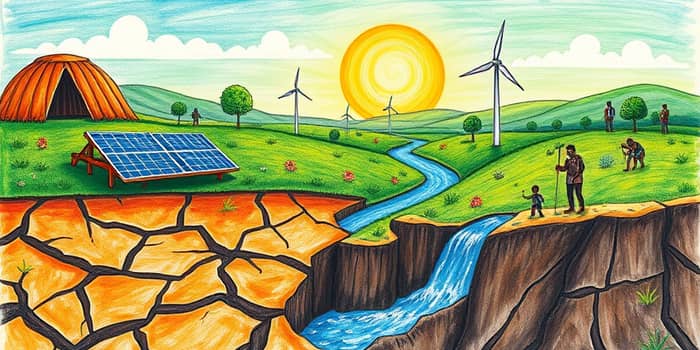
In today’s interconnected world, resource scarcity presents urgent economic challenges and compels societies to reimagine growth. From parched farmlands in sub-Saharan Africa to supply shortfalls of critical battery minerals, shortages threaten human welfare and planetary health. Yet, embedded within this crisis is an innovation catalyst across multiple sectors, inspiring breakthroughs that redefine resilience and prosperity.
The Scope and Urgency of Resource Scarcity
Resource scarcity refers to a shortage of critical resources—water, food, energy, and raw materials—vital for sustaining economic growth, human welfare, and environmental stability. Scarcity can be physical, when actual reserves dwindle; economic, when infrastructure or investment falls short; or geopolitical, when strategic control over distribution creates bottlenecks and tensions.
By 2025, an estimated 2.2 billion people will lack access to safely managed drinking water, and roughly half the global population may face water stress. Countries such as Pakistan, India, Ethiopia, Yemen, and Mexico already contend with severe shortages. In regions like the Horn of Africa, recurrent droughts affect millions, while in Central and South Asia, glacier melt reduces river flows, threatening agriculture and livelihoods.
Food scarcity is equally alarming. Over 295 million people experienced acute hunger in 2024, marking a record high. Conflict, economic crises, and climate-driven crop failures exacerbate vulnerability. Chronic undernourishment affects 820 million globally, while rising food demand—projected to increase 70% by 2050—stretches agricultural systems to their limits.
Raw materials and energy resources also strain under growing demand. Critical minerals like lithium and rare earth elements are indispensable for renewable energy technologies, yet current extraction rates fall far below what’s needed. To meet battery demands alone, material extraction must triple by 2030. Simultaneously, transitioning to low-carbon energy requires $3 trillion in investments for carbon capture, utilization, and storage by 2050—an ambitious figure set against dwindling funding.
Meanwhile, Earth Overshoot Day—the date when humanity’s demand on nature exceeds the planet’s capacity for regeneration—fell on July 24, 2025. This milestone underscores how we exhaust annual natural budgets before year-end, raising concerns over ecosystem resilience and long-term stability.
Economic Consequences of Scarcity
Scarcity drives supply-demand imbalances and rising premiums that ripple across economies. As water, food, and energy prices escalate, manufacturers face higher input costs, farmers struggle with unpredictable yields, and utilities incur expenses for alternative sources or infrastructure upgrades.
The resulting inflation affects consumers directly. In low-income regions, families may spend over 50% of income on basic necessities, deepening poverty and curtailing economic mobility. In wealthier economies, inflationary pressures prompt central banks to raise interest rates, potentially triggering recessions and unemployment spikes.
Resource shortages also disrupt global supply chains. For instance, semiconductor production relies on specific materials such as silicon and rare earth metals. Shortfalls in these inputs can stall electronics manufacturing, delaying product launches and eroding company revenues.
- Job insecurity and slowed growth emerge as industries cut back on production.
- Governments face mounting pressure to subsidize essential goods, straining public budgets.
- Trade barriers and export restrictions may arise as nations prioritize domestic needs.
- Populations vulnerable to displacement—estimated at 700 million due to water scarcity—face humanitarian crises.
Drivers of Resource Scarcity
- Climate change intensifies droughts, floods, and heatwaves, reducing water availability and crop productivity.
- Rapid population growth—to 8.5 billion by 2030—amplifies pressure on finite resource systems.
- Pollution from industrial waste and agricultural runoff degrades soil and freshwater ecosystems.
- Geopolitical conflicts over strategic resources, such as lithium in South America or rare earths in Southeast Asia, trigger supply volatility.
Technological and Policy Innovations
Facing escalating scarcity, innovators across sectors deploy a spectrum of solutions. These range from cutting-edge technologies to policy frameworks designed to foster efficient, equitable, and sustainable resource use.
Some of the most impactful approaches include:
- Solar-powered pumps provide safe drinking water to remote communities, bypassing fossil-fuel dependencies.
- Circular economy models emphasize reuse, recycling, and waste reduction, extending the life cycle of materials.
- Substitution strategies in battery chemistry replace cobalt with aluminum or manganese, lowering the environmental footprint of electric vehicles.
- Regenerative agriculture projects in Kenya rebuild soil health through agroforestry techniques, increasing resilience to droughts and improving local incomes.
- Trade reforms, such as the EU Critical Raw Materials Act, diversify supply chains and ensure fair access during crises.
- Government incentives, including tax credits and direct subsidies, mobilize private capital toward renewable infrastructure and water purification technologies.
- Social innovation harnesses creativity to adapt tools and processes under constraint through collaborative networks.
- International cooperation, like the Global Mineral Security Partnership, fosters research into alternative materials and shared governance models.
Debates and Future Directions
While scarcity propels innovation, it also sparks critical debates. Should economies shift from GDP metrics toward wellbeing and ecological health? Advocates of steady-state economics and natural capital valuation call for recalibrating success metrics to reflect nature’s limits.
Another contention lies between rapid crisis response and systemic transformation. Emergency measures—rationing water or subsidizing food—are vital in the short term but may divert funds from deeper structural reforms. Policymakers must balance immediate relief with investments in resilient infrastructure and education.
Global equity considerations further complicate decisions. Developing nations argue that historical emissions and resource consumption by wealthier countries justify differentiated responsibilities and access rights. Aligning climate, trade, and development policies is essential to ensure fairness and security.
Conclusion: Embracing Innovation and Equity
Resource scarcity, while imposing formidable economic and social challenges, also ignites an unprecedented wave of creativity and collaboration. From solar pumps on parched fields to circular factories reclaiming industrial byproducts, solutions illustrate humanity’s capacity for adaptation.
Success hinges on integrating technological advances with robust policies and inclusive governance. By rethinking growth through the lens of sufficiency and resilience, societies can navigate scarcity without sidelining progress. The imperative is clear: transform scarcity into opportunity, foster partnerships across sectors, and build a future where innovation thrives amid constraint and equity guides every decision.
As stakeholders—governments, businesses, communities—embrace these principles, they lay the foundation for a sustainable world where resources serve all generations fairly and effectively.
References
- https://www.fsinplatform.org/report/global-report-food-crises-2025/
- https://www.bcg.com/publications/2021/identifying-resource-scarcities
- https://humannecessityfoundation.com/water-scarcity-in-2025/
- https://pmc.ncbi.nlm.nih.gov/articles/PMC8747850/
- https://earth.org/the-biggest-environmental-problems-of-our-lifetime/
- https://climate.sustainability-directory.com/term/resource-scarcity-impacts/
- https://www.wri.org/insights/circular-economy-global-progress
- https://www.fundssociety.com/en/opinion/how-can-the-global-economy-adapt-to-resource-scarcity-2/
- https://planetaryhealthalliance.org/themes/resource-scarcity/
- https://www.kuka.com/en-us/future-production/megatrends/scarcity-of-resources
- https://knowledge4policy.ec.europa.eu/foresight/topic/aggravating-resource-scarcity/more-developments-relevant-aggravating-resource-scarcity_en
- https://fiveable.me/key-terms/introduction-engineering/resource-scarcity
- https://www.footprintnetwork.org/our-work/earth-overshoot-day/
- https://www.weforum.org/publications/global-risks-report-2025/in-full/paste-test/
- https://www.worldwildlife.org/our-work/freshwater/water-scarcity/
- https://worldpopulationreview.com/country-rankings/countries-with-water-scarcity