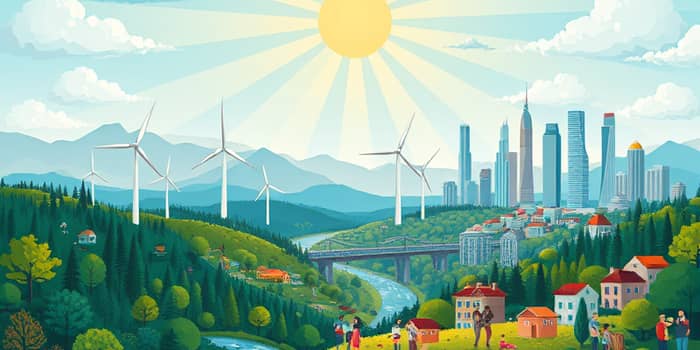
As the world enters the final five years leading to 2030, a powerful transformation is underway. Nations, communities, and organizations are racing to weave environmental stewardship and economic prosperity into a cohesive tapestry. With the clock ticking, urgent collective action is essential to secure a resilient future.
The Sustainable Development Goals remain the world’s guiding framework. From 193 UN member states to hundreds of local governments, the ambition to integrate ecology and economy has never been stronger. Yet, the path forward is fraught with challenges, inequalities, and hard tradeoffs.
The Ecological-Economic Integration Paradox
At the heart of global strategy lies a paradox: how to pursue robust economic growth while safeguarding our planet’s life systems. This balance demands innovation, policy reform, and cultural shifts.
Many countries struggle to reconcile short term gains with long term sustainability. Investing in infrastructure, industry, and digital transformation must go hand in hand with restoring ecosystems, curbing emissions, and protecting biodiversity.
Success depends on reimagining metrics of progress. Beyond GDP, nations must adopt holistic measures of wellbeing and resilience. This shift unlocks pathways to growth that complement, rather than compromise, nature.
Six Priority Action Areas
The Sustainable Development Report 2025 identifies six critical domains where ecological integration and economic strategy intersect most powerfully. Targeted action in these areas can create exponential benefits.
- Food systems: promoting sustainable agriculture and reducing waste
- Energy access: expanding renewable power to all communities
- Digital transformation: harnessing technology for environmental management
- Education: equipping learners with sustainability skills
- Jobs and social protection: ensuring decent work in green sectors
- Climate and biodiversity: strengthening resilience and conservation
Mobilizing resources and expertise across these sectors will determine if we can tip the scales towards a truly sustainable future.
Regional Successes and Disparities
Progress on the 17 SDGs is uneven. Europe leads with Finland, Sweden, and Denmark among the top performers. East and South Asia have surged ahead, propelled by rapid socioeconomic development and targeted policies.
Yet many regions lag. Sub Saharan Africa and parts of Latin America and the Caribbean struggle with poverty, disease, and infrastructure gaps. Even top performers face challenges in climate and biodiversity goals.
This snapshot underscores the diversity of experiences. Each region must tailor approaches to its unique ecological and economic contexts.
Radiant Examples of Progress
Despite daunting barriers, stories of transformation illuminate the way forward. Renewable energy now towers as the fastest growing source of power worldwide. In 2025, 45 countries achieved universal electricity access and 54 eliminated neglected tropical diseases.
- Bridged the digital divide with affordable connectivity
- Expanded education enrollment and literacy rates
- Reduced malaria and HIV burdens by pioneering health systems
These achievements demonstrate that when vision, policy, and funding align, rapid gains are possible.
Facing the Critical Barriers
No journey towards sustainability is free of obstacles. Persistent challenges threaten to derail progress if left unaddressed.
- Extreme poverty and hunger still afflict millions
- Conflict and instability disrupt development efforts
- Debt burdens limit long term investment capacity
- Inequalities marginalize vulnerable communities
- Climate chaos intensifies resource scarcity
Overcoming these intertwined barriers requires innovative finance, policy coherence, and unwavering political will.
Financing the Future: Closing the Gaps
Financing remains the most formidable bottleneck. Despite billions pledged, global public goods remain underfunded. Roughly half the world’s population resides in countries unable to invest adequately in sustainable development.
The Fourth International Conference on Financing for Development highlighted the need for a reformed global financial architecture. Lowering borrowing costs, expanding green bonds, and leveraging private capital are critical steps to unlock the resources needed for SDG success.
Strategic partnerships between public and private sectors can generate fresh flows of climate finance and social investments, propelling both economic growth and environmental recovery.
Local to Global: Leveraging Multi level Action
National Voluntary Reviews and Voluntary Local Reviews provide vital accountability frameworks. As of March 2025, 190 of 193 countries submitted national plans and 249 local governments reported progress.
Local leaders are the vanguard of innovation. From urban rewilding projects to community renewable microgrids, subnational action showcases practical models that can be scaled worldwide.
By connecting local insights with global policy dialogues, the world can foster a virtuous cycle of learning, adaptation, and impact.
The Road Ahead: Strategies for 2030
With only five years left, the race to 2030 demands bold, coordinated strategies. The following pathways can accelerate progress:
First, mainstream green finance into national budgets. Removing subsidies for fossil fuels and redirecting funds towards clean energy unlocks transformative opportunities.
Second, integrate sustainability into education curricula. Empowering young people with environmental literacy builds a generation of changemakers capable of navigating complexity.
Third, harness digital tools for real time monitoring and optimization of resource use. Data driven decision making enhances efficiency and transparency.
Fourth, reinforce social protections to ensure no one is left behind. Targeted support for marginalized groups magnifies the benefits of economic growth.
Finally, foster inclusive multilateralism. Collaborative platforms that amplify voices from all regions, sectors, and communities strengthen the collective capacity to meet shared goals.
As the countdown to 2030 intensifies, the integration of ecology and economy must shift from aspiration to actuality. By embracing collaborative innovations and shared responsibilities, humanity can chart a course towards sustainable prosperity for all.
The challenge is immense, but the potential rewards—thriving ecosystems, resilient societies, and inclusive economies—are within reach. Now is the moment to act decisively, united by a common vision: a sustainable future where nature and humanity flourish in harmony.
References
- https://unstats.un.org/sdgs/report/2025/
- https://sdgtransformationcenter.org/reports/sustainable-development-report-2025
- https://dashboards.sdgindex.org
- https://dashboards.sdgindex.org/rankings/
- https://www.who.int/publications/i/item/9789240110496
- https://www.undp.org/sustainable-development-goals
- https://ourworldindata.org/sdgs