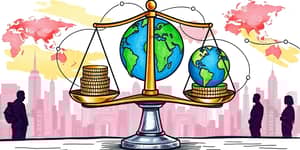
At a time when economies weave complex narratives of growth, disruption, and transformation, forecasting emerges as both an indispensable tool and a profound challenge. Through a blend of art and science, analysts strive to anticipate shifts in GDP, inflation, and sectoral trajectories.
These projections not only shape government policies but also guide corporate strategy and individual investments amid persistent global disruptions in trade and policy uncertainty.
The Foundation: Art Meets Science
Economic forecasting stands at the crossroads between quantitative rigor and human judgment. While econometric and statistical models crunch historical data, expert insights validate assumptions and calibrate expectations.
Forecasters combine advanced techniques—from time-series analysis to machine learning—with scenario planning to capture a range of possible futures. This integration of quantitative methods and qualitative judgment ensures that forecasts remain grounded in reality while sensitive to emerging risks.
In this evolving discipline, reliable forecasts underpin critical decisions across public and private sectors.
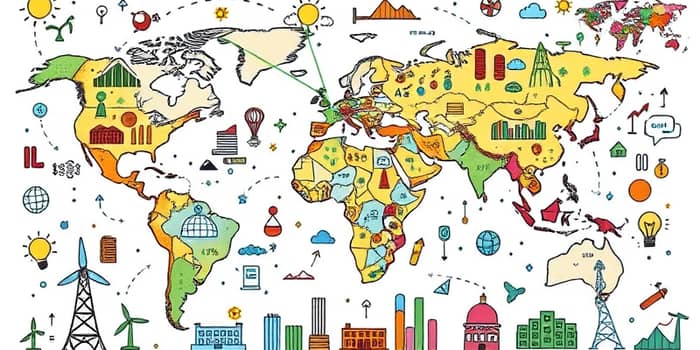
Mapping the Global Macroeconomic Landscape
Global GDP growth has moderated, with the IMF projecting 3.2% in 2025 and 3.1% in 2026. Inflationary pressures, once peaking above 4.5%, are expected to ease toward 3.6% by 2025 as central banks calibrate monetary policy.
However, advanced economies face lower momentum—hovering near 1.5% growth—while emerging markets sustain rates above 4%, led by vibrant activity in Asia.
These divergent trajectories reflect a world in flux, where regional dynamics and policy frameworks yield widely varying outcomes.
Sectoral Megatrends: Energy, Technology, and Finance
The energy transition is in full force, with global clean energy investment hitting $2 trillion in 2024. Renewables now supply over one-third of world electricity, and technologies like offshore wind, green hydrogen, and circular economy solutions offer a potential $7.9 trillion annual value by 2050.
Meanwhile, the digital revolution reshapes industry: smart manufacturing revenues could reach $350 billion in 2025, while Industry 5.0 applications may hit $658 billion by 2030. Data-driven insights and scenario analysis guide firms as they navigate automation, IoT expansion, and 5G deployments.
In finance, ESG considerations dominate. The green bond market soared to $2 trillion in 2025, and ESG assets are forecasted to hit $40 trillion by 2030. Investors increasingly reward sustainable strategies, linking capital flows to climate goals and social impact.
The mobility sector also transforms: electric vehicle sales are set to exceed 20 million in 2025, representing more than a quarter of all new car sales, and the shared mobility market could reach $815 billion by 2032.
Innovations in Forecasting Methodologies
Traditional statistical and econometric frameworks remain foundational, yet forecasters are innovating rapidly. Scenario analysis models explore tariff shocks, energy price swings, and financial corrections under various conditions.
Importantly, AI-driven forecasting models are reshaping the field. Machine learning algorithms ingest vast datasets—from satellite imagery to online prices—and uncover patterns that elude classical methods. The emerging “AI Economy Score” now delivers robust predictions for GDP and employment indicators.
Real-time “nowcasting” tools such as the Atlanta Fed’s GDPNow harness high-frequency financial and survey data to bridge the gap between official releases, enabling more agile decision-making. Additionally, dynamic regional weighting strategies ensure that global aggregates accurately reflect shifts in economic center of gravity.
Policy Divergences and Geopolitical Shifts
Monetary policy diverges sharply: the US Federal Reserve remains cautious as it watches inflation, while the ECB pursues gradual easing. Japan anticipates modest tightening by 2026, signaling a broader normalization trend.
Trade realignment continues, with rising protectionism and reshored supply chains altering investment flows. Major powers adopt mercantilist policies, prompting businesses to reassess sourcing strategies and build resilience against potential disruptions.
The interplay between geopolitical tensions and economic policy underscores the importance of flexible frameworks that can absorb shocks and pivot as circumstances change.
Risks and Opportunities Ahead
Forecasters identify multiple downside risks that could derail growth trajectories:
- Policy uncertainty and persistent protectionism
- Energy and commodity price shocks
- Financial market corrections and debt vulnerabilities
- Institutional erosion and geopolitical conflict
Yet opportunities abound for those who embrace innovation and sustainability:
- Technological innovation as a growth driver
- Green transition unlocking new markets
- Emerging economies—particularly India—leading demand expansion
- Circular economy models creating long-term value
By focusing on resilient supply chains, investing in clean technologies, and leveraging data-rich forecasting tools, stakeholders can position themselves to capitalize on these trends.
Conclusion and Steps for Stakeholders
Economic forecasting is evolving in tandem with the very trends it seeks to predict. As volatility persists, medium- and long-term adaptability will be the hallmark of successful strategies.
For policymakers: prioritize data transparency, invest in digital infrastructure, and align regulatory frameworks with sustainable growth objectives.
For businesses: integrate AI-driven insights into planning cycles, diversify supply chains, and embed ESG criteria into core strategies.
Investors should balance portfolios across traditional assets and emerging sectors—clean energy, smart manufacturing, and digital services—while monitoring risk indicators closely.
Ultimately, mastering the art of economic forecasting requires a holistic approach that blends advanced analytics, expert judgment, and a deep understanding of global megatrends. With robust methodologies and a forward-looking mindset, stakeholders can navigate uncertainty and seize opportunities in a rapidly changing world.
References
- https://www.mckinsey.com/capabilities/strategy-and-corporate-finance/our-insights/economic-conditions-outlook
- https://skaleegenkapital.com/2025-2030-global-economy-forecast/
- https://www.weforum.org/publications/chief-economists-outlook-september-2025/
- https://www.startus-insights.com/innovators-guide/global-megatrends-full-guide/
- https://www.imf.org/en/publications/weo/issues/2025/10/14/world-economic-outlook-october-2025
- https://www.imf.org/en/publications/weo/issues/2025/07/29/world-economic-outlook-update-july-2025
- https://www.spglobal.com/market-intelligence/en/solutions/products/economics-analysis-forecasting
- https://www.ey.com/en_us/insights/strategy/global-economic-outlook
- https://www.atlantafed.org/cqer/research/gdpnow
- https://www.weforum.org/publications/the-future-of-jobs-report-2025/
- https://www.oxfordeconomics.com/key-themes-2025/
- https://www.imf.org/en/Publications/WEO/Issues/2025/10/14/world-economic-outlook-october-2025
- https://www.worldbank.org/en/publication/global-economic-prospects
- https://www.kearney.com/service/global-business-policy-council/global-economic-outlook
- https://www.nber.org/conferences/si-2025-forecasting-empirical-methods
- https://www.conference-board.org/publications/global-economic-forecast-update
- https://www.conference-board.org/publications/global-economic-outlook-2025-to-2039-opportunities-caveats-uncertainties
- https://www.oecd.org/en/publications/2025/09/oecd-economic-outlook-interim-report-september-2025_ae3d418b.html