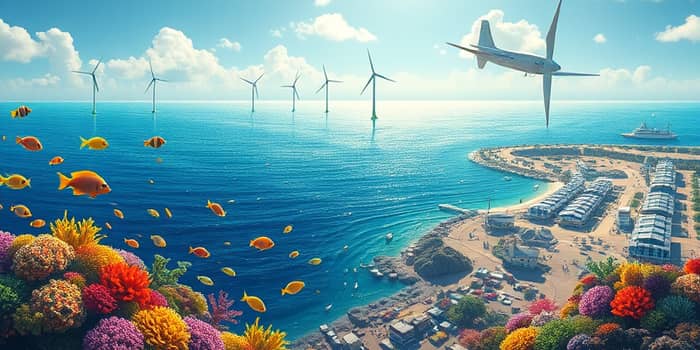
The world’s oceans hold untapped potential to drive prosperity while safeguarding marine health. By forging a balanced path, communities can harness waves of opportunity without sacrificing the delicate ecosystems beneath the surface.
In this article, we explore how the blue economy can transform livelihoods, power innovation, and align with global sustainability goals.
Understanding the Blue Economy
The blue economy embodies the sustainable use of ocean resources for economic growth, social equity, and ecosystem resilience. It transcends traditional industries by weaving together fisheries, maritime transport, and tourism with cutting-edge fields like offshore renewable energy and marine biotechnology.
Central to this concept is the idea of preserving the health of ocean ecosystems. Aligning closely with SDG 14—Life Below Water—the blue economy integrates environmental sustainability and social justice, ensuring that coastal communities thrive without depleting their natural heritage.
Economic Value and Potential
Oceans generate immense economic value. With an estimated asset worth of US$24 trillion and annual goods and services valued at US$2.5 trillion, the ocean ranks as the world’s seventh-largest economy. Sectors have expanded 2.5-fold since 1995, outpacing the global average.
This vast wealth supports over 100 million jobs globally, with some estimates reaching 600 million livelihoods—underscoring how innovative marine-derived pharmaceuticals and traditional fisheries alike bolster food security and employment.
- Total ocean asset value: US$24 trillion
- Annual ocean goods & services: US$2.5 trillion
- Contribution to global GDP: 3–4%
- Jobs supported: 100–600 million
- Aquaculture’s share of fish supply: 58%
These numbers reveal both the current magnitude and the promise of future growth as new markets emerge in wave energy, marine biotechnology, and beyond.
With projections to reach US$3 trillion by 2030, the blue economy presents an unparalleled avenue for sustainable development and resilience, particularly for Small Island Developing States and coastal nations.
Key Sectors Driving Growth
The blue economy encompasses marine and coastal tourism alongside staple industries and pioneering ventures. Traditional sectors such as fisheries, aquaculture, and maritime transport remain foundational, while forward-looking fields unlock new value streams.
- Fisheries and aquaculture: providing essential protein and jobs worldwide
- Maritime transport and ports: facilitating 80% of global trade by volume
- Marine and coastal tourism: accounting for one-third of ocean exports
- Offshore renewable energy and blue carbon: harnessing wind, wave, and carbon sequestration
- Marine biotechnology and bioprospecting: discovering novel compounds for medicine
By diversifying portfolios and fostering technology transfer, governments and businesses can amplify returns while distributing benefits equitably across regions.
Addressing Environmental Challenges
Despite its promise, the ocean economy faces acute threats: overfishing, habitat destruction, pollution, acidification, and rising sea temperatures. Each year, some 2 million tons of plastic enter marine environments, endangering wildlife and human health.
Recognizing that over two-thirds of ocean value hinges on healthy ecosystems, stakeholders must invest in restoration. Marine protected areas, sustainable fishing quotas, and circular waste management are vital to reversing degradation before critical services collapse.
Policy, Governance, and Blue Justice
Effective governance demands multi-level collaboration—local communities, national agencies, and international bodies working in concert. Key frameworks include the UN Sustainable Development Goal 14 and regional blue economy strategies championed by the EU, Commonwealth, and Pacific alliances.
Central to this is the concept of blue justice, ensuring small-scale fishers and marginalized groups gain fair access to resources. Transparent decision-making, rights-based management, and inclusive platforms prevent disenfranchisement and support long-term sustainability.
Action Plans for a Sustainable Future
To unlock the blue economy’s full potential, stakeholders must commit to strategic action across sectors. An eight-point plan endorsed by leading NGOs and financial institutions provides a roadmap for recovery and growth.
- Embed ocean recovery in national development agendas
- Act decisively on climate change mitigation and adaptation
- Expand protection of coastal and marine areas
- Invest in science, data, and innovation for ocean health
- Strengthen small-scale fisheries and coastal community rights
- Foster cross-sector, multi-level collaboration
- Support sustainable financing mechanisms and blue bonds
- Implement transparent accounting of ocean assets to guide policy
Individuals and businesses can also contribute by reducing single-use plastics, supporting sustainable seafood, and advocating for marine conservation in their communities.
Looking Ahead: The Horizon of Blue Growth
As we chart the course toward a regenerative future, the blue economy offers a beacon of hope. Emerging technologies—autonomous monitoring drones, genetic breakthroughs in marine organisms, and next-generation floating solar platforms—promise to redefine the boundaries of possibility.
By embracing a holistic integration of economy and ecology, humanity can secure both prosperity and planetary health. The time is now to turn the tide: to cultivate oceans of opportunity while healing the waters that sustain us all.
References
- https://en.wikipedia.org/wiki/Blue_economy
- https://wwf.panda.org/es/?244970%2FOcean-wealth-valued-at-US24-trillion-but-sinking-fast
- https://www.lse.ac.uk/granthaminstitute/explainers/what-is-the-blue-economy/
- https://www.greeneconomycoalition.org/news-and-resources/are-our-oceans-worth-24-trillion
- https://www.energy.gov/eere/water/powering-blue-economy
- https://unctad.org/news/fast-growing-trillion-dollar-ocean-economy-goes-beyond-fishing-and-shipping
- https://www.oecd.org/en/blogs/2025/03/10-ocean-economy-facts-you-need-to-know.html
- https://www.worldbank.org/en/news/infographic/2017/06/06/blue-economy
- https://oceanservice.noaa.gov/facts/oceaneconomy.html
- https://www.congress.gov/crs-product/IF12188
- https://www.oceaneconomics.org/NOEP/Market/ocean/OESsearch.aspx
- https://thecommonwealth.org/bluecharter/sustainable-blue-economy
- https://www.worldbank.org/en/topic/oceans-fisheries-and-coastal-economies
- http://sdgs.un.org/topics/oceans-and-seas