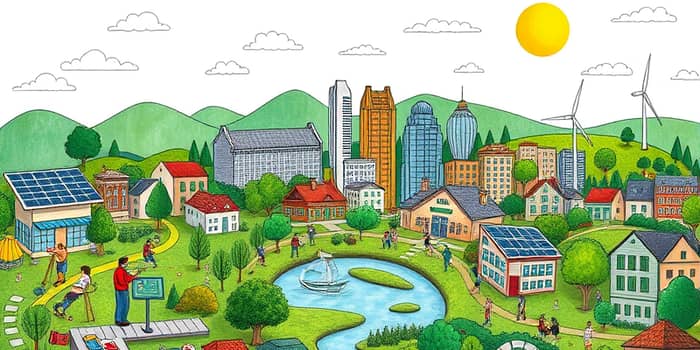
Humanity stands at a crossroads. A throwaway culture fueled by the traditional “take-make-waste” model has led to unprecedented resource strains and environmental crises. Yet a transformative alternative exists: the circular economy. By reimagining production and consumption as a set of closed loops, we can preserve our planet’s bounty, bolster resilience, and unlock vast economic opportunities.
Understanding the Circular Economy: Principles and Definitions
The circular economy is a regenerative economic system designed to minimize waste and pollution by keeping materials in continuous use. It contrasts sharply with the linear approach, which extracts finite resources and discards them as waste.
At its core lie three interdependent principles:
- Waste and pollution are designed out of systems.
- Products and materials are kept in use for as long as possible.
- Natural systems are regenerated.
Practically, this translates into strategies like reuse, repair, refurbishment, remanufacturing, and closed-loop recycling—each step retaining value while reducing environmental harm.
Economic and Environmental Impact
Adopting circular strategies at scale promises both economic prosperity and substantial environmental gains. According to the Ellen MacArthur Foundation, global circular approaches could unlock trillions in economic value, delivering £3.4 trillion (US$4.1 trillion) by 2030. Yet today, more than 91 percent of materials are wasted after a single use.
Emissions reductions would be dramatic. A full shift could reduce carbon emissions by 22.8 billion tons, equivalent to nearly 39 percent of 2019’s total. Targeting key sectors—cement, aluminum, steel, plastics, and food—could cut 9.3 billion metric tons of CO₂e, roughly matching current global transport emissions.
- Enhanced economic resilience through diversified supply chains and material security.
- Innovative business models that increase consumer engagement and loyalty.
- Job creation in services, repair, recycling, and remanufacturing.
Policy Landscape and Regional Strategies
National and regional policies are accelerating circular transitions. In the European Union, the Circular Economy Action Plan under the Green Deal mandates closed-loop material flows and sustainable product design. France enforces repairability indices, compelling manufacturers to prioritize durability.
China integrated circularity into its Five-Year Plans, improving industrial efficiency and urban planning for waste management. The Netherlands aims to be fully circular by 2050, already reducing its material footprint through smart procurement and recycling targets.
Innovations in the Global South illustrate diverse pathways. In Nigeria, ColdHubs uses solar-powered cold storage to slash food spoilage, saving 42,000 tonnes in 2020. Seoul’s RFID-enabled smart bins cut landfilled food waste by 47,000 tonnes over six years, demonstrating the power of technology-driven stewardship.
Corporate Leaders Driving Change
Forward-thinking companies are embedding circularity into their operations, showcasing innovative business models that maintain material value and create new revenue streams.
These leaders underscore how circular strategies can deliver both environmental stewardship and robust financial performance.
Sectoral Innovations and Case Studies
Across industries, pioneers illustrate the versatility of circular solutions:
Manufacturing and Supply Chain: Closed-loop supply systems shield firms from resource price volatility and geopolitical risks. By recovering metals from end-of-life electronics, companies reduce dependency on mined raw materials.
Packaging: Biodegradable and reusable packaging materials are scaling rapidly. Innovative films derived from agricultural byproducts replace single-use plastics in both consumer and industrial contexts.
Mobility and Infrastructure: The Netherlands’ bicycle policy—with 20,000 km of cycle lanes and 23 million bikes for 17 million residents—demonstrates how urban design fosters sustainable transport, energy savings, and vibrant public life.
Food Systems: Urban farming initiatives transform organic waste into nutrient-rich soil. Smart bins, composting facilities, and decentralized micro-farms are emerging in major cities worldwide.
Challenges and Barriers to Adoption
Despite clear benefits, large-scale circular adoption faces hurdles. A systemic shift demands new policy frameworks, supply chain redesign, and shifts in consumer mindsets. Upfront investment and complex end-of-life logistics further complicate progress.
- Lack of harmonized regulations across borders and sectors.
- Limited consumer awareness of repair and reuse options.
- Initial capital costs deter many small and medium enterprises.
Overcoming these obstacles requires cross-sector collaboration, targeted incentives, and transparent reporting to build trust and drive momentum.
Future Outlook and Collective Action
The global momentum behind the circular economy is unmistakable. As climate policies tighten and resource constraints intensify, circularity offers a pathway to decouple economic growth from resource use and align with post-2030 sustainability goals.
Individuals, businesses, and governments all have roles to play. Consumers can choose durable products and embrace sharing platforms. Companies can reengineer products for repair and recycling. Policymakers can enact strong incentives, mandates, and infrastructure investments.
Together, we can reimagine prosperity—one that values regeneration over extraction, resilience over vulnerability, and collaboration over competition. The journey toward a truly circular economy is complex, but its promise—a healthier planet and equitable growth—compels us to act now.
References
- https://www.reconomy.com/circular-economy/
- https://www.weforum.org/stories/2023/03/9-examples-circular-economy-accelerating-transition/
- https://en.wikipedia.org/wiki/Circular_economy
- https://www.sap.com/blogs/6-examples-of-circular-economy-concepts
- https://www.ellenmacarthurfoundation.org/topics/circular-economy-introduction/overview
- https://penfriend.ai/blog/circular-economy-business-examples
- https://www.unepfi.org/pollution-and-circular-economy/circular-economy/
- https://stateofgreen.com/en/news/10-examples-of-circular-economy-solutions/
- https://climatepromise.undp.org/news-and-stories/what-is-circular-economy-and-how-it-helps-fight-climate-change
- https://www.ellenmacarthurfoundation.org/topics/circular-economy-introduction/examples
- https://www.wrap.ngo/taking-action/climate-change/circular-economy
- https://www.startus-insights.com/innovators-guide/circular-economy-examples/
- https://www.weforum.org/stories/2024/02/how-manufacturers-could-lead-the-way-in-building-the-circular-economy/
- https://www.techtarget.com/sustainability/feature/Real-world-examples-of-the-circular-economy
- https://web.stratxsimulations.com/recent-posts/five-companies-embracing-the-circular-economy