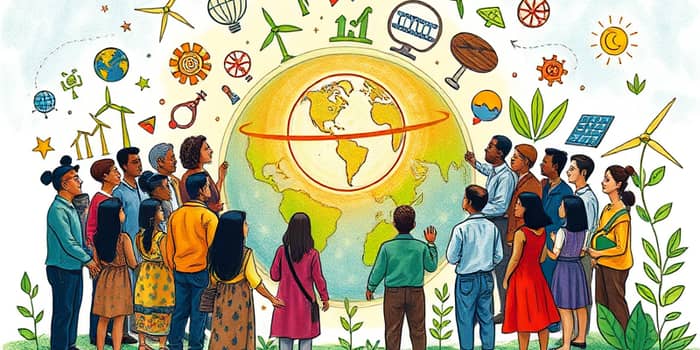
At the dawn of 2026, economies around the globe stand at a crossroads. While growth is projected to moderate to 2.7%, real incomes and livelihoods remain under pressure due to persistent inflationary strains and fiscal constraints. In this dynamic environment, stakeholders must adopt a comprehensive strategy that aligns economic recovery with environmental stewardship and social equity.
This blueprint draws on the latest forecasts and policy recommendations to provide a clear pathway toward a resilient, inclusive, and sustainable global economy. Whether you are a policymaker, business leader, or concerned citizen, you will find actionable insights and inspiring narratives to guide collective action.
Global Growth Outlook: Navigating Uncertain Times
Global GDP growth is set to ease from 2.8% in 2025 to 2.7% in 2026, remaining below the pre-pandemic trend of 3.2%. Several factors contribute to this deceleration: tightening fiscal space in many countries, supply chain disruptions, and rising geopolitical tensions. Yet, within these constraints, diverse regions exhibit unique trajectories, reflecting differences in consumption patterns, investment climates, and policy responses.
Headline inflation is expected to decline to 3.1% in 2026, down from 3.4% in 2025. Although this shift offers some relief, high prices continue to strain household budgets and business operations. Coordinated actions will be essential to sustain disinflationary momentum while fostering growth.
Below is an overview of regional projections that illuminate both challenges and pockets of resilience:
Key Challenges: Turning Risks into Opportunities
- Slowing growth and uneven recovery
- Inflation and cost-of-living strains
- Trade fragmentation and protectionism
- Debt and fiscal pressures
- Geopolitical and supply chain risks
The slowdown in expansion poses a threat to progress on the Sustainable Development Goals, particularly in developing economies facing tight fiscal space. Yet, these obstacles can inspire innovation in public finance and economic governance.
Persistently high inflation erodes real incomes and exacerbates inequality. Addressing this requires targeted subsidies, enhanced social safety nets, and supply-side interventions to alleviate bottlenecks.
Trade disputes and rising tariffs undermine the predictability of global commerce. Reinvigorating multilateral frameworks and exploring regional solutions, such as the USMCA review, can restore confidence and open new markets.
High public and private debt levels, especially in Africa and Latin America, threaten fiscal stability. Credible debt management plans, combined with concessional finance from multilateral institutions, can help countries navigate these pressures without sacrificing growth.
Accelerating the Green Transition: Pathways to Sustainability
The climate crisis demands a sharp pivot from short-term priorities to long-term resilience. Although the world is unlikely to meet the Paris Agreement’s 1.5°C target, there is a window to limit warming and manage unavoidable impacts.
- Energy shifts: solar and wind >17% capacity growth
- Adaptation finance: $9 trillion needed by 2050
- Carbon pricing covers 28% of emissions
- Insurance models for climate risks rising
Advancements in renewable energy are encouraging: fossil fuel demand growth remains below 1%, while investments in solar and wind projects surge. Governments and private investors must scale these technologies through incentives and streamlined regulation.
Closing the adaptation finance gap requires a tripling of public finance flows by 2035. Innovative mechanisms, like the Tropical Forest Forever Facility, aim to mobilize blended finance for conservation and resilience-building in vulnerable regions.
Policy Roadmap: Coordinated Actions for Lasting Impact
To harness growth potential and safeguard livelihoods, governments must embrace coordinated monetary, fiscal, and industrial policies. This tripartite approach can synchronize efforts across domains and amplify overall effectiveness.
- Align monetary easing with targeted fiscal support
- Implement the Sevilla Commitment on debt workouts
- Leverage G20 and World Bank guarantees
- Foster open trade and multilateral cooperation
Strategic deployment of resources can create space for infrastructure investment, research, and human capital development. By embedding sustainability criteria into fiscal packages, policymakers can ensure that short-term relief translates into long-term resilience.
Public-private partnerships are critical for scaling climate finance. Mobilizing institutional investors, philanthropic capital, and development banks can deliver the additional resources needed to bolster emerging economies.
Leveraging Technology and Innovation for Inclusive Growth
Technology is a powerful enabler, but it must be guided by principles of inclusion and efficiency. Artificial intelligence, for instance, promises productivity gains but also strains energy systems and widens digital divides.
Emerging subsectors—semiconductors, green hydrogen, sustainable aviation fuel—offer high-growth potential. Countries like Japan and Germany are focusing on these areas to retain their competitive edge and foster job creation.
Supply chain diversification, including nearshoring and South-South partnerships, can strengthen resilience. Mexico’s manufacturing incentives and Africa’s renewable energy initiatives exemplify how strategic market positioning unlocks new opportunities.
Realizing this blueprint demands unwavering commitment, strategic fiscal use to rebuild space, and an inclusive mindset that prioritizes well-being alongside growth. Closing multilateral gaps and championing global solidarity will pave the way for an economy that serves both people and planet.
As the international community convenes at COP30 and beyond, negotiations must embrace a phase-out fossil fuels roadmap in 2026 and uphold equitable transitions for affected workers and communities. By working in unison, we can bridge $1.3T annual climate target and chart a course toward universal sustainable prosperity.
Though challenges loom large, history reminds us that collective ingenuity can overcome adversity. This Economic Blueprint offers a compass for action—guided by evidence, anchored in equity, and driven by the shared vision of a thriving global future.
It is time to move from ambition to implementation, renew trust in multilateral institutions, and renew open trade system frameworks that underpin shared growth. Together, we can transform uncertainty into opportunity and design a future that empowers all.
References
- https://unctad.org/publication/world-economic-situation-and-prospects-2026
- https://www.spglobal.com/sustainable1/en/insights/2026-sustainability-trends
- https://www.un.org/en/desa-en/wesp-2026
- https://www.deloitte.com/us/en/insights/topics/economy/global-economic-outlook-2026.html
- https://www.globalissues.org/news/2026/01/08/42064
- https://www.insurancejournal.com/news/international/2026/01/02/852886.htm
- https://www.oxfordeconomics.com/key-themes-2026/
- https://www.alliancebernstein.com/us/en-us/defined-contribution/insights/investment-insights/the-2026-global-economy-likely-resilient-despite-frictions.html
- https://www.brookings.edu/articles/a-look-back-at-2025-and-whats-in-store-for-2026-from-the-global-economy-and-development-program/