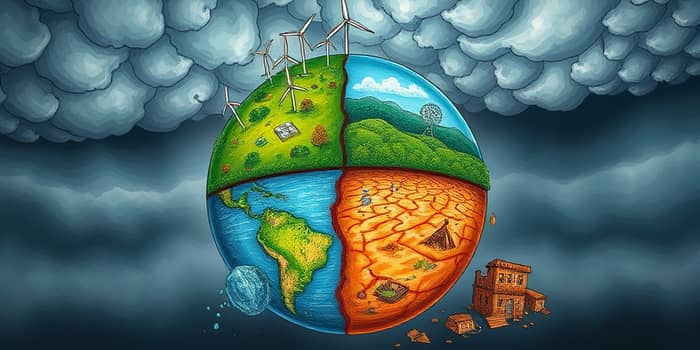
The unfolding climate crisis is not only an environmental emergency—it is reshaping global economies, disrupting sectors, and threatening livelihoods everywhere. As communities grapple with rising costs, policymakers and businesses must confront the stark reality of a planet in upheaval.
From melting ice caps to intensifying storms, the economic repercussions are both profound and far-reaching. This article explores the latest projections, sectoral breakdowns, regional disparities, and strategies to build a more resilient world.
Global Cost Projections and Model Predictions
Recent analyses indicate that climate-related damages could amount to $1.7–$3.1 trillion per year by 2050, a figure that underscores the urgency of swift action. Without decisive mitigation, losses may reach 20% of global GDP by 2100, devastating growth prospects and eroding decades of development gains.
Climate models vary in scope and methodology, but consensus is clear: higher warming leads to steeper declines. In a pessimistic scenario of 2°C warming, some estimates project GDP shrinkage of up to 85% by century’s end. Even in more moderate forecasts, economies face contractions between 2.1% and 23%, depending on regional resilience and adaptation capacity.
Sectoral and Societal Impacts
Climate change affects industries unevenly, with some sectors facing existential threats and others racing to adapt.
- Agriculture: Crop yields may decline by 10–25% in vulnerable regions, driving food price spikes and job losses in rural communities.
- Health: Direct costs of climate-related illnesses could reach $2–4 billion annually by 2030, while heat exposure already cost $1.09 trillion in lost labor productivity in 2024.
- Energy: The shift to low-carbon sources demands massive investment—yet delays in transition amplify stranded-assets risk in fossil fuel industries.
- Extreme weather events: Storms, floods, and wildfires inflicted $2 trillion in damages in 2023 alone, highlighting economic losses from extreme weather events that ripple through supply chains and insurance markets.
Uneven Regional Impacts and Modeling Complexities
Not all regions bear the burden equally. Low-income countries often lack infrastructure to withstand shocks, while wealthier nations face higher absolute losses due to denser urban concentrations and complex financial systems. Coastal cities confront rising sea levels, small island states risk disappearing, and landlocked economies struggle with water scarcity.
Modeling these dynamics involves numerous assumptions about emissions trajectories, adaptation investments, and policy frameworks. Discrepancies in data quality and local resilience measures further complicate projections, creating cascading economic risk and uncertainty that policymakers must navigate.
Key Challenges and Barriers
Several hurdles impede progress:
The political will to enact stringent carbon pricing or phase out fossil fuel subsidies often clashes with short-term interests. Financing gaps in developing nations limit adaptation projects, while technological barriers slow deployment of clean-energy infrastructure.
Moreover, entrenched inequalities mean that vulnerable populations—indigenous communities, women, and low-income households—face disproportionate hardships. Addressing climate change thus requires integrating social justice into economic planning.
Strategies for Mitigation and Adaptation
Building a resilient economy demands a multifaceted approach:
- Accelerate renewable energy deployment through targeted incentives and public-private partnerships, reducing reliance on volatile fossil fuel markets.
- Invest in nature-based solutions—such as reforestation, wetland restoration, and sustainable agriculture—to sequester carbon and bolster ecosystem services.
- Enhance infrastructure resilience by upgrading buildings, roads, and water systems to withstand extreme weather, flooding, and heatwaves.
- Implement climate-informed financial instruments, including green bonds and risk-sharing mechanisms, to mobilize capital and protect vulnerable communities.
Role of Finance and Private Sector Engagement
The financial sector wields immense influence in shaping climate outcomes. Banks, insurers, and investors must integrate climate risk into decision-making, aligning portfolios with net-zero goals. Divestment from high-emission industries and reallocation toward sustainable ventures signal market confidence in the transition.
Companies, too, can lead by adopting science-based targets, enhancing supply chain transparency, and exploring circular economy models. Corporate commitments translate into real-world impacts when paired with accountability frameworks and regulatory standards.
A Call to Global Action
The economic stakes of inaction are vast, yet the path forward holds promise. By embracing collaboration among governments, businesses, civil society, and communities, we can transform this planetary reckoning into an era of resilient growth and shared prosperity.
Success hinges on bold leadership, innovative financing, and urgent policy responses and innovation that protect vulnerable populations while catalyzing new industries. As the clock ticks, every fraction of a degree in warming avoided translates into trillions of dollars saved and millions of lives safeguarded.
Let this moment galvanize collective effort toward a resilient, equitable, low-carbon future. The economic impact of climate change is undeniable, but so too is humanity’s capacity to innovate, adapt, and thrive. The choices we make today will echo across generations—let us choose wisely, act boldly, and secure a sustainable legacy for all.
References
- https://www.cfr.org/article/climate-change-affecting-economy-proving-so-challenge
- https://fieconsult.com/quantifying-the-economic-costs-of-climate-change-across-sectors/
- https://www.nber.org/papers/w34357
- https://www.cbo.gov/publication/61146
- https://www.weforum.org/stories/2023/10/climate-loss-and-damage-cost-16-million-per-hour/
- https://www.who.int/news/item/29-10-2025-climate-inaction-is-claiming-millions-of-lives-every-year--warns-new-lancet-countdown-report
- https://www.un.org/en/climatechange/reports
- https://www.e-education.psu.edu/earth103/node/717
- https://climatedata.imf.org
- https://www.epa.gov/climateimpacts/climate-change-impacts-sector
- https://www.unsw.edu.au/news/2024/08/economic-costs-climate-change
- https://openknowledge.worldbank.org/bitstreams/3b12ad3c-3182-4772-95b3-205076b6bf14/download