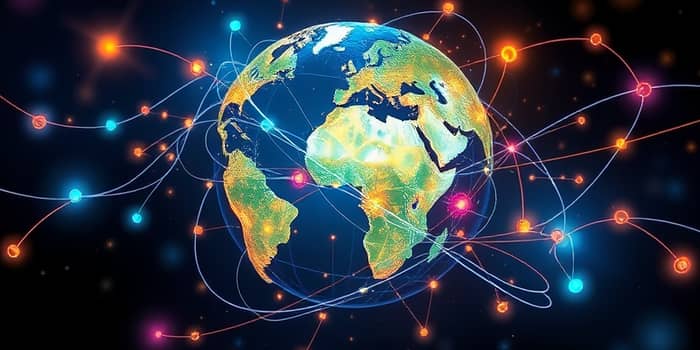
In a world where national economies no longer operate in isolation, the concept of the global economic web has never been more relevant. This intricate global web of trade shapes our daily lives, from the cost of everyday goods to the stability of financial markets. Understanding its evolution illuminates both opportunities and vulnerabilities.
Historical Evolution
The story of economic interconnectedness begins with the ancient Silk Road to modern globalization, a journey of exchange that linked distant civilizations. Caravans carried silk and spices across continents, creating pathways for ideas and technologies to travel alongside goods.
As centuries passed, maritime voyages and industrial revolutions accelerated the pace of integration. The invention of steamships, railways, and telegraphs in the 19th century reduced barriers of time and distance, laying the groundwork for the networked economy we see today.
By the late 20th century, advances in digital communication and transportation gave rise to complex global supply chains, cross-border investments, and instant financial transactions. This progression transformed local markets into nodes within a vast and dynamic network.
Mechanisms of Interconnection
Global economies interact through multiple channels, each reinforcing the web's resilience and complexity:
- Trade routes connect producers and consumers across borders, enabling specialization and comparative advantage.
- Financial systems channel capital flows through banks, markets, and institutions like the IMF, providing liquidity and guidance during crises.
- Labor migration shifts skills and labor supply, as millions move in search of opportunity, influencing wages and demographics.
- Technology and knowledge exchange via digital platforms accelerates innovation, with open-source hubs driving collective breakthroughs.
- Global supply chains distribute production steps across countries, optimizing costs but creating vulnerabilities to cascading disruptions.
Together, these mechanisms form a tapestry of interdependence, where a change in one strand can resonate throughout the entire system.
Network Analysis of Economic Sectors
Modern economists employ network models to map interactions between industry sectors, revealing patterns of dependency and resilience. Input–output (EIO) frameworks treat sectors as nodes and transactions as links, quantifying how shocks propagate.
In analyses of the U.S. economy, sectors group into clusters, with certain industries acting as bridges. These backbone sectors, often in finance or manufacturing, serve as critical connectors ensure system resilience by rerouting flows when local disruptions occur.
One useful way to visualize this structure is through sectoral matrices and descriptive tables:
Metrics like the dependency coefficient highlight the strength of ties between sectors. High coefficients signal non-trivial connections that amplify shocks, while lower ones mark peripheral relationships.
Contagion and Systemic Risks
The same channels that enable prosperity can also transmit crises at market-speed. A local event—such as a housing market collapse—can ripple through trade lines, asset markets, and investment portfolios worldwide.
Historically, the 2008 U.S. housing bust illuminated the fragility of interconnected financial networks. When mortgage-linked assets lost value, banks and investors across continents felt the impact, triggering a global contraction.
Natural disasters and political upheavals follow similar patterns. The 2011 Japanese earthquake disrupted auto and electronics supply chains, while political unrest in a single oil-producing nation can send shockwaves through energy markets.
Policy Responses and Coordination
Mitigating systemic risks demands cooperation beyond national borders. Institutions like the IMF provide monitoring and support, but true resilience arises from cross-border coordination for sustainable growth.
- Harmonizing macroeconomic policies to address trade imbalances and currency fluctuations.
- Coordinating regulatory frameworks to oversee financial institutions and market operations.
- Establishing rapid-response mechanisms for crisis management and liquidity provision.
Yet challenges remain: balancing national sovereignty with global commitments, and designing policies flexible enough to adapt to evolving networks without stifling innovation.
Future Outlook
The evolution of the economic web continues, driven by emerging trends and technologies:
- Digital currencies and blockchain platforms may redefine how value moves across borders.
- Integration of environmental metrics could link economic networks to climate resilience strategies.
- AI-driven analytics will enable real-time mapping of interdependencies, highlighting emerging risks.
As we navigate this future, the question becomes how to harness interconnection for shared prosperity while guarding against systemic threats. Building frameworks that blend innovation with safeguards will be key.
Ultimately, the economic web is a testament to human ingenuity and collaboration. By understanding its structure and dynamics, policymakers, businesses, and citizens can work together to foster growth, distribute opportunity, and build a resilient global economy for generations to come.
References
- https://www.studysmarter.co.uk/explanations/archaeology/arcaheology-of-trade/economic-interconnections/
- https://fiveable.me/key-terms/ap-world/interconnected-economies
- https://www.newyorkfed.org/newsevents/speeches/2012/dud120508
- https://www.dtcc.com/dtcc-connection/articles/2022/may/04/interconnectedness-revisited
- https://www.lagavi.com/blogs/journal/interconnectedness-of-life
- https://www.climatelit.org/topic/earth-system/interconnectedness/