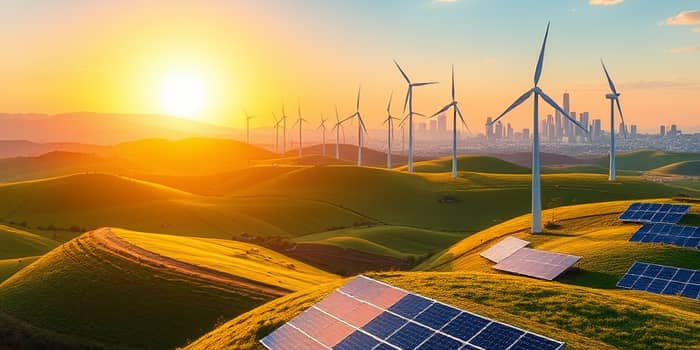
The global shift toward clean power is reshaping economies, driving growth, and redefining strategic priorities for nations at every level.
Global Economic Stakes
To achieve a net-zero future by mid-century, annual investment in the energy transition must reach $5–6 trillion by 2030. Current investment in 2025 hovers slightly below those levels, yet projections indicate a steep ramp-up is essential. Clean energy already accounted for 10% of global GDP growth in 2023, with regional contributions including China (20%), the United States (6%), India (5%), and the European Union (nearly 33%). As global GDP nearly doubles by 2050, total energy spending will hold near $6.5 trillion per year while its share of GDP declines thanks to efficiency gains.
Macro-Economic Impacts and Returns
Clean energy investments drive both risk mitigation and growth. In 2023, renewables quadrupling was required to meet 2030 targets, yet progress was uneven. Operating expenses for renewables remain low, offering price stability and predictability for consumers and businesses alike. Reallocating the tenfold greater fossil fuel subsidies toward renewables could close key financing gaps, estimated at $2.2 trillion per year for emerging markets. Domestic production of renewable electricity also reduces exposure to volatile global fuel prices, bolstering national energy security.
Case Studies by Region
China leads with nearly half of global wind and solar capacity, surpassing its own 2030 goals years ahead of schedule. Rapid rooftop solar deployment and targeted feed-in tariffs have catalyzed local manufacturing and innovation clusters. In contrast, Costa Rica, Iceland, and Uruguay showcase near-100% renewable grids powered by hydro, geothermal, wind, and solar, exporting excess clean electricity to neighboring countries. The United States and European Union leverage policy instruments like the Inflation Reduction Act and Clean Industrial Deal to channel hundreds of billions into clean energy manufacturing and infrastructure.
Job Creation and Community Benefits
- As of 2023, 35 million clean energy jobs outnumbered fossil fuel positions worldwide.
- Renewable projects generate property taxes, land leases, and infrastructure upgrades, often revitalizing rural areas.
- EV adoption cut oil demand by 0.3 million barrels per day in 2024, saving $9 billion in avoided imports.
Evolution of the Energy Mix
Electrification is set to more than double global electricity demand by 2060, driven by transport, heating, and industry. Renewables overtook coal’s share in the early 2025 global electricity mix, with wind, solar, and storage displacing over 650 TWh of fossil generation in 2024—saving $35 billion. Hydrogen and its derivatives could supply up to 6% of final energy demand by 2060, unlocking new investment pathways for countries ready to integrate advanced fuels.
Market Dynamics and Competitiveness
Solar and wind remain the dominant investment targets. In 2024, the renewable energy market reached $1.13 trillion and is projected to expand at 8.5% annually, surpassing $2.18 trillion by 2032. Solar module prices fell 35% in 2024 to just nine cents per watt, while EV battery costs dipped below $100 per kilowatt-hour—achieving cost parity with internal combustion vehicles. Falling costs of clean technologies continue to enhance competitiveness versus legacy energy sources.
- Battery storage additions nearly doubled in 2024, supporting variable renewables.
- Lower maintenance and zero fuel costs offer sustained savings.
Supply Chains, Geopolitics, and Trade
Governments are racing to secure critical minerals—lithium, cobalt, and rare earths—to build resilient domestic supply chains. China currently controls 70% of rare earth extraction and 90% of processing capacity. Rising tariffs and protectionist measures in the US, EU, and China risk adding 2–3% to renewable component costs and slowing deployment by 6% in some regions by 2035. Meanwhile, global trade volumes may contract by 0.2% in 2025 under a “peak trade” scenario, incentivizing more localized energy systems.
Risks and Headwinds
- Climate-related losses reached $320 billion in 2024, up one-third from 2023, highlighting the cost of inaction on climate.
- Emerging markets face a $2.2 trillion annual finance gap, risking stalled decarbonization.
- Policy ambition clashes with financing challenges and shifting private capital priorities.
Innovation, Equity, and the Just Transition
Massive R&D investments in storage, smart grids, hydrogen, and efficiency are unlocking spillover benefits such as tech exports and new industries. A just transition requires re-skilling programs, equitable finance, and social safety nets to support regions dependent on fossil industries. Renewable projects deliver social value through infrastructure and jobs, yet must ensure that vulnerable communities are not left behind.
Conclusion and Strategic Outlook
The energy transition represents the defining economic challenge and opportunity of our era. Policymakers and investors must align to mobilize trillions in capital, harness innovation, and ensure that the shift to renewables delivers broad-based prosperity. Achieving net-zero by mid-century is feasible, but only with decisive action to close financing gaps, strengthen supply chains, and uphold a just transition for all communities. In doing so, nations will secure resilient economies, foster growth, and safeguard the planet for future generations.
References
- https://www.dnv.com/energy-transition-outlook/2025/
- https://www.weforum.org/stories/2023/05/renewable-energy-incentives-households-countries/
- https://www.energy-transitions.org/bitesize/on-the-horizon-of-the-energy-transition-a-new-economy-is-rising/
- https://www.climatecouncil.org.au/11-countries-leading-the-charge-on-renewable-energy/
- https://www.rff.org/publications/reports/global-energy-outlook-2025/
- https://prismecs.com/blog/the-economic-impact-of-investing-in-renewable-energy
- https://www.weforum.org/publications/fostering-effective-energy-transition-2025/in-full/redefining-global-energy-systems/
- https://www.un.org/en/climatechange/raising-ambition/renewable-energy
- https://www.mckinsey.com/mgi/our-research/the-hard-stuff-2025-taking-stock-of-progress-on-the-physical-challenges-of-the-energy-transition
- https://ourworldindata.org/renewable-energy
- https://rmi.org/the-energy-transition-in-2025-what-to-watch-for/
- https://www.irena.org/Data
- https://wmo.int/media/news/un-report-renewable-energy-makes-economic-sense
- https://www.pvfarm.io/blog/how-investing-in-renewable-energy-drives-growth-and-prosperity
- https://ember-energy.org/latest-insights/global-electricity-mid-year-insights-2025/
- https://www.newsecuritybeat.org/2025/11/the-global-energy-transition-is-about-securing-the-future-not-managing-decline/