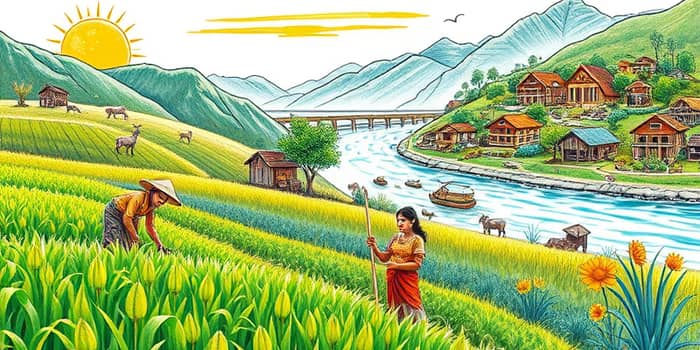
Global policies often seem distant to rural communities, yet their effects ripple through every farm, market, and household. From climate-smart agriculture programs to community-driven tourism, the connection is profound: international decisions drive local transformations.
Agriculture and Food Security Initiatives
At the forefront of this feedback loop are investments in climate-smart agriculture (CSA) and food security. International research alliances and funding bodies collaborate to provide small-scale producers with the resources they need.
Take the Honduras Rural Competitiveness Project (COMRURAL II/III), which reached 6,287 participants—33% women, 15% youth, 11% indigenous. This program created 6,678 new jobs by improving market linkages and promoting empowering rural small-scale producers to adopt modern techniques. Partnerships between governments and institutions drive this progress.
The Africa Integrated Climate-Smart Agriculture Research (AICCRA) project, backed by a $60 million investment, extended CSA tools to nearly 3 million farmers, 39% of whom are women. In Mali, RiceAdvice users enjoyed yields 0.9 ton/ha higher and earned $320/ha more. Such gains illustrate how boost local yields and incomes under resilient practices.
Empowering Communities Through Sustainable Tourism
Sustainable tourism policies offer a blueprint for poverty reduction, conservation, and empowerment. Community-Based Tourism (CBT) initiatives in East Africa demonstrate this model at work.
Villages near Serengeti and Ngorongoro in Tanzania once relied solely on subsistence farming and livestock. After implementing CBT, residents diversified incomes through guiding, handicrafts, cultural performances, and lodge employment. Average monthly earnings rose to TZS 100,000–500,000, reflecting a diversified income opportunities beyond farming approach.
Studies show a significant income increase (t=2.93, p=0.0189), and household income became a key predictor of improved livelihoods (p<0.001). Women and youth engagement grew, while poaching and resource conflicts declined, revealing the power of inclusive policy frameworks.
Private Sector Interventions and Supply Chain Upgrades
Global corporations align with sustainability goals to strengthen supply chains. Unilever’s smallholder programs, for example, deliver training in regenerative agriculture, certification support, and agroforestry practices.
In Côte d׳Ivoire, smallholders integrate crops and trees, improving soil health and climate resilience. Thailand’s jasmine rice farmers adopt sustainable fertilizers, lowering costs and boosting yields. These projects highlight how corporate partnerships drive sustainable growth in agricultural communities worldwide.
Building Economic Resilience in Crisis Contexts
Crisis recovery demands localized strategies. UNDP’s area-based, participatory value chain assessments avoid top-down, one-size-fits-all solutions. In Lebanon, a seafront rehabilitation project generated jobs for fishers and revived coastal tourism. In Somalia, market renovations in Gabiley added sanitation facilities and expanded trading spaces.
These interventions underscore the importance of local governance and stakeholder engagement in crafting resilient economies that can withstand shocks like Ebola, COVID-19, and extreme weather events.
Trade Policies, Subsidies, and Local Markets
Global subsidy trends shape food prices and farmer incomes. While subsidized staples enhance affordability and food security, they can depress market prices, undercutting smallholder livelihoods. Balancing these effects requires careful policy calibration to support both consumer needs and sustainable production.
Overcoming Challenges and Ensuring Equity
Despite successes, inequities persist. CBT benefits may skew toward better-connected households, while women, youth, and indigenous groups face barriers in training, capital access, and decision-making forums.
Climate vulnerability compounds these challenges, as droughts and land conflicts threaten gains. Strengthening local institutions like the Ujamaa Community Resource Team and wildlife management associations ensures more equitable benefit sharing and sustainable resource use.
Measuring Impact for Sustainable Progress
Rigorous monitoring and evaluation are essential. Key metrics include yield increases, income gains, job creation, and social indicators like health, education, and conservation outcomes. Statistical significance tests (e.g., p<0.05) validate program effectiveness and guide policy refinement.
Actionable Steps for Policymakers and Practitioners
- Foster inclusive partnerships between governments, NGOs, and private sector stakeholders.
- Allocate funding for participatory value chain assessments at the local level.
- Design subsidy reforms that balance affordability with farmer profitability.
- Invest in training programs that target marginalized groups, including women and youth.
- Implement adaptive monitoring systems to capture real-time data and community feedback.
- Promote cross-sectoral policy dialogues to integrate climate, agriculture, tourism, and trade goals.
By weaving together global vision and local action, policymakers and practitioners can create a virtuous feedback loop. When international standards and funding flow into communities—empowering farmers, artisans, and entrepreneurs—the ripple effects strengthen economies, protect ecosystems, and uplift lives. The journey towards resilient, equitable livelihoods is complex, but with evidence-based strategies and inclusive governance, every policy decision can become a catalyst for positive change on the ground.
References
- https://www.worldbank.org/en/topic/agriculture/brief/food-security-update
- https://www.tandfonline.com/doi/full/10.1080/23311886.2025.2569757
- https://www.unilever.com/sustainability/livelihoods/
- https://www.iisd.org/articles/explainer/five-trends-shaped-global-subsidies-over-decades
- https://www.ncbi.nlm.nih.gov/books/NBK599631/