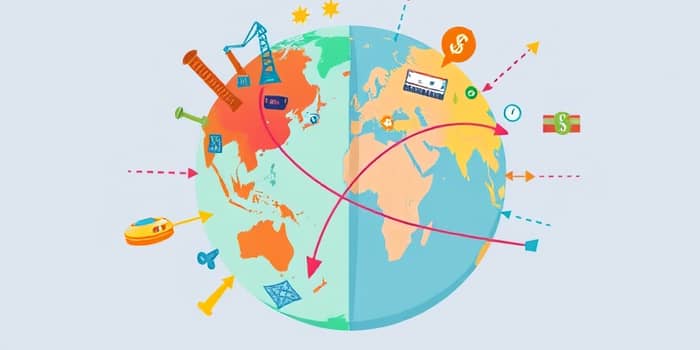
The global economy is transforming at a rapid pace, driven by political alignment over cost efficiency.
This shift creates distinct clusters, with the East led by China and the West anchored by the US and Europe.
Understanding this divide is crucial for businesses and individuals seeking to thrive in fragmented markets.
It's not just about trade; it's about survival in a new era of competition.
The New Trade Geography: Clusters and Corridors
Global trade is no longer unified but divided into trust-based clusters.
These clusters boost cross-border flows by nearly $1.9 trillion, altering traditional routes.
For example, the India-Middle East-Europe corridor is projected to grow 40% this decade.
It offers lower geopolitical friction and multimodal logistics advantages.
North America now prioritizes Mexico over China, reflecting manufacturing relocation.
China-ASEAN forms a self-sustaining loop for intermediates and electronics.
This reduces Western dependence and reshapes supply chains globally.
Winners in this landscape include several emerging hubs.
- India gains as a multi-corridor hub serving both East and West.
- Vietnam benefits from manufacturing shifts and trade realignment.
- Indonesia leverages its strategic position in Southeast Asia.
- Mexico becomes a key partner for the US and allies.
Europe faces challenges due to high energy costs and rigidity.
This erosion of manufacturing centrality highlights the need for adaptation.
This table illustrates the stark contrasts in trade strategies.
It shows how tariffs and partnerships define the economic battleground.
Geopolitical Actors and Their Moves
China leads the East with a bold manufacturing and tech push.
It aims to reduce foreign dependencies despite domestic challenges like deflation.
The economy is projected to be larger than the US by 2026.
The US drives Western restrictions through tariffs and export controls.
It focuses on critical tech to maintain a balance of power.
Europe pursues slow de-risking and deals with the Global South.
It also increases defense spending to catch up with rivals.
The Global South, including India and Brazil, seeks independence.
It is expected to contribute 50% of global growth by decade-end.
A quadripolar world emerges with distinct spheres of influence.
- Eurosphere: Democracies and multilateral frameworks.
- Sino-Russian autocracies: Focused on aligned economic policies.
- US-led balance-of-power bloc: Emphasizing security and alliances.
- Swing states: Such as India and Southeast Asia, navigating both sides.
Key Battlegrounds of the Geoeconomic Rivalry
Six multipolar arenas define the East-West competition.
These arenas reshape trade, technology, and finance in profound ways.
Understanding them is essential for strategic planning and risk management.
- Trade and FDI: Patchwork agreements replace unified global norms.
- Supply Chains: Friendshoring to aligned nations creates new clusters.
- Tech and AI: The US-China race defines security and innovation.
- Energy and Climate: Divergent policies fragment carbon rules into clubs.
- Finance: Fragmentation costs $0.6–5.7 trillion annually, with multipolar currencies rising.
- Human Capital and Resources: Scramble for oil, water, and skilled labor intensifies.
Geoeconomic confrontation, including sanctions and tariffs, tops 2026 risks.
It surpasses even misinformation as a critical global challenge.
Numbers That Define the Divide
Economic projections highlight the scale of this transformation.
Key figures offer insights into future trends and opportunities.
- GDP shifts by 2026: China surpasses the US; India exceeds any EU country.
- Trade flows: Aligned clusters add $1.9 trillion; the IME corridor grows 40%.
- Fragmentation costs: Ranging from $0.6 to $5.7 trillion annually.
- R&D and patents: China accounts for over 25% of industrial R&D and 50% of tech patents.
- Growth share: The Global South contributes approximately 50% by 2030.
- Tariffs: US-China peaks at 145% and 125%, with risks remaining.
These numbers underscore the high stakes in global economic competition.
They guide decisions for investors and policymakers alike.
Navigating Risks and Opportunities
Full decoupling between the US and China could halt trade.
It forces neutral countries to pick sides in the divide.
Financial fracture sees national interests trumping multilateralism.
Intra-West barriers add complexity to global finance.
Stability factors include interconnected trade that binds spheres.
This interconnection helps avert conflict despite rising extremism risks.
Businesses must adapt with supply chain resilience strategies.
China splits and subsidy grabs are common responses.
- Diversify supply chains to reduce dependency on single regions.
- Invest in technology to stay competitive in key arenas.
- Engage with emerging hubs like India and Southeast Asia.
- Monitor tariff changes and geopolitical developments closely.
- Leverage bilateral deals to access new markets and customers.
Practical steps can mitigate risks and capitalize on new corridors.
The Future Hubs: Emerging Corridors
The India-Middle East-Europe corridor bridges Asia, East Africa, and Europe.
It rivals traditional routes like the Suez Canal for efficiency.
Multi-node hubs such as the Middle East serve as logistics pivots.
India, Southeast Asia, and Central Asia act as swing battlegrounds.
Losers include legacy route-tied regions that lose optionality.
Embracing these changes requires foresight and flexibility.
- IME Corridor: Enhances multimodal logistics and reduces geopolitical friction.
- Middle East: Becomes a key pivot for global trade flows.
- India and SE Asia: Offer strategic advantages for serving both East and West.
- Central Asia: Gains importance as a connector in new economic geometries.
These hubs represent new opportunities for growth and innovation.
They are essential for navigating the fragmented global marketplace.
The geoeconomic divide is not just a challenge; it's a call to action.
By understanding the dynamics, businesses can turn risks into advantages.
Embrace adaptation, foster resilience, and seek collaboration where possible.
The future belongs to those who navigate this divide with insight and agility.
References
- https://www.kenresearch.com/articles/global-trade-rewiring-new-corridors-opportunity
- https://www.bcg.com/publications/2025/geopolitical-forces-shaping-business-in-2026
- https://www.cer.eu/in-the-press/geopolitics-2026
- https://www.weforum.org/stories/2026/01/yesterday-risk-today-reality-fragmented-financial-system/
- https://www.euronews.com/2026/01/14/economic-confrontation-biggest-threat-to-global-stability-in-2026-world-economic-forum-rep