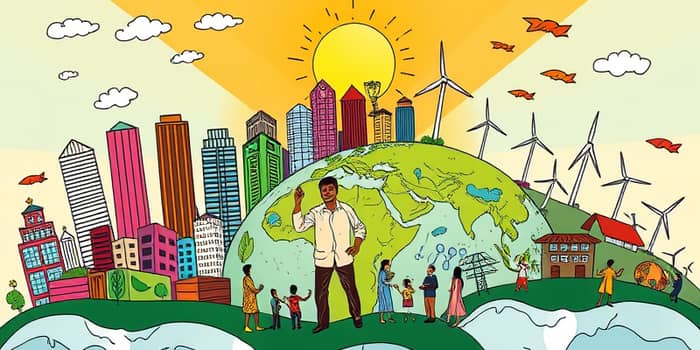
As the world economy approaches 2026, policymakers, businesses, and citizens stand at a crossroads. Global growth forecasts range from 2.7% to 3.3%, reflecting both optimism from technological advances and cautiousness in the face of structural challenges. This article offers an inspiring roadmap to navigate uncertainty, combining data-driven insights with practical strategies to harness opportunities and mitigate risks.
Global Growth Forecast Overview
Leading forecasts present a mixed yet hopeful picture. The IMF projects 3.3% growth, buoyed by fiscal and monetary stimulus, while Goldman Sachs sees 2.8%, driven by US strength and euro area support. UN agencies estimate around 2.7%, noting lingering constraints on investment. Deloitte’s baseline anticipates modest expansions: 1.9% for the US, 4.5% for China, and approaching 7% in India. These varying numbers underscore the uneven recovery across geographies and the importance of adaptive approaches.
Despite lower than pre-pandemic rates—when global growth averaged 3.2%—there are significant pockets of resilience. Consumer spending remains robust in developed markets, while emerging economies benefit from structural reforms and demographic tailwinds. The near-term outlook depends on the balance between technology-driven investment bursts and persistent headwinds such as trade tensions and capacity imbalances.
Key Drivers Fueling Momentum
- Consumer spending resilience: Households in many regions continue to spend, supported by wage gains and eased inflation.
- Unprecedented fiscal and monetary support: Tax cuts, targeted stimulus, and central bank rate cuts bolster demand.
- AI-driven investment and nearshoring trends: Companies shift supply chains closer to home and pour resources into automation.
- Renewable energy and infrastructure upgrades: Public and private capital flows into green projects.
- Digital transformation in service sectors: Finance, healthcare, and education innovate rapidly.
Headwinds and Structural Challenges
- Subdued investment and weak labor markets: Capital expenditures lag, and hiring remains below pre-2019 trajectories.
- Structural headwinds and geopolitical uncertainties: Trade tariffs, regional conflicts, and regulatory fragmentation persist.
- Overcapacity in key sectors: China’s steel and real estate sectors adjust to declining domestic demand.
- High debt levels among emerging economies: Fiscal strains limit stimulus options, especially in Africa and Latin America.
- Sticky inflation pockets: Services and housing costs remain elevated in several advanced markets.
Regional Perspectives
While global averages provide a snapshot, national and regional dynamics vary widely. Below is a concise table outlining core forecasts, supportive factors, and principal risks for key regions and economies.
Policy Levers and Corporate Strategies
- Coordinated fiscal-monetary stimulus: Governments can time spending on infrastructure to complement central bank easing.
- Trade diversification initiatives: Firms should explore new markets to reduce tariff exposure.
- Reskilling and workforce development: Public-private partnerships can close skill gaps in AI and green sectors.
- Sustainable finance frameworks: Channeling capital toward ESG-compliant projects enhances resilience.
Navigating Uncertainty: Practical Steps
In an environment where forecasts shift constantly, agility becomes a strategic asset. Businesses and policymakers can adopt these concrete measures:
1. Scenario Planning: Develop best-, base-, and worst-case growth models and stress-test budgets across each scenario.
2. Flexible Capital Allocation: Maintain liquidity reserves to seize investment opportunities during market dislocations.
3. Data-Driven Decision-Making: Leverage real-time analytics to monitor consumer sentiment and supply chain health.
4. Collaborative Public-Private Partnerships: Pool resources for infrastructure and technology projects where returns are long-term.
Embracing Innovation and Resilience
The 2026 growth landscape rewards those who balance cautious planning with bold innovation. Emphasizing resilient policy frameworks and adaptive strategies ensures that economic gains translate into sustained prosperity. Integrating digital tools, from AI-powered forecasting to blockchain in supply chains, can unlock productivity leaps. Meanwhile, targeted support for reskilling can create an inclusive growth that leaves no one behind, bridging skill gaps and expanding labor force participation.
Conclusion: Charting a Path Forward
The global economy in 2026 faces a complex interplay of opportunities and threats. By recognizing the sustained consumer spending and easing inflation, embracing new technologies, and addressing subdued investment trends with bold policies, stakeholders can tilt the odds toward prosperity. The journey requires cooperation across borders, sectors, and disciplines—an unwavering commitment to building agility and long-term resilience effectively. With informed choices and a spirit of innovation, the world can transform the 2026 growth gambit into a defining success story for the next decade.
References
- https://www.goldmansachs.com/insights/articles/the-global-economy-forecast-to-post-sturdy-growth-in-2026
- https://www.deloitte.com/us/en/insights/topics/economy/global-economic-outlook-2026.html
- https://desapublications.un.org/publications/world-economic-situation-and-prospects-2026
- https://www.imf.org/en/publications/weo/issues/2026/01/19/world-economic-outlook-update-january-2026
- https://rsmus.com/insights/economics/economic-outlook-for-2026.html
- https://unctad.org/publication/world-economic-situation-and-prospects-2026
- https://www.worldbank.org/en/publication/global-economic-prospects
- https://www.imf.org/en/publications/weo