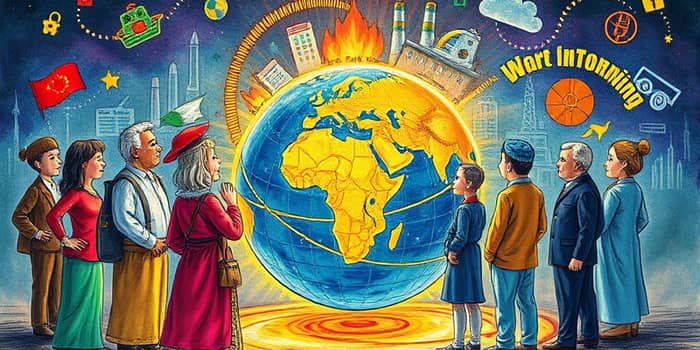
For decades, the world has witnessed a profound transformation in the balance of economic power. What began as isolated growth across emerging markets has blossomed into a sweeping phenomenon often referred to as the Great Convergence. This concept captures the historic shift of wealth and economic power from traditional Western strongholds toward dynamic regions in Asia, Latin America, and beyond.
The rise of the BRIC nations—Brazil, Russia, India, and China—alongside other emerging economies, has lifted billions from poverty, yet faced headwinds in recent years. Against the backdrop of trade fragmentation, tariffs, and geopolitical tensions, a unique opportunity emerges to reset global collaboration and propel shared prosperity into the coming decades.
Understanding the Current Global Outlook
Consensus forecasts for 2025 place global growth between 3.0 and 3.2 percent, down modestly from 3.3 percent in 2024. Advanced economies are projected to expand by an average of 1.5 percent, while emerging markets exceed 4 percent. This gradient highlights the accelerating pace of convergence as lower-cost producers capture market share.
Despite this momentum, inflation is moderating worldwide toward 2.1–2.6 percent by 2025, with exceptions such as the United States facing upside risks near 3.5 percent. A slower demand environment, combined with easing energy prices, is gradually anchoring price pressures without derailing growth.
With a projected world economy of $117 trillion in 2025, policymakers face a delicate balancing act: sustaining growth while managing debt, deficits, and evolving financial conditions. Strategic investments and prudent fiscal policies can lock in gains from this transition.
Regional Divergence: The Story by Region
Growth patterns vary significantly across major economies. The United States is forecast to grow at 1.8 percent in 2025, hampered by lingering tariffs, restrictive immigration policies, and inflation carryover. The Euro Area trails at around 1 percent, constrained by export softness and cautious consumer spending.
Contrastingly, China is set to achieve 4.5–4.9 percent expansion, driven by clean energy investments that now comprise roughly 10 percent of GDP. India leads the pack with nearly 6 percent growth, powered by a booming services sector and supportive reforms that reduce export reliance and foster domestic demand.
Emerging and developing economies collectively exceed 4 percent growth, illustrating how the lower manufacturing costs and commodity booms have propelled a broader set of nations into the global spotlight. Trade diversification, from Europe to North America, strengthens resilience against regional shocks.
Major Disruptors to Convergence
Amid these gains, several factors threaten to stall or reverse progress. Heightened trade barriers, geopolitical tensions, and policy shifts cast a shadow over open markets and investment flows.
- US Tariffs and Trade Policy: Prolonged tariffs risk slowing global trade growth, now near 2.3 percent.
- Geopolitical Instability and Nationalism: Rising fractures impede multinational collaboration and investor confidence.
- Policy Uncertainty and Rising Barriers: Fiscal deficits and regulatory headwinds elevate financing costs and deter long-term planning.
Each of these disruptors can amplify economic fragmentation, erode the gains of convergence, and leave vulnerable populations at risk. Addressing them requires coordinated diplomacy, transparent rule-making, and a commitment to multilateral frameworks.
Enablers and Opportunities Ahead
Despite these challenges, powerful catalysts can sustain and accelerate the Great Convergence. Advances in technology, labor markets, and energy systems offer avenues for inclusive, sustainable growth.
- AI Revolution and Reskilling: The remarkable AI revolution reshaping industries could create 170 million new roles while displacing 92 million jobs, underscoring the urgency of lifelong learning.
- Labor Market Transformation: Addressing skills gaps and fostering inclusion across gender and age will unlock productivity across regions.
- Green Energy Investment: Renewables are now up to 53 percent cheaper, with solar and wind capacity surging as part of a renewable energy capacity expanding rapidly.
- Fiscal and Monetary Collaboration: Coordinated easing by central banks and targeted government spending can stimulate demand where it is needed most.
Harnessing these enablers demands visionary leadership, robust public-private partnerships, and an unwavering focus on equity and environmental stewardship.
Historical Context and Path Forward
Looking back, the Great Convergence traces its roots to the late twentieth century, when manufacturing migrated to Asia and commodity revenues surged in resource-rich nations. This era marked an unparalleled redistribution of wealth that transformed living standards across continents.
Today, as foreign direct investment patterns recalibrate and trade blocs evolve, there is a risk of reversing poverty alleviation gains. Yet this moment also presents a clear inflection point: a chance to redesign global systems for the twenty-first century.
Key strategies for moving forward include:
- Multilateral Collaboration: Strengthening institutions to manage trade, finance, and climate change collectively.
- Upskilling and Education: Preparing workforces for a rapidly changing technological landscape.
- Sustainable Infrastructure: Investing in resilient transportation, digital networks, and green energy projects.
- Gender Parity and Inclusivity: Ensuring that women and underrepresented groups participate fully in economic gains.
By embracing these pathways, the global community can forge a more balanced, inclusive, and resilient future where prosperity is widely shared.
As we stand at the crossroads of economic history, the choices we make today will determine whether the Great Convergence becomes a lasting legacy of collaboration or a fleeting chapter in global fragmentation. Collective action, informed policy, and a steadfast commitment to equity can secure a brighter tomorrow for all nations.
References
- https://www.imf.org/en/publications/weo/issues/2025/07/29/world-economic-outlook-update-july-2025
- https://www.ey.com/en_us/media/webcasts/2025/01/global-economic-outlook-navigating-currents
- https://www.weforum.org/stories/2025/08/inflection-points-7-global-shifts-defining-2025-so-far-in-charts/
- https://www.morganstanley.com/insights/articles/economic-outlook-midyear-2025
- https://www.imf.org/en/publications/weo/issues/2025/10/14/world-economic-outlook-october-2025
- https://www.oecd.org/en/about/news/press-releases/2025/09/global-economic-outlook-weakens-as-policy-uncertainty-weighs-on-demand.html
- https://www.visualcapitalist.com/117-trillion-world-economy-in-2025/
- https://www.mckinsey.com/capabilities/strategy-and-corporate-finance/our-insights/economic-conditions-outlook