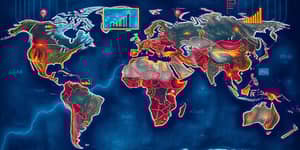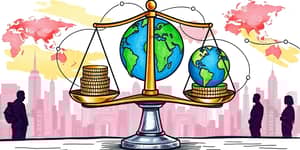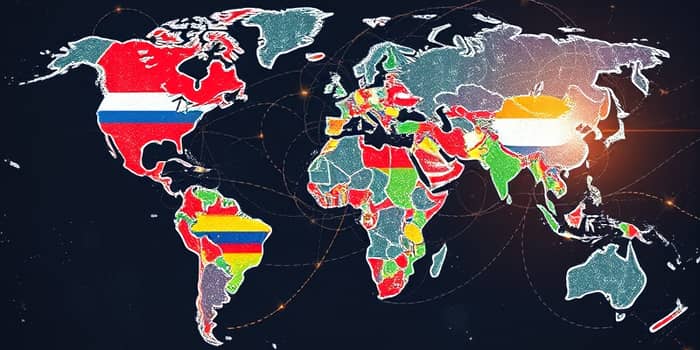
In 2026, the global economy moves through a profound transformation marked by fragmentation and new alliances. As traditional supply chains segment and trade walls rise, countries are developing resilience through coalition and capacity-building to navigate an era defined by uncertainty. This narrative explores how economic blocs evolve, how technology reshapes growth, and how nations adapt fiscal and structural frameworks to emerge stronger from this great recalibration.
Multipolar Rebalancing and Rising Resilience
Over the past decade, the world has shifted from a single dominant power to a complex tapestry of influence. The era of the shift from unipolar US dominance is giving way to overlapping spheres led by the United States, China, the European Union, and emerging coalitions across Asia, Africa, and Latin America. Trade restrictions, once temporary responses to crises, have become instruments of geopolitical strategy, reshaping supply chains and investment flows.
Middle powers are redefining sovereignty as strength rather than isolation, embracing strategies of permanent rupture rather than transition. By forging partnerships in infrastructure, finance, and technology, these nations aim to reduce vulnerability to sudden policy shifts. Coalitions such as the Quadrilateral Security Dialogue and EU-ASEAN-Canada alignments illustrate a new paradigm: economic security built on shared interests and diversified dependencies.
Uneven Growth Patterns Across Regions
Despite global growth projected between 2.7% and 3.3%, the outlook is far from uniform. Advanced economies grapple with structural headwinds, while parts of Asia and Africa leverage demographic trends and fiscal support to outpace the rest. Understanding these disparities is crucial for investors and policymakers seeking opportunity amid complexity.
These figures highlight a divergence: while emerging markets capitalize on youth populations and infrastructure investment, advanced economies must balance aging demographics with ambitious spending on green energy and defense. The uneven pace creates both risk and opportunity for cross-border partnerships.
AI as a Counterweight to Fragmentation
In a landscape of tariffs and political friction, artificial intelligence emerges as a unifying force for productivity gains. Big Tech plans to invest 90% of H1 2025 GDP growth into hardware, software, and data centers, demonstrating AI’s potential to offset headwinds from slower trade and demographic decline.
- Dependence on leveraged financing may amplify risk.
- Cross-holdings among firms can stifle creative destruction.
- Taxing mobile capital vs. labor remains a policy challenge.
- Winners and losers in the transition require compensation.
As frontier technologies diffuse, competition for AI leadership will intensify among blocs. Yet the true test lies in ensuring broad-based benefits: productivity gains must translate into higher wages, improved services, and stronger social safety nets.
Geo-Economic Tools and Their Paradoxes
Tariffs, once seen as blunt instruments, have become nuanced levers of influence. The United States now charges allies for defense guarantees and leverages trade policy to secure supply chains. At the same time, new agreements like the USMCA review and EU trade partnerships aim to restore predictability at a higher cost.
- Tariffs can protect domestic industries but raise consumer prices.
- Trade blocs enhance resilience but limit market access.
- Strategic dependencies in rare earths create mutual vulnerabilities.
This paradoxical environment demands agile diplomacy. Policymakers must balance short-term security with long-term integration, ensuring that economic tools do not fragment global growth beyond repair.
Fiscal and Structural Hurdles Ahead
Across OECD countries, deficits above 7% of GDP and limited fiscal space and ageing demographics constrain policy options. Governments face rising costs for energy transition, defense spending, and pension obligations, forcing difficult trade-offs between investment and austerity.
To navigate these constraints, many nations pursue tax reforms to generate up to 1.5% of GDP in additional revenue and channel funds into digital and green infrastructure. Central banks play a complementary role through targeted easing to support consumer spending and credit growth without igniting inflationary pressures.
Energy, Resources, and Geopolitics
As AI data centers expand, demand for reliable, low-cost power surges, thrusting the politics of energy and resource rivalry into the spotlight. Policymakers must weigh the benefits of rapid decarbonization against the need for grid stability and affordable bills, a delicate balancing act in every major market.
Meanwhile, competition for minerals and rare earths intensifies. Middle powers like Argentina position themselves as resource hubs through sweeping reforms, while China deepens alliances in Africa to secure critical inputs. This race will shape the contours of geopolitical influence for decades to come.
Outlook: Charting a Course through Complexity
Global growth cruising near 3% masks a world in flux. While technology and fiscal adaptation offer levers for prosperity, the landscape demands unwavering vigilance. As Mark Carney reminds us, we are in the midst of a rupture, not a transition, and success will depend on our collective ability to build resilient institutions, foster inclusive innovation, and embrace cooperation across emerging blocs.
By understanding the interplay of multipolar power shifts, uneven growth, AI-driven productivity, geo-economic levers, fiscal realities, and energy dynamics, stakeholders can seize the opportunities of this great recalibration and chart a steady path toward shared well-being.
References
- https://www.caixabankresearch.com/en/economics-markets/activity-growth/world-economy-2026-resilience-transition-or-disruption
- https://www.deloitte.com/us/en/insights/topics/economy/global-economic-outlook-2026.html
- https://www.imf.org/en/publications/weo/issues/2026/01/19/world-economic-outlook-update-january-2026
- https://www.weforum.org/stories/2026/01/davos-2026-how-middle-powers-are-reading-the-global-moment/
- https://news.un.org/en/story/2026/01/1166717
- https://www.morganstanley.com/insights/podcasts/thoughts-on-the-market/2026-stock-markets-economy-thematic-analysis-stephen-byrd
- https://www.oxfordeconomics.com/key-themes-2026/