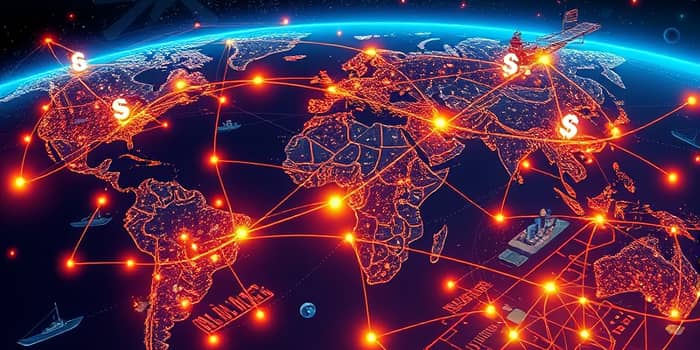
Global economies today are bound by an intricate supply chains and trade flows that create an invisible web, linking regions through commerce, finance, and policy decisions. While the promise of interconnected markets brings growth, it also amplifies vulnerabilities when disruptions arise.
Unraveling Trade Fragmentation and Tariff Wars
Since mid-2025, the US average effective tariff rate climbed to 18.2%, the highest since 1934. This escalation has sparked a global recalibration of trade routes and partnerships. Companies reroute shipments to Europe, where Chinese exports rose by 6%, or to Mexico and Canada, which saw a 25% surge. These shifts come at a cost, injecting fresh pressure into inflation and straining production networks.
Many nations now pursue bilateral agreements to dodge tariffs reaching 50%, while the ECB notes that China’s diversion of goods could help ease eurozone price pressures. Yet the shadow of economic fragmentation looms large, with potential costs to the global financial system estimated between $0.6 trillion and $5.7 trillion. Such figures underscore how heightened uncertainty and slowed growth can ripple across continents.
The Dynamics of Supply Chain Front-Loading
In the first half of 2025, businesses front-loaded orders ahead of anticipated US-China tariff hikes. This surge boosted industrial output above 2024 averages in most G20 economies, yielding 3.2% annualized global growth. By stocking up early, firms mitigated immediate disruptions but sowed the seeds of a slowdown later in the year.
As front-loading unwinds in the second half, import volumes outpace exports, dragging on GDP through a widening trade deficit. Developing countries heavily reliant on exports face falling commodity prices, tighter credit conditions, and rising debt burdens. The contrast between early resilience and later weakening highlights the fragility masked by temporary stockpiling.
Financial and Crypto Interconnectedness
Financial markets today are interwoven with crypto-assets in ways that were unimaginable a decade ago. Volatile valuations in digital assets now carry potential spillovers into traditional banking and investment portfolios. Uncertainty over tariffs and fiscal policy could trigger repricing events, where sudden shifts in risk perceptions spread rapidly through credit markets.
Policymakers grapple with how to oversee emerging asset classes while maintaining stability. The interplay between conventional finance and digital currencies underscores the broader theme of global financial market repricing and risk transmission that defines today’s economic landscape.
Geopolitical and Policy Uncertainty
Rising economic nationalism and frequent policy shifts undermine long-term investment decisions. A recent survey found that 70% of respondents across 25 countries view global conditions as a major threat to growth. Ongoing conflicts, strategic rivalries, and tariff volatility all feed into an atmosphere of mistrust and hesitation.
- Trade tensions hinder multinational supply chains.
- Policy spillovers amplify local shocks globally.
- Nationalist rhetoric delays infrastructure and innovation projects.
Technology and Sectoral Shifts
Investments in AI and high-tech industries are offsetting some drag from trade barriers. The US and Japan lead in AI-related expenditures, fostering productivity gains and creating new export opportunities. Meanwhile, traditional manufacturing centers like Germany, Austria, and Finland face headwinds, whereas services-oriented economies, such as Spain, benefit from expanding digital and tourism sectors.
This divergence highlights how sectoral adaptation to technological change can serve as a buffer against broader trade disruptions.
Fiscal and Monetary Policy Spillovers
As China’s fiscal support tapers off, growth momentum slows, reflecting diminished stimulus and the unwinding of front-loaded inventories. In the euro area, looser credit conditions have helped absorb some trade frictions, though fiscal consolidation in France and Italy weighs on domestic demand.
India’s recent GST reforms and targeted stimulus measures have sustained growth above 6%, even as export volumes falter. Across emerging markets, the shape and timing of monetary policy adjustments have profound effects on capital flows and exchange rates, illustrating cross-border policy interdependence and market reactions.
Global GDP Growth Projections
Forecasts for global growth in 2025 range widely, reflecting divergent policy assumptions and risk assessments. While the OECD and IMF anticipate 3.2% growth, bodies like the UN and WEF offer more cautious estimates around 2.4–2.6%. The variance underscores the underlying uncertainty driven by tariffs, geopolitical tensions, and the post-pandemic unwind.
Regional Breakdowns and Risks
Growth prospects vary widely across regions. The US is projected between 1.8% and 2.4%, buffered by AI-driven productivity but constrained by workforce challenges. The euro area is set to expand by just over 1%, offsetting trade drags with credit easing. China’s growth moderates from 4.9% to 4.4% as export momentum fades.
Emerging markets like India and Indonesia maintain robust trajectories near 6–7%, thanks to policy reforms and public investment. Latin America sees agricultural spikes and debt adjustments, while East Africa leads at over 5%. Yet downside risks remain significant:
- Escalating tariffs triggering inflation rebounds.
- Crypto market shocks spilling into banking sectors.
- Policy missteps leading to capital flight.
Harnessing the Invisible Web for Resilience
While the interwoven nature of modern economies can magnify shocks, it also offers pathways for collective resilience. Multilateral dialogue on tariff reduction, coordinated digital regulation, and joint investment in green and AI technologies can reinforce the web’s positive strands.
Understanding and embracing this global economic interdependence as a shared asset empowers policymakers, businesses, and communities to navigate uncertainty. By fostering transparency, diversification, and collaboration, stakeholders can transform vulnerabilities into opportunities for more inclusive and sustainable growth.
References
- https://www.oecd.org/en/publications/2025/09/oecd-economic-outlook-interim-report-september-2025_ae3d418b/full-report.html
- https://www.weforum.org/stories/2025/08/inflection-points-7-global-shifts-defining-2025-so-far-in-charts/
- https://www.deloitte.com/us/en/insights/economy/global-economic-outlook-2025.html
- https://www.imf.org/en/publications/weo/issues/2025/10/14/world-economic-outlook-october-2025
- https://unctad.org/publication/trade-and-development-report-2025
- https://www.spglobal.com/ratings/en/regulatory/article/global-economic-outlook-q4-2025-global-resilience-battles-us-policy-unpredictability-s101647254
- https://www.pewresearch.org/global/2025/08/19/global-economic-conditions-as-a-threat/