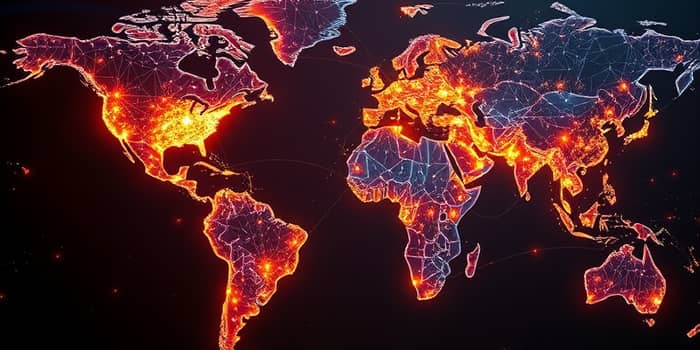
In today’s rapidly changing world, longstanding economic hierarchies are being rewritten. Traditional powerhouses such as the United States and the European Union are experiencing slower growth, while dynamic markets in Asia, Africa, and the Middle East surge ahead. This seismic shift presents both opportunities and challenges for policymakers, businesses, and communities aiming to harness the momentum of tomorrow’s growth engines.
As we look toward 2026, global output is forecast to expand by 2.7 percent, just shy of pre-pandemic trends yet indicative of a resilient recovery. With alternative forecasts projecting even stronger expansion driven by digital transformation, fiscal support, and private sector innovation, the stage is set for new leaders to emerge and reshape the global economic order.
Global Growth Projections for 2026
The consensus forecast foresees world GDP growing at around 2.7 percent in 2026, against a backdrop of subdued investment in some regions and robust expansion in others. The International Monetary Fund raises this estimate to 3.3 percent, highlighting the role of transformative artificial intelligence investments and sustained fiscal stimulus in propelling advanced economies. Meanwhile, the World Bank anticipates steady recovery in Europe and Central Asia, and private sector adaptability continues to offset lingering trade tensions.
Despite headwinds such as geopolitical uncertainty and climate-related shocks, certain regions stand out for their growth potential. East Asia is projected to grow at 4.4 percent, South Asia at 5.6 percent, and parts of the Middle East and Africa at around 4 percent or higher. These figures underscore the importance of strategic investments and inclusive policies that support long-term development.
Emerging Leaders: Top 10 Fastest Growing Economies
Behind headline figures lie nations that are rapidly ascending the economic ladder, powered by demographics, technology, and ambitious reform agendas. These emerging markets are not only posting high GDP growth but are also building the foundations for long-lasting influence on the world stage.
- Ethiopia: Investing heavily in transport and energy infrastructure for sustained expansion
- Nigeria: Leveraging a young and dynamic workforce to drive digital finance and services
- Bangladesh: Expanding export-driven manufacturing and nurturing domestic consumption
- United Arab Emirates: Evolving into a global hub with smart city projects and trade platforms
- India: Multi-engine growth from consumption, services, manufacturing, and technology
- Philippines: Riding domestic demand and a vibrant services sector
- Saudi Arabia: Diversifying beyond oil into tourism, logistics, and renewable energy
- Indonesia: Building up ports, power networks, and digital startups
- Mexico: Benefiting from proximity to the US and modernizing its industrial base
- Vietnam: Establishing itself as a major manufacturing and trade gateway
Key Drivers Fueling the New Order
The rise of these fast-growing economies is underpinned by a set of interrelated forces that are reshaping how value is created and shared across borders. Leaders are focusing on policies that enhance productivity, foster innovation, and build resilience against global shocks.
Among the most influential catalysts are:
- transformative artificial intelligence investments driving efficiency and new product development
- diversification beyond oil and gas in Middle Eastern and African economies
- Massive infrastructure commitments that connect markets and reduce costs
- Demographic dividends from a young and dynamic workforce fueling consumption and entrepreneurship
- Regional trade agreements and digital platforms enhancing market access
Risks and Challenges Ahead
No growth narrative is without its obstacles. High debt levels, climate vulnerabilities, and geopolitical tensions pose significant risks to sustained expansion. For example, countries in Latin America face policy uncertainty, while parts of Africa contend with fiscal strains and external shocks.
Moreover, the AI revolution brings its own challenges. Without careful management, unchecked technological disruption risks could exacerbate inequalities and create new forms of economic disruption. Balancing innovation with regulation and inclusive policies is essential to ensure that gains are broadly shared.
Building Resilience and Seizing Opportunities
In this era of transition, stakeholders must adopt forward-looking strategies that blend ambition with prudence. Governments, businesses, and civil society all have critical roles to play in cultivating environments where growth translates into real-world improvements.
Key strategic priorities include:
- Investing in education and skills to prepare the workforce for tomorrow’s demands
- Strengthening institutions and governance frameworks to support transparent markets
- Promoting public-private partnerships for strategic long-term infrastructure development
- Encouraging sustainable practices that align growth with environmental stewardship
- Fostering regional cooperation to unlock shared prosperity
As the global center of gravity continues to shift, the narrative of economic power is being rewritten in capitals from Addis Ababa to New Delhi, Lagos to Jakarta. By understanding the dynamics at play and adopting inclusive and sustainable growth models, nations and communities can harness the energy of this transformation for the benefit of all.
The future belongs to those who can blend resilience with innovation, and foresight with collaboration. In a world where change is the only constant, the path to becoming an economic superpower lies not just in rapid growth, but in building systems that endure, uplift, and inspire.
References
- https://desapublications.un.org/publications/world-economic-situation-and-prospects-2026
- https://www.youtube.com/watch?v=GX-EgvTtp0Y
- https://www.mercer.com/insights/investments/market-outlook-and-trends/economic-and-market-outlook/
- https://www.imf.org/en/publications/weo/issues/2026/01/19/world-economic-outlook-update-january-2026
- https://rsmus.com/insights/economics/economic-outlook-for-2026.html
- https://www.weforum.org/publications/global-risks-report-2026/digest/
- https://knowledge.insead.edu/responsibility/five-global-trends-business-and-society-2026