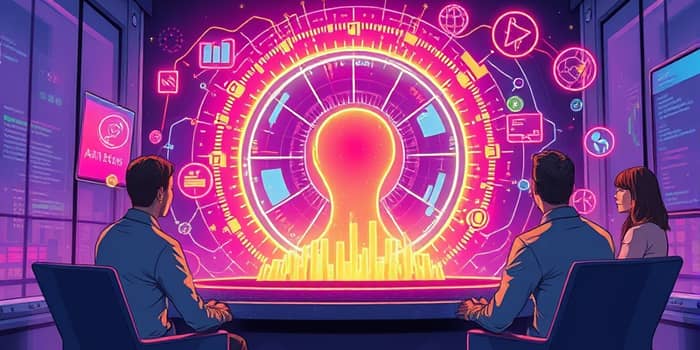
In a world where marketing often reacts to consumer shifts, the Online Oracle emerges as a visionary guide powered by AI and predictive analytics. This transformative system empowers businesses to anticipate trends, personalize experiences, and unlock unprecedented profit opportunities in 2026’s rapidly evolving landscape.
From Reactive to Predictive: The Rise of the Online Oracle
Traditional marketing strategies have long been bound by past performance and guesswork, leaving businesses scrambling to catch up with consumer expectations. Today, the Online Oracle signifies a radical departure: a system that leverages advanced algorithms, machine learning models, and real-time data streams to forecast digital behaviors before they fully materialize.
By shifting focus from reactive responses to proactive predictions, organizations gain the power to tailor their messaging, offers, and product development with unprecedented precision. This evolutionary leap transforms advertising from a reactive expense into a strategic profit center.
Trend One: AI-Driven Predictive Analytics and Personalization
The core of the Online Oracle is its capability for AI analyzes vast datasets for behavior prediction. With the predictive analytics market growing at a 23.2% CAGR to reach $22.1 billion by 2026, companies can no longer afford to ignore this paradigm shift.
Key statistics underscore this momentum: 60% of marketers now leverage AI to anticipate customer needs, while 84% rely on AI and machine learning across their marketing tech stacks. Brands like Amazon exemplify hyper-personalization by retargeting customers with individualized recommendations long before they even realize their desires.
Organizations that embrace predictive analytics can automate mundane tasks, streamline customer journeys, and deliver hyper-personalization becomes the new standard across all touchpoints. In fact, 97% of industry leaders affirm that AI-enhanced analytics significantly improves social media data analysis, driving smarter decision-making at every level.
Trend Two: Generative Engine Optimization (GEO) and AI Search
As search evolves beyond keywords into rich, conversational queries, Generative Engine Optimization emerges as SEO’s natural successor. GEO focuses on creating dynamic, context-aware content libraries designed to satisfy AI-driven search interfaces like Gemini and AI Mode.
- 92% of marketers already update their SEO strategies to align with AI-powered search dynamics.
- Brands such as IKEA employ AI tools to provide visual, adaptive product recommendations that cater to complex user queries.
- By positioning products as integral “ingredients” in broader ideas, companies can capture high-value searches and boost brand affinity.
By optimizing for AI search engines, businesses not only secure visibility but also position themselves as authoritative sources within niche ecosystems. This results in higher engagement rates, reduced bounce rates, and amplified conversion opportunities.
Digital Ad Spending and Market Growth
In 2024, global digital ad spending soared to $526.17 billion, with search ads accounting for $202.40 billion. The United States leads with $298 billion in digital ad spend, expected to exceed $383 billion by 2027. Mobile devices will drive 69% of all ad impressions by 2026.
Despite this immense growth, 40% of marketers still struggle to prove ROI, and 30% of budgets are wasted each year. Only 61% report their digital strategies as effective, underscoring the urgent need for more predictive, data-driven approaches.
Emerging Technologies: Blockchain, AR/VR, and Privacy
Beyond AI, emerging technologies are reshaping trust and engagement. Blockchain introduces transparent ad delivery and fraud prevention, building consumer confidence by ensuring every impression is verified and secure.
Similarly, augmented and virtual reality bridge online and offline experiences through immersive product demos and virtual try-ons. These innovations pave the way for richer engagement and stronger purchase intent.
Amid this expansion, data privacy remains paramount. Stricter regulations and rising consumer awareness demand that businesses adopt privacy-first architectures and transparent data practices that honor user consent and foster long-term loyalty.
Nostalgia, Creativity, and Content Shifts
As audiences crave emotional connection, nostalgic remixes have surged in popularity, boosting brand likability by 20%. AI also democratizes creative production, with 46% of marketers utilizing AI for innovative campaigns that blend data and creativity seamlessly.
- 70% of consumers prefer learning through articles and blogs, generating 3x more leads than traditional methods.
- Companies deploy AI-ready templates and modular designs to maintain consistent brand identity across channels.
- Nostalgic storytelling and modern reinterpretations forge deeper emotional bonds with audiences.
Proven Profit Mechanisms and ROI
For businesses seeking measurable gains, several high-return tactics stand out. Content marketing remains a leader, delivering three times more leads than outbound techniques. AI-driven content creation tools are used by 45% of marketers to streamline production and optimize messaging.
Social media campaigns, bolstered by predictive insights, generate up to 31% more engagement, while chatbots—adopted by 53% of companies—serve as frontline customer support, capturing leads and driving conversions 24/7.
Consumer Behaviors and Insights
Every day, 83% of consumers turn to Google or YouTube for information and entertainment. AI search transforms this behavior into an exploratory, multimodal experience that blends text, image, and audio queries.
Meanwhile, 72% of Gen Z and Millennial users follow influencers for product recommendations, and 70% of buyers say they learn about brands through educational content. This underscores the need for integrated content ecosystems that educate and inspire.
Case Studies and Tools of the Trade
Industry leaders offer compelling blueprints for success. Amazon’s recommendation engine, powered by collaborative filtering, drives nearly 35% of its revenue. IKEA’s Kreativ AI tool allows users to visualize furniture in real environments before purchase.
Marketers rely on a suite of AI-driven tools:
- Chatbots for instant customer engagement (53% adoption).
- Text generation platforms for automated content (44% adoption).
- Natural language processing solutions for sentiment analysis (26% adoption).
By integrating these technologies into a cohesive Oracle platform, organizations unlock a unified view of the customer journey, enabling smarter retargeting and personalized upsell opportunities.
Embracing the Future: Building Your Online Oracle
To harness the power of predictive marketing, businesses must invest in data infrastructure, AI talent, and agile processes. Start by auditing existing data sources and identifying high-impact use cases for predictive analytics and GEO.
Next, pilot small-scale predictive campaigns to validate models and refine algorithms. Gradually expand successful pilots into full-scale programs that span social, search, email, and affiliate channels. Prioritize privacy and transparency to maintain customer trust and comply with evolving regulations.
By embedding the Online Oracle into your marketing ecosystem, your organization will transform from a reactive advertiser into a forward-looking industry leader. The future belongs to those who predict with precision, personalize at scale, and profit with confidence.
Now is the moment to embrace this powerful shift. Build your Online Oracle today and unlock the unparalleled potential of predictive digital marketing in 2026 and beyond.
References
- https://lseo.com/blog/generative-engine-optimization/top-10-digital-marketing-trends-for-2026/
- https://www.loopexdigital.com/blog/digital-marketing-statistics
- https://business.google.com/uk/think/consumer-insights/digital-marketing-trends-2026/
- https://www.hubspot.com/marketing-statistics
- https://dotdigital.com/blog/2026-marketing-predictions/
- https://digitalmarketinginstitute.com/blog/digital-marketing-trends-2026
- https://www.smartly.io/digital-advertising-trends/2026
- https://www.salesforce.com/marketing/marketing-statistics/
- https://www.techwyse.com/blog/infographics/digital-marketing-trends-2026
- https://www.brandwatch.com/reports/digital-marketing-trends-2026/
- http://reutersinstitute.politics.ox.ac.uk/journalism-media-and-technology-trends-and-predictions-2026
- https://www.smartinsights.com/digital-marketing-strategy/digital-marketing-trends-2026/
- https://www.youtube.com/watch?v=Opq_H5zHh9w