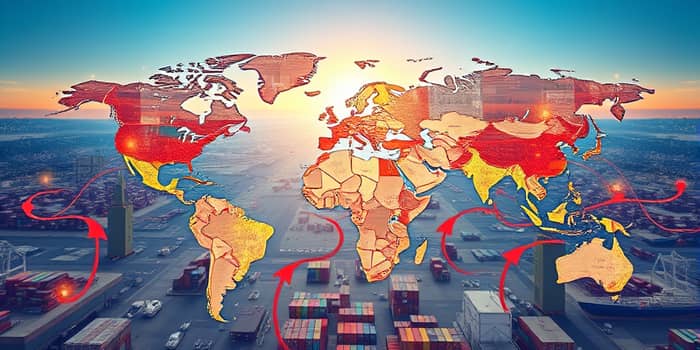
In an era of shifting alliances and geopolitical tensions, trade policy stands at the forefront of economic debate. Striking a balance between safeguarding domestic industries and embracing global markets has never been more critical.
Defining Protectionism and Free Trade
Protectionism encompasses measures designed to shield homegrown businesses from foreign competition. Policymakers often employ tariffs, quotas, and subsidies to create an economic fortress around national industries.
In contrast, free trade or economic integration seeks to lower barriers, lowering barriers and promoting specialization across borders to harness comparative advantage and fuel growth.
Historical Trends and Modern Examples
The rise of protectionism has roots in centuries of mercantilist thought, but its modern resurgence is visible in the US–China trade war. Since 2018, nations have imposed tit-for-tat tariffs aimed at influencing strategic sectors.
Meanwhile, the North American Free Trade Agreement (NAFTA) and the European Union’s single market exemplify integration efforts that spurred rapid growth. Mexico emerged as a manufacturing hub, while European members deepened cooperation. Yet these agreements also sparked debates over job displacement and inequality.
As countries oscillate between opening and closing their markets, the pendulum swings with global events. Financial crises, pandemics, and political realignments can quickly reignite calls for self-sufficiency.
Economic Impacts: Data and Case Studies
Empirical evidence shows the far-reaching consequences of tariffs and trade barriers. According to Furceri et al. (2019), a 0.4% decline in output growth occurs over five years for each standard deviation increase in tariffs.
Böer and Rieth’s 2024 research suggests that reversing US tariffs from 2018–19 could have generated a 4% output gain over three years, highlighting the long-term drag of protectionist measures.
On the consumer front, steel tariffs demonstrate the steep costs of sheltering industries. Estimates indicate these policies have been costing an estimated $800,000 per job annually when accounting for elevated prices and taxes.
Furthermore, US washing machine prices surged by 12% post-2018 duties, while soybean exports to China plunged from $12.3 billion to $3.1 billion in a single year of retaliation.
Pros and Cons of Protectionism
Supporters of protectionism often emphasize national security, job preservation, and targeted growth during downturns. Yet critics point to broader economic drag and consumer pain.
- Pros: Protects vulnerable or nascent industries, fosters self-reliance, and can cushion recessions.
- Cons: Raises prices, reduces choice, and provokes retaliatory measures that stifle exports.
Free Trade: Benefits and Drawbacks
Free trade champions argue it drives efficiency by channeling resources to their most productive uses. Open markets encourage competition, which can accelerate innovation and foster growth.
However, offshoring and wage pressures in high-cost economies can inflict hardship on specific communities. Dependence on global supply chains also introduces vulnerability to external shocks.
Developing nations may struggle to compete against subsidized imports, risking local industries and exacerbating inequality. Balancing these forces remains a critical policy challenge.
Political and Social Dimensions
Trade policy is as much political theater as economic strategy. Protectionist rhetoric resonates with workers who fear job losses, while free trade advocates point to lower consumer costs and global cooperation.
Sectoral disruptions fuel populist movements and can reshape electoral outcomes. Policymakers must navigate these currents, weighing short-term pressures against long-term benefits.
Importantly, the cost of saving a single manufacturing job through tariffs can be dramatically disproportionate compared to the aggregate burden on taxpayers and consumers.
Searching for a Middle Ground
A nuanced approach may entail targeted support for strategic sectors—such as critical technologies—while preserving open markets elsewhere. This hybrid strategy aims to combine resilience with dynamism.
Policymakers can also invest in workforce retraining, infrastructure, and research to ensure displaced workers and lagging regions remain competitive in the global arena.
Ultimately, real-world policy rarely fits neatly into pure protectionism or unbridled free trade. Instead, it operates along a continuum shaped by geopolitical currents, economic imperatives, and social priorities.
Conclusion: The Trade-Offs and Path Forward
The debate over protectionism versus integration is a tale of trade-offs. While tariffs and quotas can shield industries, they carry steep costs for consumers, investors, and trading partners.
Conversely, free trade unlocks growth and innovation but also demands policies to address displacement and vulnerability. Crafting a resilient economy requires balancing these competing forces.
By embracing targeted support, investing in human capital, and engaging in thoughtful diplomacy, nations can forge a path that harnesses the strengths of both worlds—championing open markets while safeguarding strategic interests.
References
- https://www.economicshelp.org/blog/52/trade/effects-protectionism/
- https://gomoon.ai/blog/protectionism-vs-free-trade
- https://study.com/learn/lesson/protectionist-policies-effects.html
- https://www.statestreet.com/us/en/insights/price-of-protectionism-economic-tradeoffs-of-tariffs
- https://www.onyxsi.com/vantage-point/the-economic-consequences-of-protectionism-more-than-just-inflation/
- https://www.tni.org/en/article/the-false-dilemma-between-protectionism-and-free-trade
- https://www.britannica.com/money/protectionism
- https://citizensassembly.co.uk/trade-free-trade-v-protectionism/
- https://corporatefinanceinstitute.com/resources/economics/protectionism/
- https://www.wita.org/blogs/the-tariff-tug-of-war/
- https://fiveable.me/key-terms/principles-microeconomics/protectionism
- https://www.braumillerconsulting.com/protectionism-or-free-trade/
- https://www.ssga.com/us/en/individual/insights/the-price-of-protectionism
- https://www.independent.org/article/2025/01/24/recommended-readings-on-free-trade-versus-protectionism/