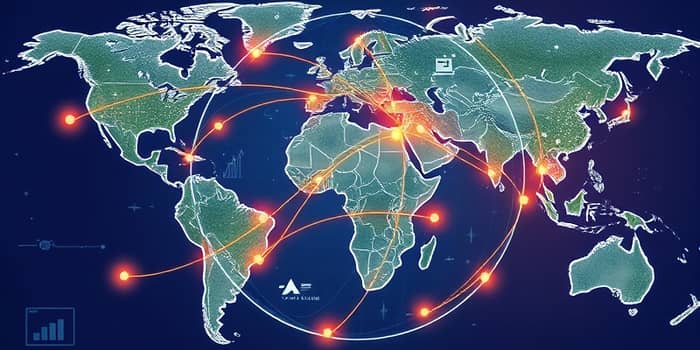
In an era defined by uncertainty, global supply chains have become the lifeblood of economies and communities. Today’s leaders face a profound call: transform fragile trade routes into unbreakable arteries that sustain growth, innovation, and shared prosperity.
Resilience as a Strategic Imperative
Resilience has moved from the margins to the center of executive agendas. No longer a niche risk topic, it is now a board-level strategic and policy priority that shapes network design and competitive advantage. Firms and governments alike recognize that paying a premium for reliability can outweigh the hidden costs of disruption.
From the ports of Rotterdam to the factories of Shenzhen, the future of trade hinges on how well we fortify these global arteries against deliberate policy shifts, natural disasters, and cascading shocks.
Mapping the Risk Landscape
Building a robust network begins with understanding the threats. These fall into six major categories:
- Geopolitical and policy risks (tariffs, export controls, sanctions)
- Macroeconomic and financial volatility (inflation, tightening credit)
- Operational disruptions (shipping bottlenecks, port congestion)
- Environmental and climate hazards (storms, floods, droughts)
- Cyber and data vulnerabilities (security breaches, data localization)
- Labor and talent shortages (skills mismatches, workforce gaps)
Each category carries its own dynamics, yet they intersect in ways that can amplify overall risk. Recognizing these interdependencies is the first step toward crafting a truly resilient network.
Quantifying Vulnerabilities and Losses
Data gives us the clarity to act. Recent surveys reveal that fewer than 8% of businesses feel they have full control over supply chain risks, while 63% report losses exceeding expectations. Tariff shocks alone affect 82% of firms, with 20–40% of activities directly disrupted.
Overconcentration of sources is equally alarming: 30% of global import market concentration rests on Chinese exports, up from 5% two decades ago. Naïve reshoring could shrink world GDP by more than 5%, illustrating that simple relocation is no panacea.
Strategies for Building Robust Networks
Organizations worldwide are moving beyond reactive measures. The most resilient networks combine governance, design, and continuous monitoring:
- Establishing dedicated risk management teams and frameworks with clear executive oversight
- Designing globally distributed, diversified supply ecosystems that avoid single points of failure
- Embedding proactive scenario planning and stress testing into annual budgets and decision cycles
Crucially, firms must balance diversification against cost efficiency. Blanket reshoring may offer political cover but can introduce new vulnerabilities—from domestic disasters to hidden skill gaps.
Harnessing Technology and Innovation
Digital transformation empowers agility and foresight. Leading companies deploy:
digital twins and predictive analytics platforms to simulate disruptions before they happen, allowing teams to reroute trade flows in real time.
Blockchain and IoT sensors deliver end-to-end visibility, while AI-driven risk scoring prioritizes mitigation efforts. When incidents arise, automated alerts and collaborative dashboards speed decision-making across finance, operations, and procurement.
Policy, Collaboration, and Geopolitical Alignment
No single organization can immunize itself alone. Policymakers and private sector actors must forge public-private partnerships and joint innovation efforts to strengthen infrastructure, harmonize standards, and support workforce development.
Trade facilitation reforms, which have cut costs by up to 5% over the past decade, show what cooperative frameworks can achieve. Similarly, aligning industrial policy on critical minerals and digital infrastructure ensures that essential inputs remain accessible under shifting geopolitical influences.
Case Studies: Sectoral Resilience in Action
Consider the automotive industry, which confronted simultaneous semiconductor shortages and shipping congestion in 2024. By diversifying chip suppliers, co-investing in localized packaging facilities, and leveraging AI-driven inventory buffers, leading manufacturers reduced downtime by 40% year-over-year.
In agriculture, cooperative digital marketplaces are linking smallholder farmers in Africa with global buyers, bypassing traditional intermediaries. This model not only enhances traceability but also drives fairer pricing and climate adaptation measures.
Looking Ahead: Evolving Challenges and Opportunities
The shape of global trade in 2030 will be defined by our ability to anticipate emerging risks—from climate-driven supply shifts to next-generation cyber threats. Organizations that invest in resilient foundations today will gain both stability and flexibility tomorrow.
As we navigate an increasingly complex landscape, the central question becomes: how can we transform uncertainty into a source of competitive strength? The answer lies in a resilient network that evolves through adversity, guided by vision, collaboration, and relentless innovation.
Now is the moment to act. By embedding resilience into every layer of strategy—governance, design, technology, and partnership—businesses can not only survive the disruptions of tomorrow but also thrive in a world that demands agility, security, and shared success.
References
- https://www.wtwco.com/en-cz/insights/2025/05/wtw-global-supply-chain-risk-report-2025
- https://www.oecd.org/en/about/news/speech-statements/2025/06/2025-oecd-supply-chain-resilience-review-launch.html
- https://www.mckinsey.com/capabilities/operations/our-insights/supply-chain-risk-survey
- https://www.xeneta.com/blog/the-biggest-global-supply-chain-risks-of-2025
- https://www.z2data.com/insights/9-key-supply-chain-statistics-that-tell-the-story-of-2025
- https://unctad.org/news/global-supply-chains-under-strain-ministers-call-just-and-resilient-transitions
- https://www.weforum.org/stories/2025/06/how-supply-chains-need-to-adapt-to-a-shifting-global-landscape/
- https://www.worldbank.org/en/data/interactive/2025/04/08/global-supply-chain-stress-index
- https://tradeverifyd.com/resources/supply-chain-statistics