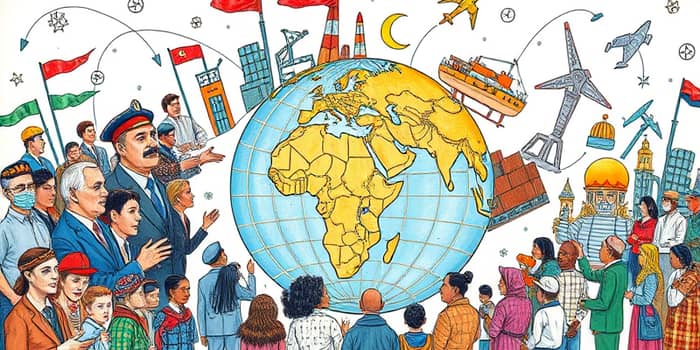
In an era of shifting alliances and economic uncertainty, nations are reasserting control over their markets, reshaping the global order with profound consequences.
Defining Economic Nationalism
Economic nationalism champions state intervention in the economy and prioritizes self-sufficiency over unfettered trade. It views markets as tools of national policy rather than mere engines of efficiency.
This ideology treats international commerce as a zero-sum contest, where relative advantage trumps collective prosperity and mutual gains.
Historical Evolution and Patterns
Rooted in mercantilism and 19th-century protectionism, economic nationalism surged during periods of crisis, from the Great Depression to post-war reconstruction.
- Mercantilist era: accumulation of bullion and tight trade controls.
- Great Depression: tariffs skyrocketed as nations guarded fragile industries.
- Post-1945 boom: liberalization followed, but underlying tensions persisted.
Over time, policymakers oscillated between openness and withdrawal, revealing the paradox of isolation and rapid expansion that defines this doctrine.
Modern Resurgence Across Regions
In the 2020s, economic nationalism has transcended partisan politics to become a global phenomenon, with governments from Tokyo to Washington enacting similar measures.
From Japan’s supply-chain shifts to the EU’s “strategic autonomy,” each region tailors policies to local concerns. Indonesia presses for resource processing at home, while China’s state capitalism blends market tools with heavy domestic control.
Collectively, these actions signal prioritize reducing dependence on foreign and a new era of guarded collaboration.
Implications for Global Trade and Security
As nations build walls around critical sectors, the multilateral framework unravels. The unintended casualty has been the multilateral system, weakening institutions like the WTO and leaving rules in question.
- Global inflation: domestic production at higher costs burdens citizens.
- Innovation suppression: cross-border research collaborations stall.
- Fragmentation: rival blocs emerge, heightening geopolitical risk.
By casting trade in zero-sum terms, economies forsake efficiency and the comparative advantages that once underpinned globalization.
Balancing Sovereignty and Cooperation
Confronted with security threats and economic shocks, policymakers seek a new equilibrium between autonomy and interconnectedness.
Thought leaders caution that excessive protectionism resembles a potent drug administered in excessive doses: intended as medicine but risking toxicity in the form of debt, corruption, and industrial stagnation.
Yet, voices across the spectrum—Marxist, liberal, and realist—agree on one point: unbridled isolation cannot deliver sustainable growth or security.
Moving forward demands innovative frameworks that embed national priorities within a cooperative architecture, ensuring resilience without succumbing to parochialism.
Forging a Path Forward
The world stands at a crossroads. Economic nationalism offers a tempting promise of control and security, but unchecked, it risks stifling growth and polarizing societies.
Leaders and citizens alike must pursue policies that blend strategic autonomy with open dialogue, embracing efficiency subordinated to imperatives of security only where genuinely necessary.
By acknowledging the legitimate concerns driving this resurgence and partnering through transparent institutions, the global community can navigate toward a balanced future.
Ultimately, the challenge is to transform competition into constructive engagement, averting the desperate scramble by states to seize dwindling gains and instead fostering a world where shared prosperity and national well-being reinforce each other.
References
- https://en.wikipedia.org/wiki/Economic_nationalism
- https://asiatimes.com/2026/02/economic-nationalism-giving-rise-to-a-zero-sum-world/
- https://fiveable.me/theories-of-international-relations/unit-11/economic-nationalism/study-guide/am0YNPsUZgErm7Qm
- https://www.columbiathreadneedle.com/en/insights/economic-nationalism-will-present-a-constant-challenge-for-investors/
- https://www.merriam-webster.com/dictionary/economic%20nationalism
- https://www.intereconomics.eu/contents/year/2026/number/1/article/strategic-direction-for-europe-in-the-new-economic-geography.html
- https://www.dictionary.com/browse/economic-nationalism
- https://www.weforum.org/stories/2026/01/future-global-trade-patchwork-model/
- https://dictionary.cambridge.org/us/dictionary/english/economic-nationalism
- https://ceritypartners.com/insights/2026-economic-and-market-outlook/
- https://www.youtube.com/watch?v=yuFAv_UEV5o
- https://www.atlanticcouncil.org/dispatches/how-2025s-us-tariff-shocks-can-give-way-to-constructive-reforms-in-2026/
- https://www.phenomenalworld.org/analysis/non-hegemony/