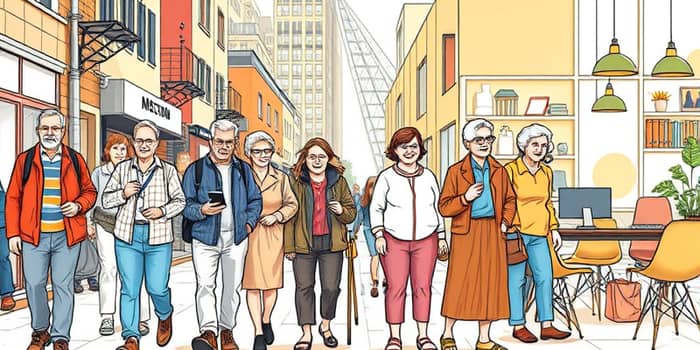
The global rise in life expectancy and the consequent increase in the share of older adults represent an unprecedented demographic shift that touches every corner of society. As the population ages, economies face a dual challenge: managing the costs of retirement and care while harnessing the skills and wisdom of experienced workers. This article explores how aging populations reshape growth, fiscal stability, labor markets, and opportunities for innovation.
By understanding these dynamics, policymakers, businesses, and communities can craft strategies that turn demographic change into a driver of prosperity rather than a burden.
A Demographic Tide Reshaping Society
Over the past decade, the number of Americans aged 65 and older has leaped by nearly 39%, the fastest growth rate since the late 19th century. Today, 17% of the US population is over 65; by 2050, that share is projected to climb to 23%. Globally, aging accelerates in emerging markets as fertility rates fall and longevity rises. The result is a higher old-age dependency ratio—fewer workers supporting more retirees—which strains public finances and social cohesion.
Yet this transformation also sparks potential for new industries and social frameworks designed around an aging citizenry.
- US 65+ population: from 58 million (2022) to 82 million (2050)
- By 2030, older adults will outnumber children under 18 for the first time
- Global urban seniors will drive city growth, with 66% living in urban areas by 2050
- Greater diversity: over half of the next 35 million Americans will be Hispanic
Economic Growth in the Face of Aging
Aging populations tend to slow GDP growth by 0.5–1.0 percentage points annually, a drag comparable to environmental challenges. This occurs because economic expansion is the product of labor force growth and productivity. As the workforce contracts, overall output risks stagnation unless innovation and efficiency gains compensate.
However, there is a silver lining of healthy aging. Investment in technology, automation, and lifelong learning can boost per-worker productivity, counteracting the numerical decline. Research shows that maintaining robust immigration and female labor participation rates can further offset the negative trends.
- Working-age population growth is slowing, reducing idea exchange and innovation
- Productivity investments in AI and robotics offer potential compensation
- Higher retirement ages aligned with life expectancy can sustain labor supply
Fiscal Pressures on Governments
Rising longevity places enormous pressure on public budgets. Social Security and Medicare currently consume 9.1% of GDP and 36% of the federal budget. By 2035, these programs could account for 11.5% of GDP, up from just 3.1% for Medicare alone two decades ago. Without reform, the Social Security OASI Trust Fund and Medicare Hospital Insurance Trust Fund risk depletion by 2033, triggering automatic benefit cuts of up to 23%.
These fiscal headwinds demand innovative policy design that ensures sustainability while honoring commitments to older citizens.
Labor Market and Productivity Challenges
Retirement of the post-World War II baby boomers creates a gap in skilled labor. Meanwhile, caregiving demands rise dramatically: Alzheimer’s cases in the United States are set to more than double by 2050, from 6 million to 13 million. Low-income seniors and families face rising financial stress and housing insecurity, especially in rural areas where median incomes trail urban counterparts by 30%.
To close these gaps, policymakers advocate for raising retirement ages, expanding access to lifelong education, and promoting health programs that keep older adults active in the workforce.
- Raise retirement age in line with life expectancy
- Promote wellness programs for adults 50 and older
- Support caregiving infrastructure to unlock labor supply
Opportunities in the Silver Economy
The so-called “silver economy” encompasses the goods and services tailored to older consumers and workers. This sector offers opportunities for entrepreneurs and established firms alike. Healthcare, financial planning, adaptive housing, and remote work platforms are in rising demand.
Older consumers wield significant spending power, and with customized services, businesses can tap into a growing market of active seniors who prioritize wellness, mobility, and lifelong learning. Urban planners are also redesigning cities to be age-friendly, incorporating better public transit, accessible housing, and community hubs.
Rural regions, meanwhile, can leverage remote work and telehealth to revitalize local economies and bridge service gaps for seniors.
Strategies for Sustainable Aging Societies
Addressing the economic impact of aging requires a multi-faceted approach centered on intergenerational equity and opportunity. Key strategies include:
- Investing in youth productivity through education and skills training
- Phasing retirement age increases while safeguarding vulnerable workers
- Reforming entitlement programs to ensure long-term solvency
Governments can also encourage public-private partnerships to expand caregiving services and support community-based solutions. Emphasizing preventive healthcare and digital literacy for older adults can reduce long-term costs and enhance quality of life.
Embracing the Longevity Dividend
Far from being a burden, aging populations can become the foundation for new forms of social and economic dynamism. By fostering environments where older adults remain healthy, engaged, and productive, societies can capture the longevity dividend, turning demographic shifts into engines of growth.
Businesses that innovate in the silver economy, leaders who craft smart fiscal and labor policies, and communities that value the contributions of all ages will thrive in the decades ahead. The silent revolution of aging is not merely a challenge to overcome but a powerful opportunity to build more inclusive, resilient, and prosperous nations.
As we stand at the cusp of this transformation, we must act with foresight and compassion, designing systems that honor past generations and empower the next. The economic impact of aging populations need not be a tale of decline but a story of triumph and renewal.
References
- https://www.scrippsnews.com/politics/economy/census-data-reveals-growing-financial-struggles-for-seniors-renters-and-rural-americans
- https://www.prb.org/resources/fact-sheet-aging-in-the-united-states/
- https://cri.georgetown.edu/what-does-an-aging-population-mean-for-economic-growth-and-investing/
- https://www.brookings.edu/articles/global-aging-the-almost-invisible-crisis-shaping-our-future/
- https://www.pgpf.org/article/how-does-the-aging-of-the-population-affect-our-fiscal-health/
- https://www.urban.org/policy-centers/cross-center-initiatives/program-retirement-policy/projects/data-warehouse/what-future-holds/us-population-aging
- https://www.cbo.gov/publication/61879
- https://www.cbo.gov/publication/61994
- https://www.census.gov/topics/population/older-aging.html