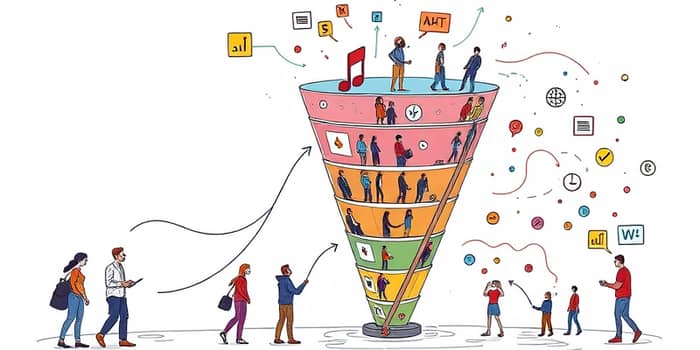
In today's competitive digital marketplace, understanding the flow from initial contact to loyal customer is essential. A well-tuned funnel can drive sustainable growth and maximize revenue.
Understanding the Modern Sales Funnel
The sales funnel is a stepwise model describing visitor movement from the first interaction to purchase and beyond. It serves both as a mental framework and a quantifiable measurement tool, guiding sellers to monitor and refine each stage.
Typical stages of an online or e-commerce funnel include:
- Awareness / Discovery
- Interest / Consideration
- Intent / Evaluation
- Conversion / Purchase
- Loyalty / Retention / Advocacy
Today’s buyer journeys are increasingly nonlinear and omnichannel. Customers may leap from social proof directly to purchase or cycle back for repeat buys. Recognizing this “collapsed” journey is crucial for tailoring strategies to each touchpoint.
Smart sellers treat the funnel as a dynamic system that demands continuous attention. Despite its power, only a minority of businesses optimize their funnels regularly, leaving significant revenue on the table.
Current Statistics and Benchmarks
Benchmark data provides context and motivation. On average, the visitor-to-customer conversion rate hovers around 2.35%, while top performers exceed 5.31%.
- Businesses with structured funnels see average deal sizes 102% higher.
- Well-organized funnels drive revenue growth 18× higher.
- Only 34% of companies optimize their funnels consistently.
- 68% of organizations lack formal funnel measurements.
Adopting funnel tools and analytics is rising, with roughly 570,000 websites using builders and automation. AI usage in sales jumped from 24% in 2023 to 43% in 2024, signaling rapid expansion.
These figures highlight that the lead-to-MQL transition is often the weakest link, while later stages see higher success when intent and fit are clear. Industry-specific optimization is key to unlocking full potential.
Top of Funnel: Awareness and Discovery
Goal: Attract qualified visitors cost-effectively. Key metrics include impressions, click-through rates, site traffic, and bounce rates.
Smart strategies for this stage include:
- Defining clear target audiences and understanding their pain points.
- Producing educational content that aligns with search intent and industry trends.
- Balancing performance ads with thought leadership initiatives.
- Ensuring delivering mobile-first experiences seamlessly.
- Leveraging social channels to amplify reach and brand awareness.
Middle of Funnel: Interest and Consideration
Goal: Convert visitors into qualified leads. Track metrics such as lead rate, demo requests, and email sign-ups.
Effective tactics in this stage revolve around nurturing and personalization. Use checklists, free trials, and gated content to capture leads. Implement automated email sequences and workflows that deliver case studies, product walkthroughs, and educational resources.
Segmentation by behavior, demographics, or role sharpens your messaging. Personalized calls-to-action can yield conversion uplifts exceeding 200%. Incorporate social proof through testimonials and user-generated content to build trust. Video demonstrations can boost engagement and lift conversions by up to 66%.
Bottom of Funnel: Conversion and Purchase
Goal: Maximize checkout completions and elevate average order value. Metrics include cart abandonment rates, checkout completion, and CPA/ROAS.
Checkout optimization is critical. Offer guest checkout with multiple options, clear shipping policies, and trust badges to reduce friction. Deploy cart-abandonment email flows and retargeted ads to recapture interested buyers, proven to improve conversions by 147%.
Incentives like time-sensitive discounts and offers or free shipping thresholds encourage immediate action. Upsells, cross-sells, and product bundles further boost order value, while transparent pricing and clear communication foster confidence at the point of purchase.
Post-Purchase: Loyalty and Advocacy
Goal: Cultivate repeat purchases, subscriptions, and referrals. Key metrics include repeat purchase rate, churn, NPS, and customer lifetime value.
Onboarding plays a pivotal role, especially for SaaS and subscription services. Guided tutorials, welcome emails, and proactive support help customers realize value quickly. Ongoing lifecycle marketing—replenishment reminders, loyalty programs, and targeted promotions—drives retention.
Encourage referrals with incentives and recognition. Delivering personalized communication and rewards not only retains customers but also transforms them into brand advocates, amplifying your funnel’s reach organically.
Leveraging Tools, Testing, and Analytics
Modern sellers rely on technology to scale funnel optimization. Analytics platforms track performance across all stages, highlighting leaks and opportunities. A/B testing of landing pages, CTAs, and email subject lines enables data-informed testing and optimization.
Automation tools handle lead scoring, dynamic content delivery, and triggered responses. AI-powered systems can analyze customer behavior, forecast trends, and personalize experiences at scale.
Key capabilities to evaluate include real-time dashboards, predictive analytics, and integration with CRM and marketing platforms. By relentlessly measuring and refining each stage, sellers ensure their funnels evolve with market dynamics.
Emerging Trends and the Road Ahead
The future of online sales funnels lies in deeper personalization, voice and conversational commerce, and immersive experiences. Augmented reality product previews, chatbots handling complex queries, and hyper-targeted micro-segmentation will redefine funnel interactions.
Privacy regulations and evolving consumer expectations demand transparency and consent-based data collection. Sellers who prioritize user trust and leverage first-party data will gain a competitive edge. Predictive AI models will shift optimization from reactive to truly proactive strategies.
By integrating these trends with proven fundamentals, the smart seller can craft a resilient, high-performance funnel that adapts to change, maximizes conversions, and fosters lasting customer relationships.
References
- https://www.amraandelma.com/marketing-funnel-conversion-statistics/
- https://business.adobe.com/blog/basics/how-to-optimize-your-ecommerce-conversion-funnel
- https://electroiq.com/stats/sales-funnel-statistics/
- https://www.tidio.com/blog/ecommerce-sales-funnel-optimization/
- https://firstpagesage.com/seo-blog/sales-funnel-conversion-rate-benchmarks-2025-report/
- https://mountain.com/blog/ecommerce-sales-funnel/
- https://revnew.com/blog/top-performing-sales-funnel-strategies
- https://www.mailerlite.com/blog/ecommerce-funnel
- https://marketingltb.com/blog/statistics/sales-funnel-statistics/
- https://www.bazaarvoice.com/blog/the-modern-e-commerce-funnel-collapse-strategies-for-conversion/
- https://cropink.com/sales-funnel-statistics
- https://www.heap.io/topics/ecommerce-conversion-funnel-optimization-guide
- https://remotereps247.com/ranked-sales-funnel-optimization-experts-you-can-hire-in-2025/
- https://www.crazyegg.com/blog/ecommerce-conversion-funnel/
- https://thesalescollective.com/sales-process-statistics-usa/
- https://wpmanageninja.com/ultimate-guide-to-conversion-funnel-optimization/
- https://unbounce.com/campaign-strategy/conversion-funnel/
- https://www.fullstory.com/blog/conversion-funnel-optimization/
- https://www.fetchfunnel.com/sales-funnel-optimization-agency/