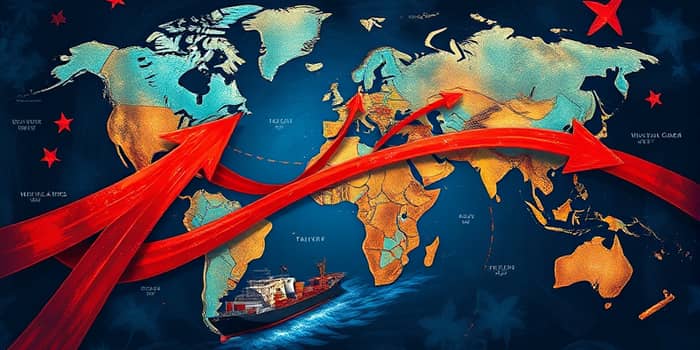
As global economies brace for unprecedented friction, businesses and policymakers find themselves at a crossroads. The sweeping tariff increases of 2025 have sent shockwaves through supply chains, markets, and boardrooms alike. In this landscape marked by uncertainty and opportunity, understanding the stakes is vital for survival and growth.
With tensions escalating between major economies, decision makers must balance risk and resilience. By examining the historical context, quantifying economic fallout, and exploring adaptive strategies, enterprises can chart a course through stormy waters.
Historical and Current Context
In early 2025, the United States ignited a new phase of trade conflict. Between February and March, tariffs on steel, aluminum, and automobiles targeted Canada, Mexico, and China. On April 2, Washington announced reciprocal tariffs announced on April 2, 2025, pegged to trade deficit ratios and imposing at least a 10-percentage-point increase across most partners.
Just one week later, a 90-day partial suspension offered temporary relief for select sectors. Despite this grace period, the effective rate for many imports surged from ~3% to ~30%. Economists observed that these measures were exceptionally high even by historical standards, disrupting expectations and fueling retaliatory responses.
Economic Impact and Projections
The immediate fallout has been stark. The European Union’s effective tariff rate leaped from under 2% to approximately 17%. US–China bilateral duties escalated to a staggering 125% after mutual retaliation. Under a “full” escalation scenario, US import levies could climb to 38%, while US exports abroad face a 32% effective rate of duties.
- US welfare loss: ~2% under status quo, near 4% if retaliation intensifies.
- China welfare decline: ~1.5% across scenarios.
- Global trade contraction: 5.5–8.5% relative to pre-2025 levels.
- G-20 GDP growth: slowed from 2.9% (2024) to 2.4% (2025–26).
Financial markets have responded with increased volatility. Equity benchmarks such as the S&P 500 are expected to trade in a range-bound corridor between 5,200 and 5,800 points. Inflationary pressures mount as import costs rise, forcing central banks to navigate a delicate policy tightrope.
Sectoral Winners and Losers
Certain industries, deeply woven into global value chains, face the brunt of disruption. Electrical equipment and electronics may see output plunge by as much as 16% in a full escalation scenario. Transport equipment follows closely with a 12% contraction.
In contrast, sectors with lower GVC integration—such as agriculture, rubber, and plastics—experience more modest declines. Temporary exemptions for pharmaceuticals and some electronics products offer short-lived relief, but further duties loom on the horizon.
Trade Flows and Supply Chain Reallocation
Imports from China to the US have collapsed by roughly 90% under current measures. Meanwhile, US purchases from Canada and Mexico have fallen by about 30%. Yet indirect Chinese exports routed through Mexico and other Asian hubs remain more resilient, dropping from $124 billion to $84 billion.
Chinese exports to Europe and the UK have enjoyed a roughly 9% boost, while Latin America and other markets have absorbed additional volumes. Companies are diversifying away from high-tariff corridors, embracing friend-shoring and strategic partnerships to maintain production continuity.
Policy Implications and Business Strategies
Policymakers and corporate leaders must adapt to an environment where protectionism intersects with geopolitics. Tariff measures anchored to deficit ratios often neglect broader economic interdependencies, leading to unintended consequences. As negotiations for new trade deals with Japan, Korea, and India unfold, uncertainty remains pervasive.
- Assess and diversify supplier networks across multiple regions.
- Implement scenario planning to anticipate tariff shifts.
- Engage in industry coalitions to influence policy outcomes.
- Invest in digital supply chain visibility for faster response.
- Explore regional trade alliances beyond US–China ties.
By adopting these approaches, businesses can transform turbulence into opportunity. Manufacturers may benefit from onshore automation, while service providers could tap into new markets less affected by duties.
Forging Ahead with Resilience
The current trade wars and tariff escalations pose formidable challenges. Yet history shows that human ingenuity thrives under pressure. Organizations that combine rigorous risk management with bold strategic pivots can emerge stronger.
Across continents, entrepreneurs are digitalizing operations, building agile networks, and securing financing to weather revenue fluctuations. Policymakers are exploring targeted relief measures, easing compliance through streamlined rules of origin and temporary exemptions.
In an era where uncertainty shapes every decision, the capacity to adapt becomes a competitive advantage. Leaders who prioritize transparency, collaboration, and innovation will navigate the shifting terrain of global commerce with confidence.
As we chart the months ahead, the need for clear-eyed analysis and decisive action has never been greater. By understanding the full scope of tariff impacts, reimagining supply chains, and engaging constructively with policymakers, businesses can not only survive but also seize new growth pathways.
Ultimately, the story of trade wars is not solely one of barriers and losses—it is also a narrative of resilience, adaptation, and the relentless pursuit of opportunity. With informed strategy and collective resolve, the global market can transform the current crisis into a catalyst for sustainable, diversified growth.
References
- https://cepr.org/voxeu/columns/roaring-tariffs-global-impact-2025-us-trade-war
- https://www.jpmorgan.com/insights/global-research/current-events/us-tariffs
- https://www.moodys.com/web/en/us/insights/tariffs.html
- https://www.businessinsider.com/us-china-trade-deal-tariffs-exports-rare-earth-morgan-stanley-2025-11
- https://www.piie.com/blogs/realtime-economics/2025/global-trade-war-update
- https://en.macromicro.me/blog/outlook-2026-series-i-the-final-chapter-of-trump-s-tariffs
- https://moderndiplomacy.eu/2025/11/11/trump-china-trade-war-escalates-through-2025/