Inflation affects every household, business, and government around the globe. As prices surge and purchasing power ebbs, understanding the forces driving inflationary tides becomes essential for individuals and policymakers alike.
The Global Inflation Turnaround
After surging near 9% in late 2022, global inflation has nearly halved to below 5% by late 2024. Despite this improvement, current levels remain well above the 1.5–2% “normal” of the 2010s. Forecasts suggest continued moderation in 2025, with overall CPI inflation easing but decelerating more slowly than initial projections.
Lessons from the Pandemic Surge
The pandemic unleashed unprecedented supply disruptions and stimulus measures that sparked rapid price increases. From 2020 to 2022, the U.S. saw cumulative consumer prices climb 23%, Germany 22%, and many Asian economies less than 8%. As supply chains recovered and lockdown-driven demand normalized, inflation pressures began to unwind.
Yet higher wages, trade protectionism, and loose fiscal policy have prevented a full return to pre-pandemic norms. Central banks and governments must now navigate the lingering effects of those stimulus measures while guarding against new shocks.
Regional Realities and Contrasts
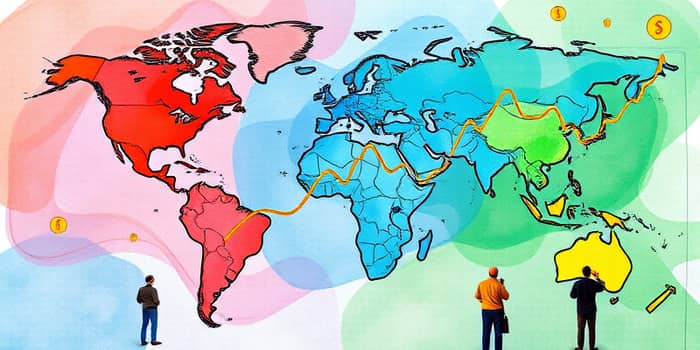
Inflation does not affect all regions equally. Diverging growth patterns, currency movements, and policy responses have created a complex patchwork of outcomes.
- Asia (ex-China): Disinflationary trend, some economies near deflation.
- G7 and Developed Markets: Approaching central bank targets around 2%.
- Latin America and Eastern Europe: Moderating, yet still elevated above 5–10%.
- Middle East/North Africa (MENA): Stabilized by currency pegs and subsidies.
- Sub-Saharan Africa: Highest rates, often above 10–20% due to currency depreciation.
Understanding these contrasts aids in crafting localized policies and individual strategies.
Key Drivers Shaping 2025 Outlook
Several interconnected factors will determine whether inflation continues to ease or resurges. A clear grasp of these drivers can inform prudent decisions for businesses and households.
- Trade and Tariff Policy: Higher import duties risk reigniting price pressures via “stop-and-go” cycles.
- Labor Markets and Wages: Low global unemployment and structural wage growth sustain upward pressure on costs.
- Monetary Policy Adjustments: Central banks plan roughly 100 basis points of rate cuts, but pauses may follow if inflation stabilizes.
- Supply-Side Realignments: Ongoing rerouting of supply chains and geopolitical tensions present upside risks.
- Commodity Price Trends: Lower food and energy costs are expected to restrain headline inflation.
Societal Impacts and Personal Strategies
Persistently high inflation erodes real incomes, disproportionately affecting lower-income households. In many regions, wage gains lag price increases, widening inequality and straining social safety nets.
Individuals and families can proactively manage these challenges by adopting sound financial habits and seeking inflation‐resilient opportunities.
- Build an emergency savings and diversified portfolios to weather unexpected price surges.
- Invest in assets with inflation-hedge potential, such as real estate or indexed bonds.
- Diversify income streams through side ventures or upskilling in high-demand fields.
- Adopt robust supply chain diversification strategies for small businesses to reduce cost volatility.
Moving Forward: Policy Debates and Future Uncertainties
Economists grapple with whether central banks should aim to re-establish sub-2% inflation targets or accept a new equilibrium of 2–3%. A shift toward the latter could provide policymakers greater flexibility, but risks embedding higher price expectations into long‐term contracts and wage negotiations.
Governments must balance recovery initiatives, such as infrastructure spending and industrial reshoring, with the need for balanced monetary and fiscal policy. Abrupt stimulus without corresponding productivity gains may reignite inflationary pressures, while overly aggressive tightening could stall growth.
Conclusion
Inflation’s global trajectory is a tale of recovery tempered by underlying pressures. While headline rates are moderating, global price stability is not yet assured. By understanding regional dynamics, key drivers, and practical strategies, policymakers and individuals can navigate this complex landscape more confidently. Vigilance, adaptability, and informed decision-making will be essential as we approach a potentially transformative economic era.
References
- https://www.focus-economics.com/blog/global-inflation-rates/
- https://worldpopulationreview.com/country-rankings/inflation-rate-by-country
- https://www.jpmorgan.com/insights/global-research/economy/global-inflation-forecast
- https://en.wikipedia.org/wiki/List_of_countries_by_inflation_rate
- https://tradingeconomics.com/country-list/inflation-rate-
- https://www.imf.org/external/datamapper/NGDPDPC@WEO/WEOWORLD/VEN
- https://www.statista.com/statistics/256598/global-inflation-rate-compared-to-previous-year/
- https://www.oecd.org/en/data/insights/statistical-releases/2025/08/consumer-prices-oecd-updated-5-august-2025.html
- https://www.imf.org/external/datamapper/PCPIPCH@WEO/OEMDC/ADVEC/WEOWORLD
- https://www.statista.com/statistics/1317878/inflation-rate-interest-rate-by-country/
- https://www.visualcapitalist.com/global-inflation-by-country-2020-2025/
- https://www.oecd.org/en/data/indicators/inflation-cpi.html
- https://data.worldbank.org/indicator/FP.CPI.TOTL.ZG
- http://www.ers.usda.gov/data-products/food-price-outlook/summary-findings
- https://www.imf.org/external/datamapper/PCPIPCH@WEO/ECU