A deep dive into the rampant global wealth gap, its roots, impacts, and potential remedies.
Understanding the Scale of the Divide
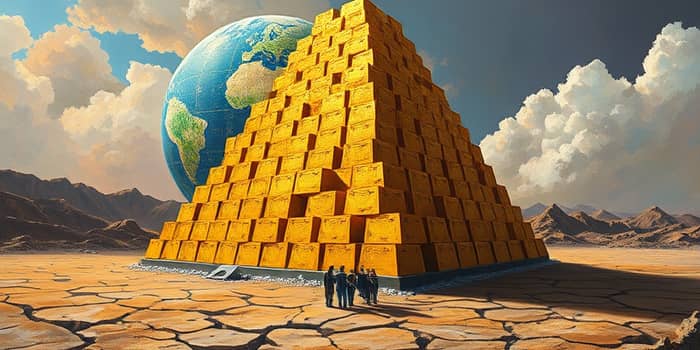
In 2025, world’s richest 10% holds 74% global wealth, while the poorest half control barely 2%. Wealth accumulation at the top has outpaced the gains of most populations, creating an unprecedented concentration of resources.
Recent studies show richest 1% owns 47.5% of global wealth. In the United States, the top decile accounts for nearly two-thirds of national holdings. Meanwhile, billionaire fortunes swelled by $2 trillion in 2024, and analysts warn of first trillionaires within a decade.
Regional and Country Comparisons
Geographic disparities reveal that inequality is most extreme in parts of Africa and Latin America. South Africa leads with a Gini coefficient of 63.0, followed by Namibia (59.1) and Brazil (51.6). In contrast, Denmark and Norway, each near 27 on the Gini scale, demonstrate more balanced distribution in advanced economies.
Regional wealth per adult also varies widely. North America averages USD 593,347 per adult, far exceeding figures in emerging markets. Europe and East Asia exhibit moderate inequality patterns, but benefits from growth often bypass marginalized communities.
Trends Over Time and Social Impact
Since the 1980s, both global and national wealth inequality have trended upward. While GDP and overall wealth have climbed, these gains concentrate among the wealthiest. Surveys reveal 54% of respondents in 36 countries view the gap as a “very big problem,” while nearly two-thirds live in nations with climbing inequality. Racial disparities are stark: median Black family wealth in the U.S. is only 15.5% of white family wealth, and Latino families hold 21.8% of white wealth.
Driving Forces Behind Growing Disparities
Multiple factors accelerate wealth concentration. Financial markets, inheritance transfers, and policy design all play major roles.
- Heavy allocations to financial assets boost returns for the wealthy.
- An estimated $83 trillion in inheritance shifts over 25 years.
- Technological change and automation favor capital owners.
- Globalization narrows some country gaps but widens internal divides.
Consequences for Societies and Economies
Rising inequality carries profound costs that reach beyond economics. It limits on social mobility and inclusion, hindering generations from improving their circumstances.
- Economic growth may stall as wealth concentrates among low-spending groups.
- Political polarization intensifies and erodes trust in political institutions.
- Poverty rates remain stubbornly flat despite surging global wealth.
Charting a Path Forward: Policy Responses
Addressing wealth inequality requires comprehensive policies on multiple fronts. Governments, international bodies, and civil society must collaborate to design fair systems.
- Progressive taxation on wealth and inheritance, ensuring the ultra-rich contribute their fair share.
- Global minimum tax agreements to curb corporate evasion and foster cross-border fairness.
- Expanding universal social protection systems to guarantee access to health, education, and income support.
- Strengthening labor rights and wage policies to shift income toward the working population.
- Implementing targeted measures to close gender and racial wealth gaps.
Conclusion: Shared Wealth, Shared Growth
Wealth inequality is not an inevitable byproduct of progress but a challenge that demands deliberate action. By embracing fair tax systems, robust social protections, and inclusive growth strategies, societies can rebuild trust and unlock human potential.
The road ahead calls for bold leadership and collective resolve. Bridging the vast wealth divide will strengthen economies, reinforce social bonds, and create a more just world for future generations.
References
- https://worldpopulationreview.com/country-rankings/wealth-inequality-by-country
- https://www.statista.com/statistics/203961/wealth-distribution-for-the-us/
- https://www.ubs.com/global/en/media/display-page-ndp/en-20250618-gwr-2025.html
- https://inequality.org/facts/wealth-inequality/
- https://blogs.worldbank.org/en/opendata/income-growth-of-the-poor-matters-for-reducing-global-income-ine
- https://www.oxfamamerica.org/explore/issues/economic-justice/extreme-inequality-and-poverty/
- https://www.visualcapitalist.com/visualizing-global-wealth-inequality/
- https://www.pewresearch.org/global/2025/01/09/economic-inequality-seen-as-major-challenge-around-the-world/
- https://wid.world
- https://inequality.org/facts/global-inequality/
- https://ourworldindata.org/economic-inequality
- https://www.un.org/en/desa/6-takeaways-world-social-report-2025