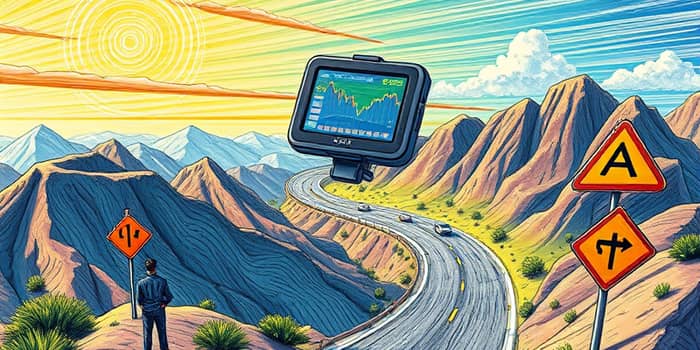
Economic activity ebbs and flows in predictable rhythms that shape markets and business. By learning to read these patterns, investors and business leaders can chart a course through uncertainty and seize opportunities when they arise.
Understanding Economic and Market Cycles
Both business cycles and market cycles reflect recurring patterns of expansion and contraction driven by broad economic forces and investor behavior. Business cycles track output, employment, and income across four distinct phases of expansion and downturns. Market cycles, by contrast, follow price and volume trends in stocks or commodities through accumulation, markup, distribution, and markdown stages.
Viewing these frameworks as an "Economic GPS" helps you interpret signals—like GDP readings or trading volumes—as waypoints that guide strategy, risk management, and timing decisions.
Business Cycle Phases
The business cycle, as defined by bodies like the NBER, unfolds in four main stages:
Early-cycle marks the immediate recovery from recession. With steep yield curves and accommodative monetary policy, GDP jumps and unemployment falls. Stocks in cyclical sectors often lead gains.
Mid-cycle brings moderate, self-sustaining growth. Inflation edges upward, rates begin tightening, and credit conditions normalize. Growth assets still benefit but with more balanced returns.
Late-cycle features slowing expansion, high inflation, and flat or inverted yield curves. Defensive sectors start outperforming as recession risks build. Investment shifts toward stability.
Recession, or contraction, sees falling output, rising unemployment, and tightened financial conditions. Bonds and cash become safe havens until recovery signals reappear.
Market Cycle Phases
While business cycles measure real activity, market cycles reflect investor sentiment and price-action. Markets often lead economic data, anticipating turns.
Understanding this cycle allows investors to buy during quiet accumulation and exit before widespread panic, harnessing price trends as directional signals.
Key Drivers of Cycles
Several fundamental forces propel these cyclic patterns:
- Economic growth and productivity—rising output expands markets.
- Monetary policy shifts—rate cuts fuel expansion, hikes slow it.
- Credit availability—easy lending boosts spending; tight credit contracts demand.
- Inflation trends—moderate inflation signals healthy growth; excessive inflation pressures policy.
- Investor sentiment—fear and euphoria amplify price swings.
Sector and Asset Performance by Phase
Different investments shine in each cycle phase. Recognizing sector leadership helps optimize returns:
- Early-cycle: Cyclical stocks (consumer discretionary, industrials).
- Mid-cycle: Broad growth assets (technology, small caps).
- Late-cycle: Defensive names (utilities, consumer staples).
- Recession: Bonds, cash, high-quality debt.
Navigating with Your Economic GPS
By interpreting indicators as navigational signals, you can make timely and informed decisions rather than reacting emotionally. Key signals include leading, coincident, and lagging data on GDP, employment, new orders, and consumer confidence.
Ultimately, no framework predicts every twist and turn perfectly. Instead, treat these cycles as guides—your own economic GPS—to calibrate risk, allocate assets, and stay oriented through expansions and downturns.
- Disbelief and fear at troughs
- Hope and optimism during recovery
- Euphoria as markup accelerates
- Complacency at market highs
- Anxiety and panic in markdown
- Capitulation before new accumulation
By anticipating emotional stages and blending them with data, you navigate cycles with confidence, steering toward sustainable growth and avoiding costly mistakes. Treat every phase as a waypoint on your journey—your Economic GPS keeps you on course.
References
- https://www.leelynsmith.com/insights/article/business-and-market-cycles-what-investors-should-know-qa-with-our-cio-brian-dorn/
- https://biz.libretexts.org/Courses/Aurora_University/Principles_of_Financial_Management/16:_Macroeconomics_for_Financial_Managers/16.03:_Business_Cycles_and_Economic_Indicators
- https://www.heygotrade.com/en/blog/mastering-market-cycle-investing-approach
- https://institutional.fidelity.com/app/item/RD_13569_40890/business-cycle-update.html
- https://www.fidelity.com/viewpoints/investing-ideas/sector-investing-business-cycle
- https://bookmap.com/blog/what-are-market-cycles
- https://www.nber.org/research/business-cycle-dating
- https://www.schwab.com/learn/story/four-stages-stock-market-cycles
- https://www.conference-board.org/topics/us-leading-indicators/
- https://foolwealth.com/insights/four-stages-of-the-stock-market-cycle
- https://www.khanacademy.org/economics-finance-domain/macroeconomics/macro-economic-indicators-and-the-business-cycle
- https://www.oanda.com/us-en/trade-tap-blog/trading-knowledge/market-cycles-key-indicators-guide/
- https://www.jpmorgan.com/insights/markets-and-economy/economy/10-economic-indicators-every-business-owner-should-know